
La Biennale di Venezia is the world’s pre-eminent gathering in art and architecture, and the Giardini is the historic landscape where extraordinary pavilions stand as ambassadors for their nations. Qatar is proud to take its place in this international assembly, advancing our role as a global leader in cultural diplomacy and providing an unparalleled platform for giving voice to the creative talent of our nation and the Middle East, North Africa, and South Asia region.
The Garden of Diplomacy
Stephanie Guest on the 2025 Venice Architecture Biennale
As we approach the 2026 Venice Art Biennale, Stephanie Guest recaps her time at the 2025 Architecture Biennale, held on the same grounds. In the city of canals, how does architecture keep its head above the rising tide of performative diplomacy?
Ciao Stephanie, Salone just finished and I’m still in Italy. Friends are lending me their apartment in central Venice for Biennale. I think you should come.
I received this text from my friend Denise in mid-April 2025. She knew I had quit my copywriting job and was at a loose end. We had spoken about my doubts and aspirations, about what to do with my hard-won but so-far unused Master of Architecture.
I booked flights almost immediately – it would be a short trip from Stuttgart. The missing piece was entry into the pre-opening days of the festival – the vernissage – which is limited to architecture professionals, the press, or those willing to spend €450 on a Biennale Gold Card. With insufficient credentials and no as-yet successful review pitches, I splurged on the third. I reassured myself that it would be worth it in the long run.
Already in Venice, in the early hours of the second preview day, dusty from the Uzbek ‘cocktail dînatoire’, I received an email accepting my essay proposal. My golden ticket was now justified.
The week before, on 1 May 2025, I attended part of a hearing at the International Court of Justice (ICJ). I was in The Hague visiting family over the German Labour Day long weekend. I listened to the Maldives, Mexico, Namibia, and Norway present arguments relating to the Obligations of Israel in relation to the Presence and Activities of the United Nations, Other International Organisations and Third States in and in relation to the Occupied Palestinian Territory. Led by Norway, the UN General Assembly had sought an Advisory Opinion from the Court after Israel had banned the United Nations Relief and Works Agency (UNRWA) – the largest provider of humanitarian aid to the Palestinian population – from operating in the Occupied Palestinian Territory. (Though because of UNRWA’s more than 11,000 local Palestinian staff who remain on the ground in Gaza, services such as medical consultations, water well maintenance, sanitation, education, and psychosocial support are ongoing.)
Some countries made technical, legal arguments, but more often the statements appeared rhetorical, aimed at the media and the public more than the judges. I felt impatient, wondering what effect all these words would have on the starvation, violence, death, and destruction in Gaza.
The hearings at the ICJ clearly had a diplomatic aspect. Absence could be interpreted as disdain or diffidence: Israel submitted a written statement to the Court but did not present oral arguments.
I kept thinking about performative diplomacy on my way to the Venice Architecture Biennale the following week. What public fronts or symbolic structures were countries putting up? How could architectural exhibits respond to massive global injustice?
At 05:40 on 8 May 2025, I boarded a flight to Venice. A gaggle of German architects gossiped at the gate. By 08:15, the Alilaguna was ferrying me across the grey-green lagoon.
Memories from my only other trip to Venice, in early September 2007, flooded in. I was backpacking solo on a tiny daily budget. A Portuguese anarchist, who checked out just as I arrived at the youth hostel – vacating what might have been the last bed in the city – handed me her ticket to the 52nd Biennale Arte. The pavilions were bereft of visitors that weekend; the exhibits seemed lonely, futile. I hadn’t known that the Venice Film Festival was in full swing on the Lido di Venezia, or that the Historic Regatta would transform the Grand Canal into a vortex of period costumes, gilded boats, and inebriated tourists. I remember the thrill of introducing myself to Bill Murray in Piazza San Marco, but I don’t remember a single artwork from the Biennale.
Eighteen years later, freshly unemployed and arriving back in Venice, I found Denise at the historic Caffè Florian in Piazza San Marco. I narrowly avoided ordering a €12 cappuccino. We hurried off to the Giardini della Biennale.
In his Guide to the Pavilions of the Venice Biennale since 1887, Marco Mulazzani records that a group of artists and aficionados hatched the idea of a biennial art exhibition in the late nineteenth century, in that very same Caffè Florian. The inaugural exhibition opened in April 1895. Initially, all works were exhibited in the Padiglione Centrale, the exhibition’s first building in the Gardens of Castello (the Giardini, for short). As the event grew, national pavilions were added to accommodate artists from abroad. The municipality assisted financially in the construction of the pavilions but then encouraged countries to acquire them as national assets.
Twenty of the thirty permanent national pavilions in the Giardini are owned by European countries – the earliest built were Belgium (1907), Hungary, Britain and Bavaria (later Germany; all 1909), France and Sweden (1912), and Russia (1914). Both World Wars caused breaks in the building program, but interest in national pavilions quickly revived. Mulazzani observes that potential pavilion-builders required ‘rapid decision-making and readily available funds’. Non-European countries who jumped at the opportunity included the United States (1930), Egypt and Israel (both 1952, although Egypt moved into a pavilion built in 1932), Venezuela and Japan (both 1956), Canada (1958), Uruguay (1960), Brazil (1964), Australia (1988), and the Republic of Korea (1996).
These buildings were designed by a coterie of famous male architects such as Alvar Aalto, William Adams Delano and Chester Holmes Aldrich, Sverre Fehn, Bruno Giacometti, Brenno Del Giudice, Gerrit Rietveld, Carlo Scarpa, and James Stirling. However, architecture only became an official exhibition theme in the 1970s, through historical surveys such as 1976’s Rationalism and Italian Architecture during Fascism. The first International Architecture Exhibition was held in 1980, which was also the year the Biennale’s exhibits expanded into a nearby location – the Corderie of the Arsenale, where ropes for ships had been manufactured since the fourteenth century. Since then, national pavilions in the Giardini have been used for both the art and architecture biennales, alternating from year to year.
The first new permanent pavilion in the Giardini in thirty-one years was approved in 2025: Qatar was granted space right near the Padiglione Centrale. A temporary bamboo structure, ‘Community Centre’ by Pakistani architect Yasmeen Lari, occupied its designated lot as a placeholder in 2025, while the permanent building, designed by Lebanese architect Lina Ghotmeh, will be completed after the 2026 Biennale Arte. Lari and Ghotmeh are the first women to design Giardini pavilions in the Biennale’s 130-year history. A February 2025 press release stated that the pavilion announcement ‘follow[ed] the signing of a Protocol of Cooperation between Qatar Museums and the Municipality of Venice in June 2024, in which the two parties agreed to strengthen their existing relationships and enhance collaboration in the cultural and socio-economic fields’. The Protocol was accompanied by a Qatari donation of €50 million to the City of Venice and coincided with the resumption of Qatar Airways flights between Doha and Venice.
At the opening of the Qatar Pavilion on 8 May 2025, the new Biennale President Pietrangelo Buttafuoco, a right-wing journalist and biographer of former Italian Prime Minister Silvio Berlusconi, said ‘Questo è il giardino della diplomazia’. This is the garden of diplomacy. Sheikha Al Mayassa, Chairperson of Qatar Museums, commissioner of the Qatar Pavilion, and sister of Qatar’s Amir Tamim bin Hamad Al Thani, responded:
The Qatari claim to being ‘a global leader in cultural diplomacy’ has been dented by a number of things: violations of workers’ rights during the 2022 FIFA World Cup, ongoing allegations of human rights and women’s rights abuses, restrictions on freedom of expression and the right to protest, as well as its petrochemical-derived wealth and high rate of per capita greenhouse gas emissions.
In addition to those with national pavilions, countries participating in the 19th International Architecture Exhibition included Albania, Argentina, Armenia, Azerbaijan, Bahrain, Bulgaria, Chile, China, Cyprus, Croatia, Estonia, Luxembourg, Grenada, Iceland, Ireland, Italy, Kosovo, Kuwait, Latvia, Lebanon, Lithuania, Mexico, Morocco, Montenegro, North Macedonia, Oman, Pakistan, Peru, Philippines, Portugal, Saudi Arabia, Singapore, Slovenia, Thailand, Togo, Turkey, Ukraine, United Arab Emirates, and Uzbekistan. Since none of these countries owned a permanent pavilion, they had to find temporary homes in the spaces of the Arsenale, or in other buildings around Venice.
While many of these temporary pavilions housed stimulating exhibitions – Bahrain won the Golden Lion for Best National Participation, for example – they felt secondary to the national pavilions at the Giardini and I found them difficult to locate in the maze of the Arsenale. I was curious about how a country gains a place in the Biennale, especially without a permanent pavilion. The Press Office of La Biennale di Venezia told me that countries submit a request, via an appointed Commissioner, to the President of the La Biennale, who then responds with an invitation, leaving the selection of the curator and exhibition project entirely up to the applicant. However, the country must be officially recognised by Italy to be considered. While Kosovo, for example, is recognised by Italy – it first presented at the Biennale in 2012, just four years after it declared independence – the State of Palestine, which declared sovereignty in 1988, is not. There was no official Palestinian representation at the 2025 Venice Biennale, though a small section of the British pavilion was dedicated to the Palestine Regeneration Team, which proposed Objects of Repair, an exhibit that took inspiration from Gazans’ reappropriation of rubble across 1935, 2005, and 2025.
Though due to reopen for the 2026 Art Biennale, the Russian pavilion closed in 2022, when the curator and artists withdrew in protest at the country’s invasion of Ukraine. In March that year, the Biennale released a statement, supporting the participation of Ukraine in the 59th International Art Exhibition and condemning Russia’s ‘unacceptable military aggression’:
[A]s long as this situation persists, the Biennale rejects any form of collaboration with those who have carried out or support an act of aggression of unprecedented severity, and will therefore not accept the presence at its events of official delegations, institutions, and personalities in any capacity linked to the Russian government.
While the Russian pavilion remained closed in 2023, it hosted the Bolivian exhibition in 2024 through a special agreement between the countries. In 2025, the Educational Program of La Biennale di Venezia occupied the Russian pavilion. A Biennale Press Release stated that:
[F]ollowing a request from La Biennale and a collaboration agreement, the Russian Federation will make the Russian Pavilion in the Giardini available for the entire duration of the Biennale Architettura 2025. This initiative provides an opportunity for cooperation and visibility for activities dedicated to universities, schools, families, and the general public as part of La Biennale’s Educational program.
The Russian Federation has owned the Pavilion since 1914 and has participated almost uninterruptedly in the International Art and Architecture Exhibitions of La Biennale ever since. In 2021, as a confirmation of its long-term commitment, it carried out major restoration work on the building, which earned it a special mention by the International Jury of the 17th International Architecture Exhibition.
There is no mention of the ongoing war. During the pre-opening days, I found it strange to see children milling about in the space, small bodies on the move or sitting on red plastic chairs, the entrance restricted by a retractable belt and security guards. Navigating EU sanctions, the Russian Pavilion will open during the 2026 Art Biennale’s vernissage and then close, though video works made during the preview will be projected for outside spectators for the remainder of the festival.
In 2025, the Israeli pavilion was closed, but not because it had been banned. When I asked the Biennale’s Press Office the reason for the closure, it responded that ‘decisions regarding the presence or absence of a National Pavilion are made independently’. I followed up several times about whether Israel had provided the Biennale with a notice or explanation but heard nothing further. An email to Israel’s Ministry of Culture and Sports asking for their comment on the closure elicited an assurance that my inquiry had ‘been forwarded to the relevant authority for consideration and response’.
No answers came. I did, however, find an article in the Israeli newspaper Ha’aretz from June 2024:
Israel will not take part in the Venice Biennale of Architecture next year in order to renovate its pavilion, officials at the Culture Ministry say […] This is the first time since the Gaza war began in October that Israel has opted out of an international event it is permanently invited to. Officials said the very high costs of renting an alternative location and the budget constraints imposed by the war forced Israel to forgo next year’s event. The pavilion’s courtyard was considered as a site for the Israeli exhibition but was ruled out for security reasons.
The article went on to quote Idit Amihai, who ran the Israeli Culture Ministry’s museums and art department for fifteen years: ‘This year of all years they have to renovate and decide not to participate by choice? It would be one thing if we weren’t invited. Now when we’re being ostracized is precisely time for us to take part.’ Since its first exhibit at the Architecture Biennale in 1991, Israel has opted out only once before, in 1974, the year after the Yom Kippur War. In 2024, the artist Ruth Patir decided at the last minute not to open her Biennale exhibit, placing a poster in the window stating: ‘The artist and curators of the Israeli pavilion will open the exhibition when a ceasefire and hostage release agreement has been reached.’ According to the article, glimpses of the artworks were still visible through the glass façade, guarded by Italian soldiers, for the duration of the 2024 Biennale. When I inspected the exterior of the Israeli pavilion, there were no soldiers or signs. Opaque plastic curtains obscured the interior and solid steel barricades wrapped the lower portion of the glazed façade. A QR code on the door took me to a page that could not be loaded. Israel is due to be represented at the 2026 Art Biennale, albeit in the Arsenale, where its proximity to the main exhibition curated by the late Cameroonian-Swiss curator Koyo Kouoh has met with objections.
One of my university friends commented that the Venice Biennale is like the Eurovision of architecture. The two festivals coincided, with the 2025 Eurovision semi-finals and final taking place just one week after the Biennale vernissage. Thirty-seven countries participated in the Eurovision contest, with Israel’s inclusion causing immense controversy. Protestors accused Eurovision of allowing Israel to song- and dance-wash its image as it commits genocide. The European Broadcasting Union, which coordinates the competition, pledged a ‘non-political’ position despite having excluded Russia. The Israeli contestant went on to win the televote and finished in second place.
I could not find any official statement about the 2025 closure of the Venezuelan pavilion. Did the country’s political situation under Nicolás Maduro – with opaque election results, repression of dissent, judicial impunity, human rights violations, and accusations of crimes against humanity – have something to do with it? Other pavilions were closed for restoration, including the Padiglione Centrale, the Czech and Slovak Republic Pavilion, and the French Pavilion – although France exhibited on scaffolding around the building. As I explored the national pavilions, I found myself interested less in their contents – or lack thereof – and more in the machinations of national representation. I traded in my architectural training to become an amateur observer of diplomacy.
The pre-opening days of the Biennale Architettura 2025, despite their apparent exclusivity, recorded 17,584 visitors. Each person I met was fuelled by espressos, spritzes, and the need to see everything. And there was too much to take in. Quite separate to the national pavilions, the central exhibition, Intelligens. Natural. Artificial. Collective., curated by Carlo Ratti, was the largest ever. It crowded 750 participants, sourced from an open call, into seven of the Arsenale halls. Some have described the exhibit as a Tech Bro Fever Dream: half-baked, duplicitous, a cacophonic mess.
I worked my way through as many exhibits and pavilions as I could in three days and still missed a lot. I collected leaflets and brought them home in my suitcase. I drank many coffees and cocktails. But the feeling of frustration I had in the ICJ returned. A ‘chapel’ of bricks made from elephant dung, designed by Thai architect Boonserm Premthada, was charming in the Biennale context but completely impractical as a solution to affordable housing. A glorified water filtration system was hoisted onto a massive steel structure as an innovative solution to Venice’s rising tide, purportedly using lagoon water to make espresso. The New York-based architects Diller Scofidio + Renfro proposed that ‘[t]he public will drink Venice’. When I ordered my coffee, however, the barista confided that the filtered lagoon water had not yet been approved for consumption and they were using regular tap water. Bahrain’s pavilion, which presented a geothermal well and solar chimney that would provide passive cooling in harsh climates, was mechanically air-conditioned in Venice, where excavation is not feasible. Britain’s ‘GBR: Geology of Britannic Repair’ was a collaboration between curators and architects from the UK and Kenya, a former British colony, and highlighted ‘vernacular practices of architectural repair’ that ‘are resilient in the face of climate breakdown and social and political upheaval’. One of their exhibits explored Gazans’ ‘reappropriation of rubble to propose new design tactics in which ruins become active participants in creating new architectural “skins”’. Perhaps unreasonably, I wanted it to address the underlying question of how to stop Israel’s ruination of the Gaza strip.
I felt the kind of frustration that all architectural exhibitions – from university grad shows to the Aino, Elissa, and Alvar Aalto retrospective I saw at the Serralves Museum in Porto in August 2025 – are bound to provoke. The real thing cannot be shown because of location or size. All architectural drawings and models are necessarily scaled down, representative rather than real. Indeed, much of architectural knowledge production operates at this level – lines on paper, sheets of cardboard. While such objects can be visually pleasing, and might become cultural artefacts in their own right, the immense volume of materials and energy on display at the Architecture Biennale – the shipping of cow dung from Thailand or clay from Mount Kenya – seemed wasteful in the context of the urgent, in situ climate and social crises that the exhibits gestured towards. However ingenious, the Bahrain pavilion’s passive low-emissions design was travestied by its energy-intensive simulation.
On my second day at the Biennale, feeling somewhat disillusioned, I had two encounters that drew me back in, that directly eyed and challenged my scepticism.
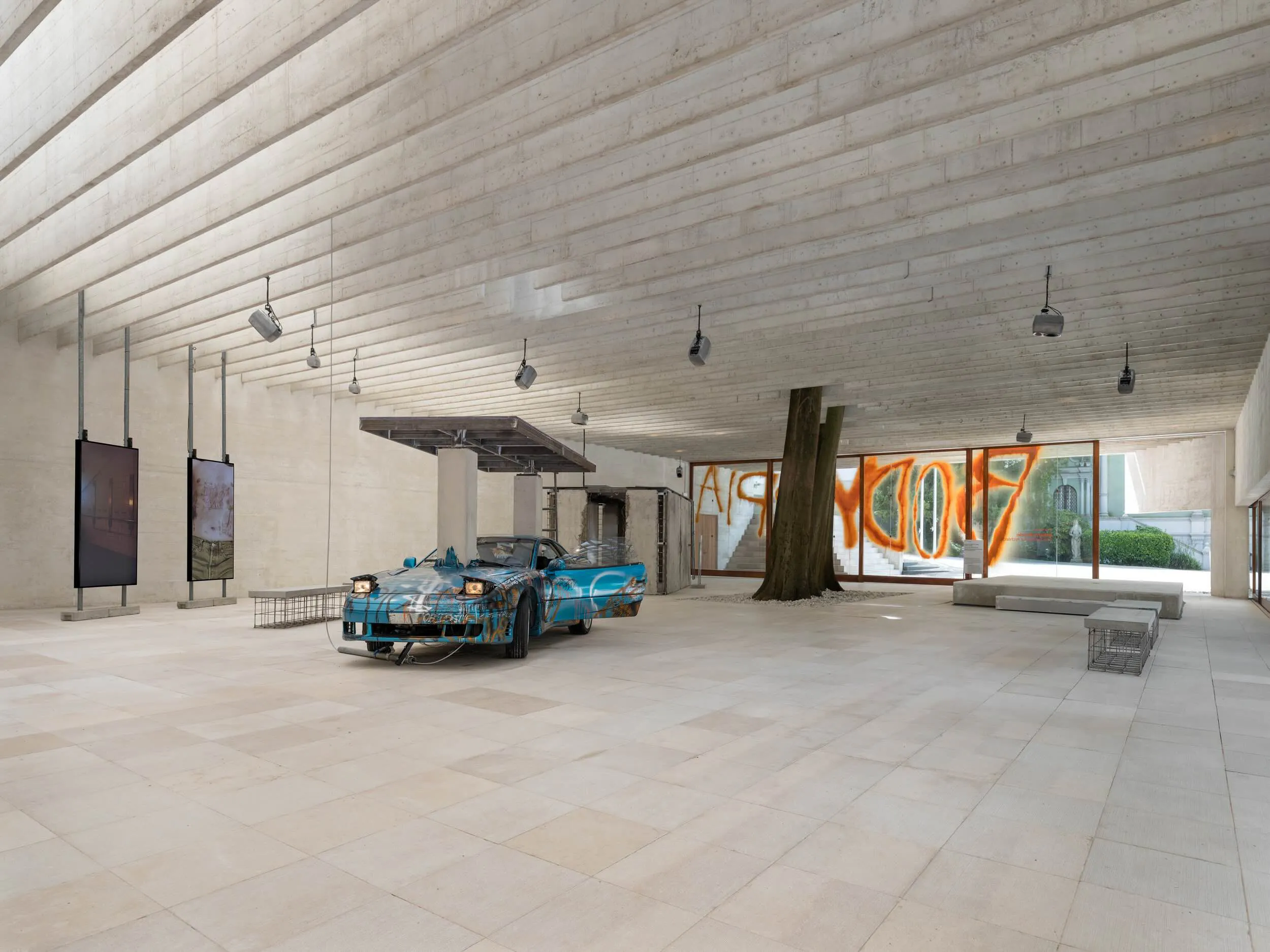
Industry Muscle: Five Scores for Architecture, Nordic Countries Pavilion at the 19th International Architecture Exhibition, Venice Biennale 2025. Installation by Teo Ala-Ruona, A.L. Hu, Teo Paaer, Tuukka Haapakorpi, Venla Helenius, and Kiia Beilinson. Curated by Kaisa Karvinen. Photo by Ugo Carmeni, courtesy of the Architecture and Design Museum Helsinki.
I met up with my former Architectural Practice lecturer, the acerbic, funny Dr Peter Raisbeck, over sandwiches of bacalao and artichokes. I suggested we visit the Nordic Countries Pavilion, where a much-lauded performance was taking place.
Designed by Norwegian architect Sverre Fehn and opened in 1962, the Nordic Countries Pavilion is a massive open room of diffuse luminescence. Three mature trees extend through the brise soleil ceiling, its pale concrete slats appearing to levitate. The pavilion represents three countries: Sweden, Norway, and Finland (which also has its own national pavilion, a small box designed by Alvar and Elissa Aalto in 1956).
The atmosphere was highly charged when we got there. Two people appeared to be fighting or dancing, grinding their bodies against each other on a raised terrazzo platform. Another two were pacing around and scrutinising the locked-together pair, making commands such as intensify! We made our way deeper into the pavilion as the bodies writhed and crawled and groped and tangled. Members of the crowd were called on to ‘stabilise’ the evolving corporeal structure, as arms from both sides were outstretched, latching on. The performers then produced thick markers from their pockets; making eye contact with the audience, they began drawing what they saw on their own skin. As they peeled their clothing away, makeshift portraiture mingled with pre-existing tattoos. One performer drew glasses around their eyes, only twenty centimetres or so from their spectator-subject. Another, with t-shirt up around their neck, turned towards us as they unzipped and removed their pants. They drew the collar and buttons of my shirt on their upper thigh while I returned their gaze despite my rising embarrassment. Their focus moved to Dr Raisbeck’s mobility scooter, the wheels of which became inscribed on their lower leg. By that stage, it was nearly 4:30pm, when the Australia Pavilion Commissioner’s Cocktail Party was set to start. But it was impossible to leave.
With their pants around their ankles, the four nearly naked scrawled-on bodies handed over the markers and invited onlookers to draw – spirals on buttocks, leg-crease traces – directly onto their skin. The performers then migrated to another area of the room and climbed a ladder onto a steel platform, supported by two concrete columns that punctured a densely graffitied car. The figures stretched up to the ceiling’s exposed concrete rafters, natural light streaming through. They continued drawing on themselves, staring back at the audience, the sound of distorted plosive exclamations unsettling yet intimate.
Some minutes later, after they had regrouped on the terrazzo platform, a plate of strawberries and a bottle of prosecco were handed to the quartet. They fed each other with tenderness and humour. They clinked glasses. One poured bubbly liquid into the mouth of another, whose smile fizzed with overflowing celebration.
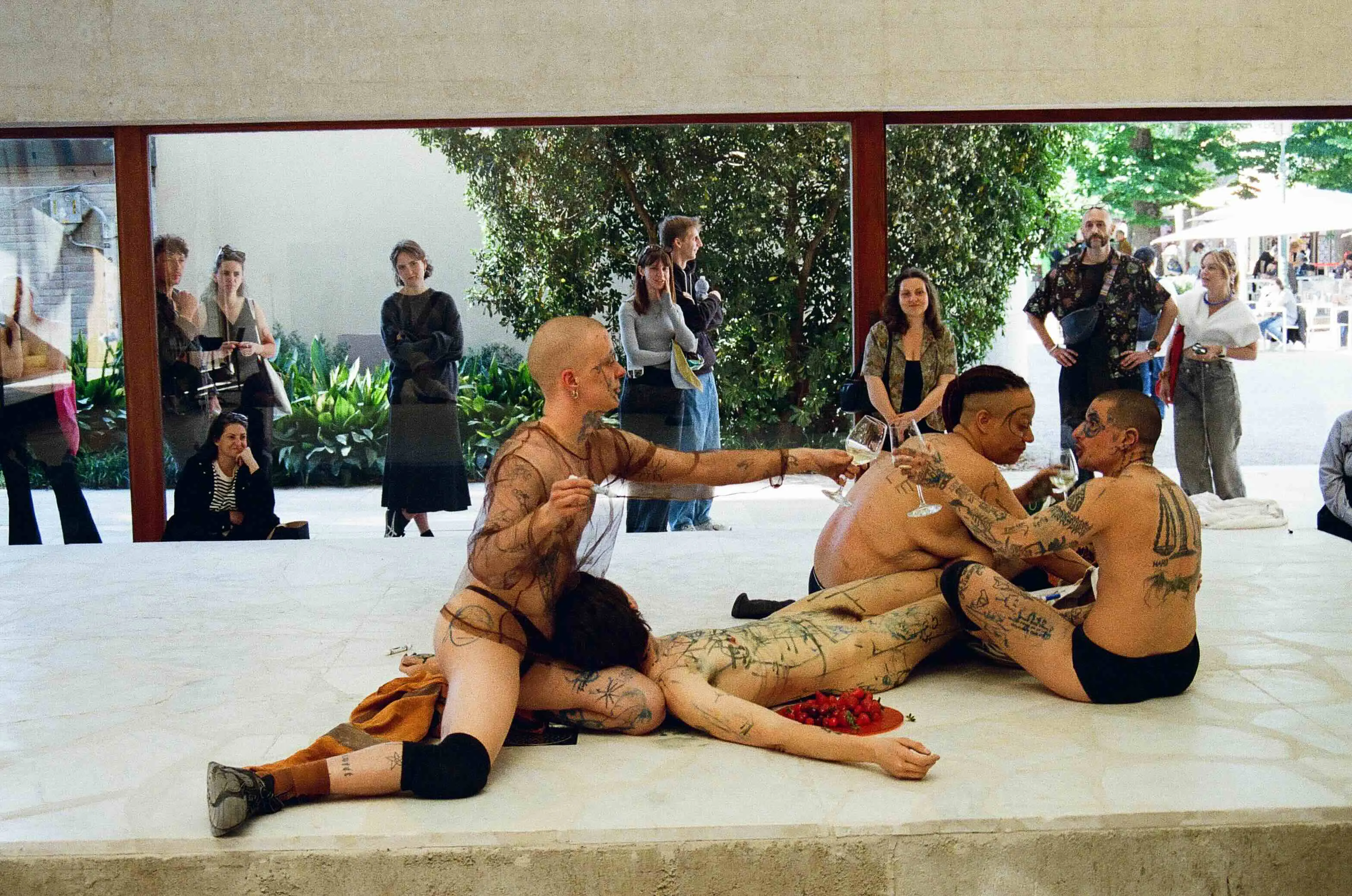
Industry Muscle: Five Scores for Architecture, Nordic Countries Pavilion at the 19th International Architecture Exhibition, Venice Biennale 2025. Performers: Teo Ala-Ruona, Kid Kokko, Caroline Suinner, and Romeo Roxman Gatt. Photo by Even Minn, courtesy of Teo Ala-Ruona.
This disarming encounter was not obviously rooted in national representation or diplomacy. Months after the performance, during their Finnish summer break, I interviewed the artist Teo Ala-Ruona and curator Kaisa Karvinen. I asked why a Nordic Countries Pavilion exists when Finland and Denmark already have their own. Karvinen explained that the idea began to be discussed after World War II, that it was a political collaboration: ‘the Nordic countries wanted to show that we can do this together’. She recommended the book Sverre Fehn, Nordic Pavilion, Venice: Voices from the Archives, which details the conflicting ambitions of the Nordic countries in an increasingly anxious Cold War milieu. It was in this geopolitical context that the pavilion was conceived. While various models have been tried since 1962, now each of the three participating countries takes a turn at curating every six years.
When I asked whether they had felt the pressure to represent Finland in any particular way, Ala-Ruona reflected that the Biennale could feel like a national branding exercise or ‘trying to do a face lift for the country that you’re representing’. Ala-Ruona challenges the limits of Finland’s socially progressive image by centring on the trans body as a conceptual framework. In 2023, Finland reformed its gender recognition law to remove requirements for sterilisation and psychiatric diagnosis, allowing adults to change their legal gender by self-declaration (though only between binary gender markers). Ala-Ruona said:
In Finland, trans rights are better than in some places, but it’s not good at all, especially with the far-right government we have at the moment […] We managed to make a work that sparked a lot of conversations and that’s more than you can dream of as an artist. I was really trying to stick to the idea that this is a speculative rather than solutions-based project.
In 2024, the Architecture and Design Museum Helsinki commissioned Ala-Ruona – along with his team of collaborators, including A.L. Hu, Teo Paaer, Tuukka Haapakorpi, Venla Helenius, Kiia Beilinson, Even Minn, Ervin Latimer, Caroline Suinner, Romeo Roxman Gatt, and Kid Kokko – to interpret Sverre Fehn’s modernism at the 2025 Architecture Biennale. The exhibition was supported by Finland’s Ministry of Education and Culture as well as its Ministry for Foreign Affairs. Karvinen spoke about the ‘beautiful messiness’ of the nation states represented in the Nordic Countries Pavilion: ‘What is not visible in the exhibition are the groups behind the works […] the ministries, the communications teams, the museum, the big artistic team. The work does not come purely from the artist but is rather filtered through all these organisations and parts of the process.’
The title of the work, Industry Muscle: Five Scores for Architecture, alludes to the ‘Five Points for Architecture’ outlined by Le Corbusier, the central figure of modernist architecture. Ala-Ruona focused specifically on modernist architecture’s ideals of purity and neutrality embodied in the Nordic Pavilion’s expanses of pale concrete, glass, and light. In a video released by the Architecture and Design Museum Helsinki during the Biennale’s pre-opening, Ala-Ruona speaks about modernist architecture as a site for ‘restaging societal norms’, particularly from ‘the trans body’s point of view’ but also ‘broaden[ing] to question the human image in general’. Through this emphasis on the body, Ala-Ruona also critiques Le Corbusier’s ‘Modulor Man’, an anthropometric scale of proportions based on the supposedly ‘standard’ height of a cis-gender man with his arm raised. In the exhibition’s accompanying essay, ‘Bodytopian Architecture’, Ala-Ruona writes:
The desire to destroy is directed at the legacy of modernism, which shapes social power structures and influences our perception of the body, eventually impacting architectural design processes […] I see destruction as a creative and reorganising practice whereby, rather than inflicting physical damage to the building, I deconstruct the mental framework that upholds the meaning and status of the pavilion in modern architecture.
During my architectural studies, Le Corbusier’s theories and buildings were idolised by lecturers and tutors. Ala-Ruona was only the second critic of Le Corbusier – after Beatriz Colomina – whom I had encountered. Industry Muscle militates against modernism’s clean lines and ‘rational’ forms by presenting structures and bodies that are graffitied, tattooed, punctured, pierced. A concrete bunker housing hormone injection apparatus appears as though it were partially demolished – steel rebars exposed, ripped, rough edges of the concrete crumbling. In a photo of an earlier part of the performance (which I missed), the four bodies stand on top of the bunker with their arms raised to the ceiling, grabbing hold of the pristine rafters. The individual figures have different heights, widths, stances. They are bodies that might have undergone hormonal or surgical transformations. They mimic the stance of Corbusier’s Modulor Man, appearing as columns holding the expansive ceiling up.
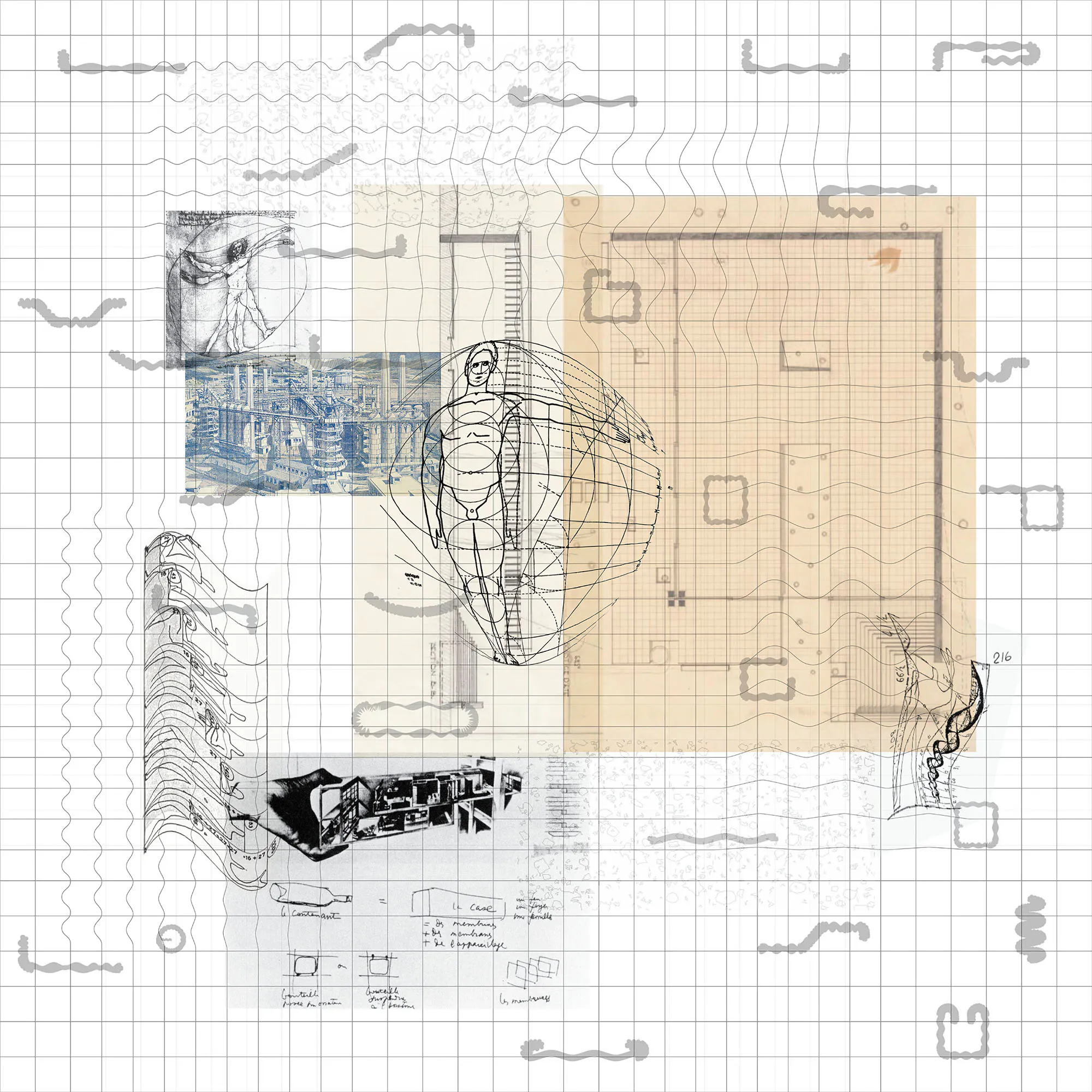
Drawing by A.L. Hu in collaboration with Teo Ala-Ruona for ‘Bodytopian Architecture: an essay written for Industry Muscle: Five Scores for Architecture’. Courtesy of Teo Ala-Ruona.
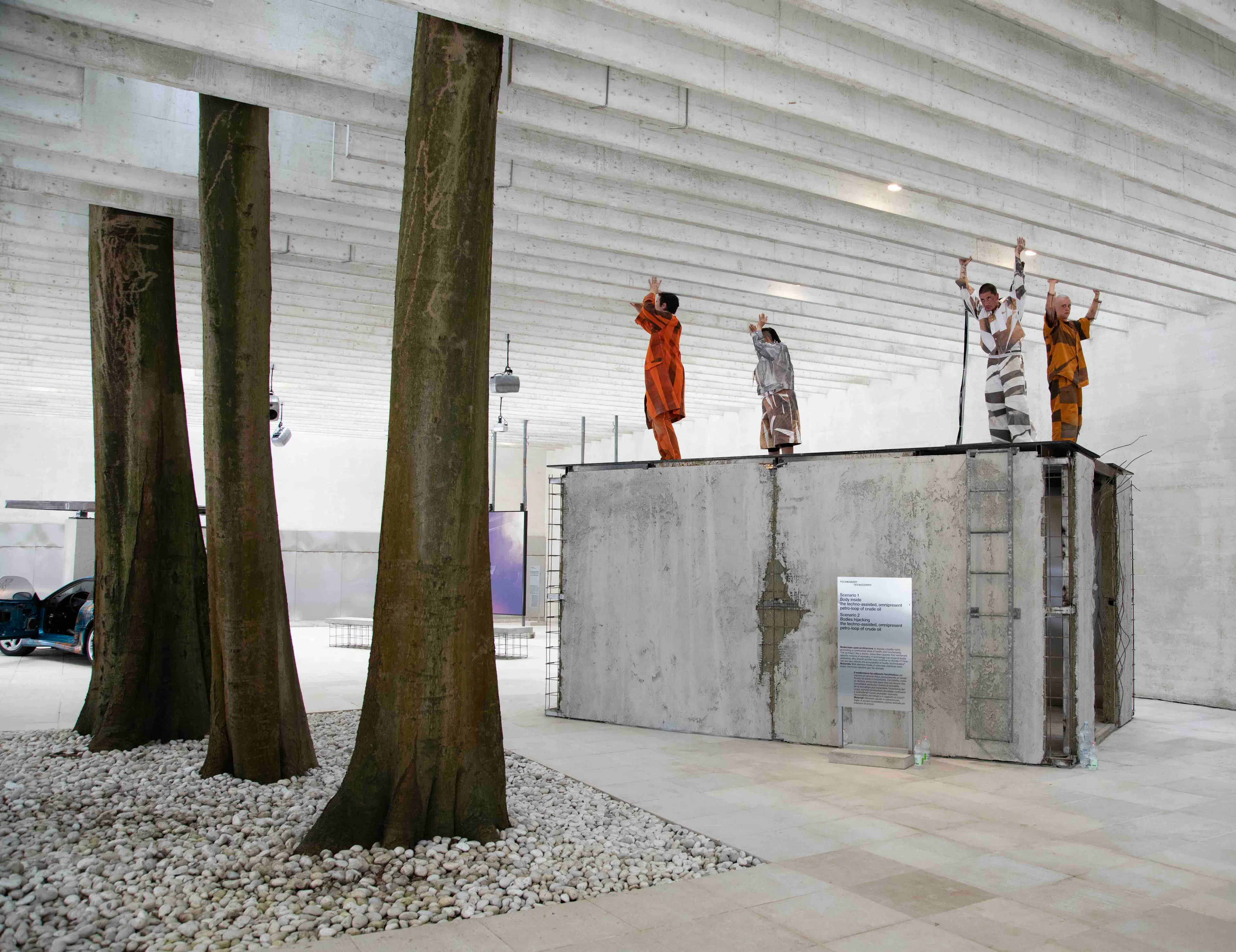
Industry Muscle: Five Scores for Architecture, Nordic Countries Pavilion at the 19th International Architecture Exhibition, Venice Biennale 2025. Performers: Teo Ala-Ruona, Kid Kokko, Caroline Suinner, and Romeo Roxman Gatt. Installation by Teo Ala-Ruona, A.L. Hu, Teo Paaer, Tuukka Haapakorpi, Venla Helenius, and Kiia Beilinson; curated by Kaisa Karvinen. Photo by Venla Helenius, courtesy of Teo Ala-Ruona.
Eye and skin contact are crucial to the kind of symbolic and cognitive damage Ala-Ruona’s work aims to inflict on the bodily norms architecture encodes. As Ala-Ruona put it, ‘gazing is a powerful everyday material that trans people live with and through, especially in public spaces and the built environment […] It’s important that we direct the gaze back towards the ones who are looking at us.’ He described the drawing scene as a comment on the representation of human figures in architectural drawings: ‘We are looking at everyone, and we are trying to draw people and their outlines onto our own bodies – we are inscribing a blueprint of the people around us onto ourselves all the time.’ Unlike the simplified and gendered figures used in modernist architectural drawings – a man in a suit, a woman in an A-line skirt and high heels – each person in the performance was approached individually, their defining features studied and drawn. The drawings were imprecise, rough, sometimes unrecognisable – done without checking the marks made on skin. Ala Ruona remarked that this represented ‘how extremely complicated, how extremely uncategorisable we are’.
It was precisely the fact of living bodies occupying rooms that was so compelling to me – and the prospect of an architecture that responds to the reality of human needs by demonstrating, at scale and through the power of performance art, how bodies might influence and be influenced by the built environment through speculative scores. Karvinen recounted that some architects had approached her after the performance, quite emotionally, ‘realis[ing] how they had been assuming or imagining human bodies when they had been designing architecture, and that they also felt seen as human bodies as they were drawn by the performers’. Ala-Ruona said that twice a spectator had asked whether the performers were robots, an ‘unexpected’ question, but one that ‘reflected on the overall curation of the Biennale – when there is an actual human body doing something, it’s considered an android’. Karvinen wanted ‘to remind everyone that architecture is not neutral, and that those tools that we’re used to seeing as architectural tools – drawing, building models – they are not neutral […] there should be more layers, more questions, more ways of approaching and looking at architecture. We don’t have to create anything new, but we should realise that it’s more complex than it seems.’ Unlike many of the national pavilions, the message emanating from the Nordic Countries Pavilion was not easily translatable into the terms of performative diplomacy – Karvinen and Ala-Ruona were happy that the complexity of the work had mostly remained intact. They did lament, however, that some of their original concepts such as ‘petroculture’ had been omitted from the press texts.
The built elements of Industry Muscle: Five Scores for Architecture are now stored in a small town near Helsinki, in the Vihdin Betoni concrete factory where they were produced. They await a possible future showing as an independent work, with a new curatorial framing, no longer tied to the museum.
Australia first applied to build a pavilion in the Giardini in 1954, when the country debuted at the Biennale Arte with paintings by Russell Drysdale. Negotiations for a pavilion began as late as 1980; a 2013 Financial Times article states that Australian arts philanthropist Franco Belgiorno-Nettis ‘lobbied so successfully that […] Australia beat 16 other countries to the last site on which to build a permanent pavilion in the Giardini’. In 1988, a ‘temporary’ fibre-cement and steel structure with a wave-like roof, designed by Philip Cox, was erected. In 2015, the permanent Australia Pavilion, designed by Denton Corker Marshall, was completed. From the outside, the structure is a bold, black, granite-clad box with a long ramp, deep balcony and a view of the canal. Large operable panels allow natural light into the main room, which is conceived as a ‘pure rectilinear white space of an almost square proportion, where art is the focus’. A distinctly twenty-first-century design, its boxy blankness is reminiscent of bog-standard house extensions seen in suburban Australia.
When Dr Raisback and I arrived, still buzzing from the Nordic Countries Pavilion performance, at the Australia Pavilion Commissioner’s drinks, the steel ramp was brimming with deans and professors of Australian architecture schools, members of the 2025 curatorial team, architectural celebrities and philanthropists, and a bunch of my former university peers. The make-shift bar on the balcony had run out of clean glasses; my friend Maria let me sip from hers.
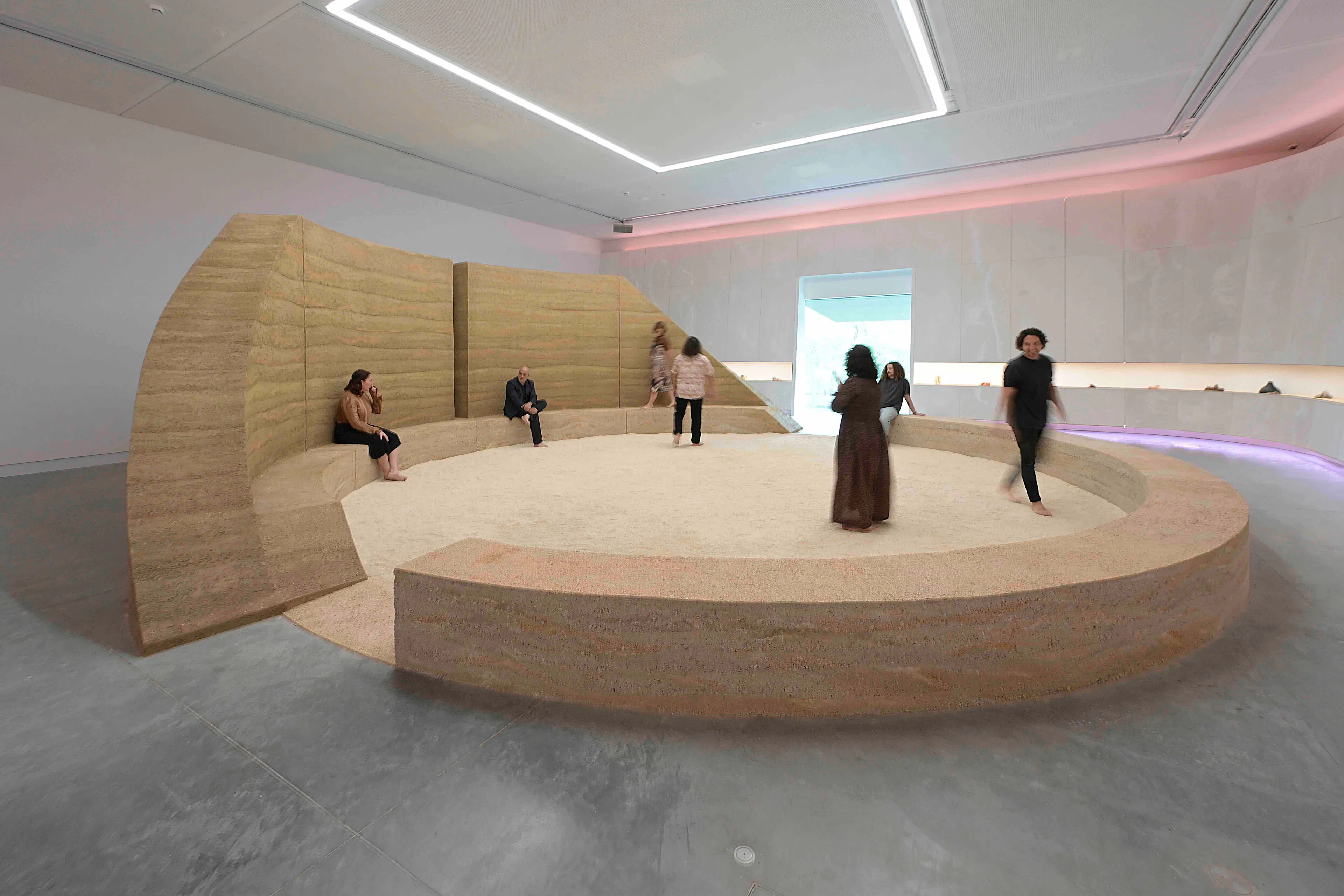
HOME, Australia Pavilion at the 19th International Architecture Exhibition, Venice Biennale 2025, with the Creative Sphere (from left to right): Elle Davidson, Michael Mossman, Kaylie Salvatori, Clarence Slockee, Emily McDaniel, Bradley Kerr and Jack Gillmer-Lilley. Photo by John Gollings, courtesy of the Australian Institute of Architects.
The 2025 installation, HOME, was created by the first all-Indigenous team to represent Australia at the Architecture Biennale. The Creative Sphere was directed by Michael Mossman (Kuku Yalanji), Emily McDaniel (Wiradjuri) and Jack Gillmer-Lilley (Worimi Biripi), with Elle Davidson (Balanggarra), Bradley Kerr (Quandamooka), Kaylie Salvatori (Yuin) and Clarence Slockee (Bundjalung). HOME is an architecture of sanctuary and ceremony. Upon entry, a massive, rammed earth wall presents as a barrier, funnelling visitors around its curves. A narrow slit in the structure allows glimpses into the gathering space beyond, inviting guests into the centre. The Commissioner’s drinks provided me with my third chance to explore the exhibition. I had attended the opening of the Australia pavilion on the Thursday morning, and had then come back the next day (prior to the Nordic Pavilion visit) for a conversation between members of the Creative Sphere about their perspectives and practices of ‘home’. When I entered on that second occasion, a few pairs of shoes had been placed neatly around the wall’s perimeter. Their owners were within the sandy amphitheatre, making marks with their bare feet. Ensconced in the round, sitting on the circular rammed earth bench, I felt a sincerity, calmness, and warmth that I had not yet found at the Biennale. Part of this may have been homesickness, though the question of what ‘home’ means for a white settler raised on stolen lands is not straightforward. After spending nearly eighteen months living in Germany, where I don’t speak the language very well or feel at home with the culture or the politics, to be in a room filled with so many people I could easily understand, talking with such familiar accents about places I’ve lived, was grounding – which is perhaps what architecture at its root should do. If having a ‘home’ means being able to interact with and contribute to a place and community as one’s full self, then, in some ways, I didn’t have a place like that anymore. In the HOME installation, though, I felt at ease.
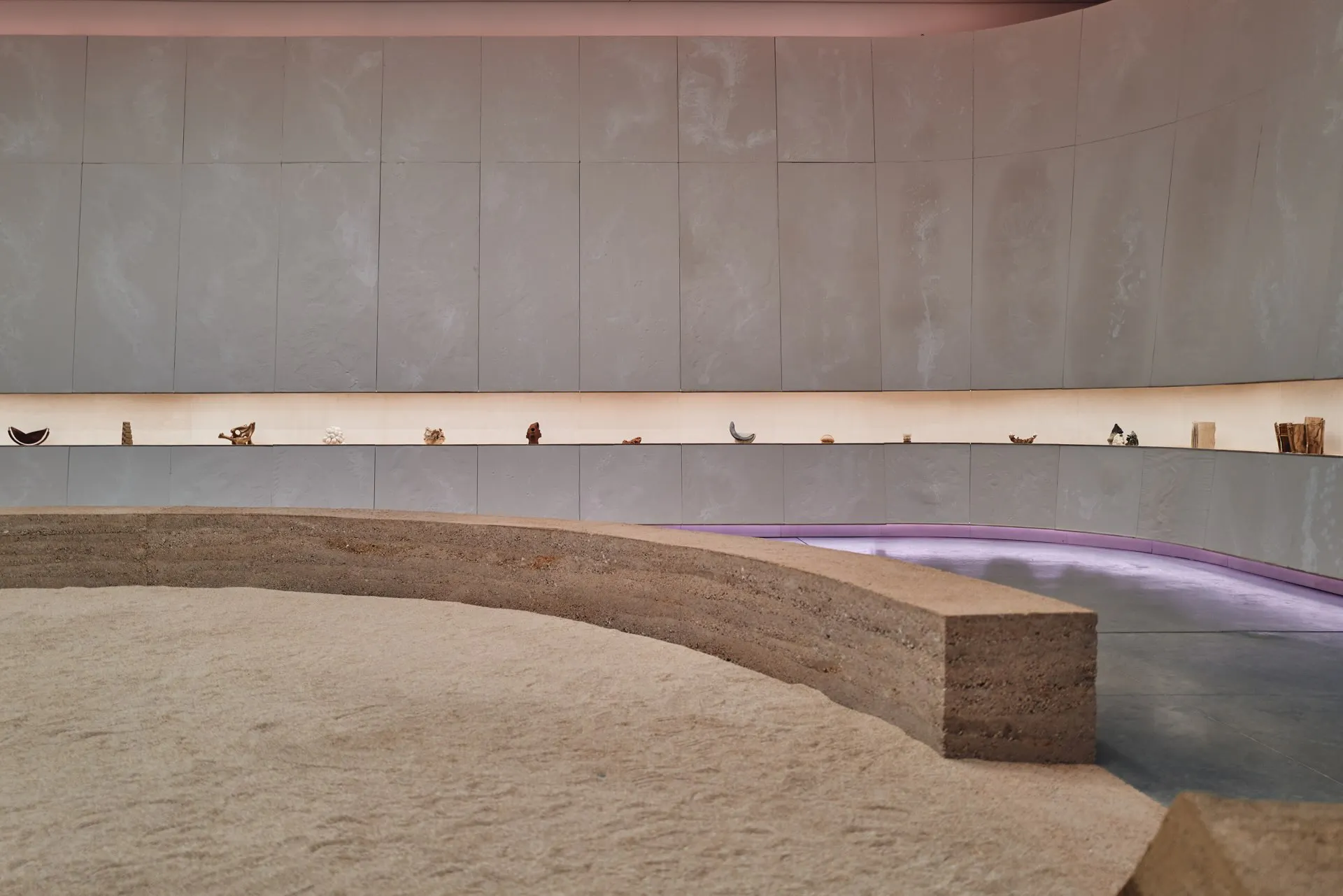
HOME, Australia Pavilion at the 19th International Architecture Exhibition, Venice Biennale 2025. Installation by Michael Mossman, Emily McDaniel, and Jack Gillmer-Lilley, with Elle Davidson, Bradley Kerr, Kaylie Salvatori and Clarence Slockee. Photo by Peter Bennetts, courtesy of the Australian Institute of Architects.
The white walls of the rectilinear pavilion were covered over by 127 handcrafted plaster panels mounted on a subtly curved and hidden timber frame. Set into this structure, known as the Living Cloak, was a sand-lined ledge where thirty-nine small hand-made objects – called Living Belongings – were displayed. Visitors were invited to caress the soft surfaces of, and handle, the Belongings, to interact with them, to learn from them. Pale violet and peach lights emanated from underneath and above the Living Cloak, bathing the space in dawn-like optimism. While the materials looked like they could have been Australian, they were in fact sourced locally, from the Veneto region. This approach emphasised not only sustainability – shipping was avoided – but also paying attention to place, applying a methodology of Country rather than (settler) transplantation. Yet rammed earth, plaster, and sand are all materials that involve mining and extraction – materials that, we were assured, would be returned to the land after the installation was dismounted.
We were a relatively small group during that session, sitting in a circle around the interior forum. Some people had taken their shoes off, their toes intermingling with the sand, but I kept my boots on. Ready to make scintillating observations, I had my notebook out, but put it away when Clarence Slockee told us to stand up and chant a base rhythm of ‘dingo, wallaby, kookaburra, emu’ – ‘don’t speed up!’ – while he started to sing. People smiled at each other sheepishly. By the end of the session, when we were standing again and clicking to a beat set by Slockee, any initial discomfort or awkwardness had dissipated – ‘come on, you’ve gotta use your body!’ There was something about this moment that felt more profound than any of the other pavilions or exhibits presenting more disembodied architectural or technological forms. It wasn’t as edgy as the experience of embodiment in the Nordic Countries Pavilion; it was friendlier, more communal, yet also more private. We were bound together for that hour, and no one left the circle early. The fact that the space was round and sheltered from external view helped – no one was looking in on us, or judging. I started recording the dance, but then felt that it was against the spirit of the moment and put my phone away.
I had originally been interested in the ‘new role of producer’ that Creative Australia had assumed in 2025 for the Architecture Biennale, after it rescinded the 2026 Biennale Arte contracts of artist Khaled Sabsabi and curator Michael Dagostino only six days after their announcement in February 2025. At the May opening of the 2025 Venice Architecture Biennale, the question of whether the Australia pavilion at the Biennale Arte would be empty in 2026 was still live. As I made my way up the ramp towards the bar at the Commissioner’s Cocktail Party, I recognised Dr Mossman and interrupted his cheerful conversation to ask whether I could interview him about the involvement of Creative Australia in the project. His face fell a little, and he told me that the Creative Sphere had made a statement of solidarity with Khaled Sabsabi and Michael Dagostino. In a virtual interview I conducted with him months later, he added:
This was my first engagement with Creative Australia. It was about keeping an open mindset to work with them professionally, but also to develop relationships that we can continue to build on in the future. The news of the Art Biennale and the termination was very jarring at the time. It was always in our minds moving forward, in terms of how we were positioned in relation to the pavilion for this year, but then the uncertainty of not knowing what was going to happen next year meant that it was always present during our interactions with our Creative Australia colleagues. It was an interesting time to work through and navigate. To come out the other side now, to have the decision reversed – there was a big relief that the continuity of the space, of how that pavilion celebrates Australian culture, would be unbroken.
Dr Mossman explained that the role of Creative Australia in the 2025 Architecture Biennale was to help knit the project together in terms of production and invigilation. He had found it a constructive experience. Responding to my questions in early July 2025, Creative Australia emphasised that it ‘ha[d] not played a role in the selection process of the creative team’, deferring instead to the Australian Institute of Architects (AIA), which stood as the Commissioner of Australia’s representation.
The question of Creative Australia’s role was not the main story in relation to the 2025 Australia Pavilion. The crucial message was about creating a place for dialogue, storytelling, and building relationships after the October 2023 referendum for an Aboriginal and Torres Strait Islander Voice to Parliament was rejected by a majority of Australian voters. This was the first Venice Architecture Biennale following the referendum. Dr Mossman reflected on the significance of the timing in an October 2024 ArchitectureAu article: ‘While the result presented a setback to Aboriginal and Torres Strait Islander agency and self-determination at a constitutional level, it opened opportunities for impactful dialogue between Indigenous and non-Indigenous people, which we will continue with Home.’ The dialogue started before the Biennale opening, with specially designed and facilitated architecture electives at eleven universities around Australia responding to the exhibition’s ‘big question’, as Dr Mossman put it: ‘What does home mean to you?’ The Living Belongings that lined the pavilion’s walls were some of the outcomes of this exercise and are significant in inviting ‘a more-than-gallery-approach’ through interaction.
Dr Mossman described the HOME installation as a place of respite and reflection:
When I went in there last, there were people on the bench, writing in their journals or just having a moment to interact with the space and gather their thoughts in some way. I had a yarn with one student from Graz, Austria – we had a nice conversation, about how the space facilitates rest, enacts it – to just sit quietly and relax, to have a moment to recover from the mountain of information that’s present in a lot of other exhibitions. That’s a welcome contribution to visitors. […] For each new visitor, there’s an invitation to come and take in the information and relax and to gather themselves.
Places to retreat to were rare at the Biennale – the lines for the café were too long, the main exhibition was an unrelenting onslaught, a lack of tree-cover at both the Giardini and Arsenale left visitors exposed to rain and sun. I snatched moments of reflection sitting in the shade of the US Pavilion’s massive timber ‘porch’, in the Irish Pavilion’s ‘Assembly’ hall, and on the Bahrain Pavilion’s sandbags. But none of these places were as discreet as the Australia pavilion, none as meditative.
The Voice referendum was not mentioned during the vernissage. Bradley Kerr said that the installation was about joy as an act of resistance: ‘the most joyful experience has been seeing Kaylie’s children playing in this big sand box, people taking their shoes off. If all you take away is that this is a big sand box, I hope you enjoy playing in it.’ Less a garden of diplomacy than a pit for play and conversation, then. Though perhaps the two structures are not as far apart as one might think. I had been introduced to Jane Cassidy, the immediate past President of the AIA, who chaired the selection jury for the 2025 Australian Architecture Pavilion, over Cynar and Aperol in a leafy Venetian courtyard. Speaking over a video call in mid-June, Cassidy explained, when I asked her what she considered Australia’s international contribution to be:
[W]e have a lot to offer in terms of the international discussion around architecture, but also the much broader discussion about sustainability across all its realms and what our relationship with our country is, and the place that we call home. Having an all-First Nations Creative Sphere this year was game-changing […] The fact that our pavilion was fundamentally about learning and growing together through building relationships and having conversations that help us learn about each other – I think in the global political context right now, world leaders might learn from that as a concept.
This emphasis on the relationship to country is enshrined not only in the Biennale selection, but also in the core professional competencies required to register as an architect in Australia, five of which (there are sixty in total) refer to an understanding of Country and First Nations perspectives. But whether the HOME installation’s generosity and spirit of sanctuary will be taken up and reciprocated authentically by local built-environment practitioners is a challenge facing the profession. Cassidy reflected on the exhibit as a counterpoint to the disappointing 2023 Voice referendum: ‘[T]here’s simplicity, but also sophistication in helping people really think about what being an Australian is, and to learn from each other through conversation, building respect and empathy’.
On 22 October 2025, the ICJ handed down its Advisory Opinion on the Obligations of Israel in relation to the Presence and Activities of the United Nations, Other International Organizations and Third States in and in relation to the Occupied Palestinian Territory. By ten votes to one, the Court stated that Israel, as an occupying Power, is required ‘to agree to […] and not to impede […] relief’ provided by the United Nations and its entities, in particular UNRWA, to the people of Gaza and, unanimously, that Israel must ‘respect the prohibition on the use of starvation of civilians as a method of warfare’. This came twelve days after Donald Trump’s ‘Gaza peace plan’ was accepted by Hamas and Israel, after two years of slaughter, starvation, and destruction. Israel rejected the ICJ’s opinion, and the US Department of State described the ruling as ‘corrupt’. Israel continued launching attacks across Gaza and restricting the distribution of aid. As of its most recent situation report, dated 29 April 2026, UNRWA is still blocked by the Israeli authorities from directly bringing in any humanitarian assistance, including food, into the Gaza Strip. Positioned outside Gaza in a series of temporary installations, the agency has enough food parcels, flour, and shelter supplies for hundreds of thousands of people.