
The woman twists her neck very far to the side and bares her teeth like a sick horse. No one puts a hand on her, no one takes anything from her. She feebly peers back over her shoulder. The knife should dig into her heart and twist around! The remainder of the necessary strength fails. Her eyes alight on nothing, and, with no burst of rage, fury, or passion, Erika Kohut stabs a place on her shoulder, which instantly shoots out blood. The wound is harmless, but dirt and pus must not get in. The world, unwounded, does not stand still. The young people must have vanished into the building for a long time. One building lies next to the other. The knife is placed back in the handbag. A gap yawns in Erika’s shoulder; tender tissue has divided unresistingly. The steel has entered, and Erika exits.
Cassandra of the Conservatory
Alexander Howard on Elfriede Jelinek at eighty
As Nobel Laureate Elfriede Jelinek turns eighty, Alexander Howard looks back over her prolific career in fiction and drama, situating her work’s provocative reckoning with Austrian history alongside the contemporary resurgence of the far right.
Like many readers outside the German-speaking world, I first encountered Austrian writer Elfriede Jelinek through Michael Haneke’s 2001 film adaptation of her 1983 novel The Piano Teacher, which won the Grand Prix at Cannes. I remember seeing the film in a small, slightly tattered cinema in London’s Soho. Its plot centres on Erika Kohut, a masochistic and sexually repressed music instructor at the Vienna Conservatory. Living with her domineering mother in an impossibly claustrophobic apartment, Erika embarks on a doomed and abusive relationship with a young student, Walter Klemmer. Shot in Haneke’s characteristically austere manner, the film is peppered with acts of cruelty and abasement. The threat of sexual violence hangs over much of the narrative. Erika’s self-destructive impulses are presented with a precision that can be difficult to watch, such as at the film’s end when, having just seen Walter arrive at the concert hall where he is due to perform, she drives a kitchen knife deep into her shoulder. The blade enters her body with a thud. Strikingly, Erika herself emits no sound; nor does pain visibly register on her face, marked by the bruises of a recent assault. The act complete, she walks calmly out into the Vienna night, blood beginning to seep through her tightly buttoned-up blouse.
It is a moment that has stayed with me. What I didn’t realise at the time, however, is just how different the film is from the book – not so much in terms of plot, but in terms of affective intensity. The transfer from page to screen plays a role in this, of course, as it does with all adaptations. But there is something particular about Haneke’s handling of The Piano Teacher that warrants more attention. In Jelinek’s novel the scene I’ve just described pans out like this (in Joachim Neugroschel’s English translation):
Haneke presents us with a handful of gestures: the wince, the self-mutilation, the walk into the night. Jelinek lingers. The narration circles obsessively around the body and the puncture wound, refusing to let the moment pass. Even the final sentence depends on a grim piece of verbal patterning, yoking together the knife’s entry and Erika’s exit. The scene is shaped as much by verbal construction as by physical action.
In interviews, Haneke has recalled reading the novel shortly after its publication and immediately thinking it would make for an ideal debut feature. When he approached Jelinek to inquire about the rights, he found the door firmly closed. Jelinek and the experimental filmmaker Valie Export had already developed their own screenplay. However, several years later and after repeated failures to secure funding, Jelinek had become deeply frustrated with the film industry and wanted nothing further to do with the project. At that point she sold the rights to the actor Paulus Manker, who approached Haneke to write a fresh treatment. After a fair bit of haggling, Haneke agreed and completed a script, only for that production to come to nought. Eventually, one of the project’s producers suggested that Haneke direct it himself. It took a fair bit of convincing: Haneke was by now an established filmmaker-screenwriter and had reservations about adapting material that was not his own. He agreed to make the film on a specific condition: the French actress Isabelle Huppert must play Erika Kohut. The Piano Teacher remains Haneke’s only feature-length film adaptation.
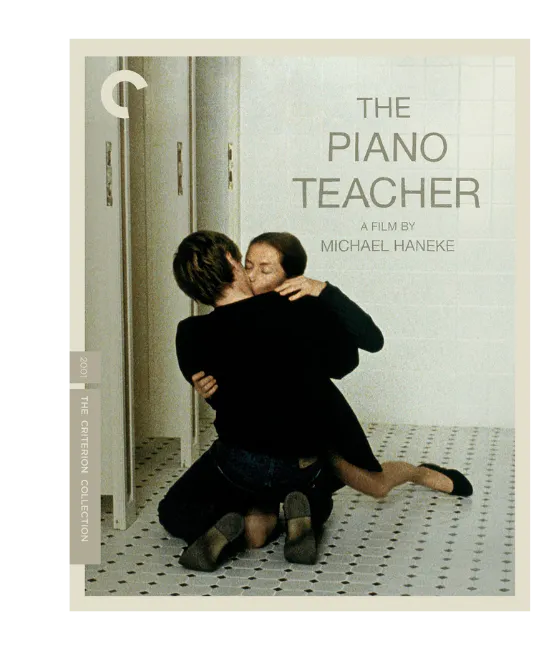
Film poster for The Piano Teacher (2001), directed by Michael Haneke. Image Source: The Criterion Collection.
Haneke is upfront about the ways in which he departs from Jelinek’s novel. He had little interest in the book’s (semi-autobiographical) concern with tracing the origins of Erika’s psychic wounds, discarding the extensive material dealing with Erika’s childhood and her relationship with her mother. He was equally wary of Jelinek’s ‘cynically criticising’ narrative voice, which ran the risk, he thought, of coming across as ‘smug’ and self-satisfied when presented on the screen. In order to make The Piano Teacher filmable, he thus largely dispensed with the very qualities that made Jelinek’s writing so distinctive. Jelinek rushes at the reader in a torrent. Haneke restricts himself to what the camera can observe. Where Jelinek turns words and thoughts over with compulsive, recursive insistence, Haneke pares away explanation and excess. Comparing the two works, Haneke himself notes in the interview included in the 2017 Criterion Collection release of the film:
I feel I’ve been dealing very freely with the novel and the way it was written. I would say that my version of looking at the story is pretty distanced and cool, while the novel itself is almost angry and very emotional. The novel is much more subjective and the film is much more objective.
My own contrast between the film’s restraint and the novel’s verbal torrent risks duplicating Haneke’s familiar oppositions: coolness against emotional, objective against subjective – one might even say masculine against feminine. Yet to characterise Jelinek’s prose primarily in terms of emotion is to miss what makes it so singular: what overwhelms the reader is not simply its anger, but its extraordinary formal force. In Neugroschel’s hands, Jelinek’s staccato sentences gather a strange momentum through stockpiling and incessant qualification until they become almost unbearably thickset.
The opening paragraph of the novel establishes the pattern that governs what follows:
The piano teacher, Erika Kohut, bursts like a whirlwind into the apartment she shares with her mother. Mama likes calling Erika her little whirlwind, for the child can be an absolute speed demon. She is trying to escape her mother. Erika is in her late thirties. Her mother is old enough to be her grandmother. The baby was born after long and difficult years of marriage. Her father promptly left, passing the torch to his daughter. Erika entered, her father exited. Eventually, Erika learned how to move swiftly. She had to. Now she bursts into the apartment like a swarm of autumn leaves, hoping to get to her room without being seen. But her mother looms before her, confronts her. She puts Erika against the wall, under interrogation, inquisitor and executioner in one, unanimously recognized as Mother by the State and by the Family. She investigates: Why has Erika come home so late? Erika dismissed her last student three hours ago, after heaping him with scorn. You must think I won't find out where you’ve been, Erika.
Within the space of a few lines, the narrator has moved from physical description to family history, from the domestic present to a compressed account of Erika’s childhood, before transforming the mother into an impossibly overblown figure: an ‘inquisitor and executioner in one’. Is this meant to be comic or sinister? Both at once? The phrase functions as satirical exaggeration, yet it also carries genuine heft. The prose continually collapses different discourses into one another in its shifts from family dynamics to political surveillance, from realist narration to metaphorical elaboration. It takes the form of what Jelinek herself calls Sprachflächen (‘language surfaces’): expansive, densely layered blocks in which competing voices and linguistic registers coexist without synthesis or resolution. The effect is overwhelming and exhausting by design.
Sustaining that effect in English places considerable demands on Jelinek’s translators. When they succeed, verbal echoes gather pressure; when they falter, deliberate distortion can read as clumsiness. Reviewing Martin Chalmers’ translation of Greed in 2007, Tim Parks argued that its strained English had lost the original’s musicality. Jelinek’s confidante and translator Gitta Honegger, who was then working on her translation of Die Kinder der Toten (The Children of the Dead), countered that a phrase that he found awkward concealed an allusion to Nazi exhortations at Stalingrad. Parks acknowledged the correction while maintaining his reservations. Their exchange reveals how easily linguistic and historical density can get lost in the act of translation or escape a reader’s notice. This matters because, when it comes to Jelinek, a mistranslation might become a misreading of history: a risk translators and critics alike must guard against.
This is the quality that Haneke necessarily leaves behind. His camera can reproduce the events of The Piano Teacher, but cannot reproduce the experience of Jelinek’s prose. I discovered that for myself not long after seeing the film, when I tracked down a second-hand Serpent’s Tail edition of the novel. I devoured it and then promptly forgot about Jelinek until 2004. I was living in Brighton by then. One morning, while grabbing a coffee and reading the newspaper, I learnt that Jelinek had just won the Nobel Prize in Literature – the first German-speaking woman writer to do so. The Guardian quoted the Nobel Committee’s citation, praising the ‘musical flow of voices and counter-voices’ that revealed ‘the absurdity of society’s clichés and their subjugating power’. The emphasis on musicality was apt. Before turning to literature, Jelinek, as is oft noted, trained as a pianist and organist at the Vienna Conservatory; music runs through much of her work, nowhere more obviously than in The Piano Teacher.
In the coverage that followed the award, Jelinek was being talked up as one of Austria’s most controversial writers, a high-profile and outspoken public intellectual whose vociferous criticism of her homeland’s history and culture had made her a deeply polarising figure. I tracked down what little of Jelinek’s work I could lay my hands on. Aside from The Piano Teacher, I could find only three other English translations of her novels in print: Women as Lovers, Wonderful, Wonderful Times, and Lust. Media coverage mentioned that Jelinek was also a poet and playwright. But none of that work seemed available in English.
Still, the three novels that were available offered a fairly representative cross-section of Jelinek’s literary vision. Best thought of as fictional marionettes, Jelinek’s characters function as embodiments of the institutions and ideologies that have produced them. As she herself has explained in Claudia Müller’s 2022 documentary, Elfriede Jelinek – Language Unleashed, her characters exist ‘at the mercy of political and social mechanisms’. They are vessels ‘of the action or meaning, who act the way they must and cannot act any other way’. Women as Lovers, her fourth novel, originally published in 1975, takes aim at the myths surrounding romance and domestic fulfilment, exposing the economic calculations and gendered power relations underpinning them. Wonderful, Wonderful Times, released five years later, continues in a similar vein, tracing the persistence of politically suspect habits of thought lurking beneath post-war Austria’s carefully cultivated veneer of democratic normality.
Of the three, Lust (1989) is an outlier. Thematically, it continues many of Jelinek’s longstanding concerns with exploitation and power. Stylistically, however, it operates on an altogether different level. Set against the Alpine landscape, which exerts a powerful gravitational pull on Jelinek’s imagination as a site of Austrian myth and historical repression, the novel is unyielding in both its linguistic experimentation and its depiction of sexual domination. Pretty much dispensing with plot altogether, Lust focuses on Gerti, the wife of Hermann, the authoritarian manager of a paper mill, whose marriage consists of little more than routine sexual violence. A tryst with an equally reprehensible, apish younger man offers no possibility of escape. The result is a pitiless critique of late capitalism and the mutually reinforcing logics of patriarchal sexuality and rapacious consumption through which it reproduces itself.
Lust is a stunningly abrasive, punishing novel that actively strives to repel even the most intrepid reader. The following passage, in Michael Hulse’s rendition, gives some indication of how Jelinek goes about her business. Approach with caution:
Any moment now his God-given sap will rise in his stem, his cup will overflow. Hurry up, stuff that prick in its designated slot, no loitering. You can hear her shrieks, you can see the whites of her eyes, what are you waiting for? The young man is suddenly alarmed at the totality with which he can spend himself without being spent. Again and again he reappears from within the woman, only to bury his little bird in the box again. He’s now licked Gerti from top to toe. His tongue’s still tart with the taste of her piss. Next her face. The woman snaps at him and bites. It hurts, but it’s a language animals understand. He grabs her head, still by the hair, pulls it up off the floor and slams it back where he first found it. Gerti splays her mouth wide open and Michael’s penis gives it a thorough go. Her eyes are shut. He jabs his knees in, forcing the woman to spread her thighs again. The novelty of this has worn off, unfortunately, since he did it the same way last time.
Nothing in this passage invites erotic identification. The sexual act is presented as mechanical labour, reducing bodies to instruments caught in an inevitably violent and dehumanising routine from which even the merest pretence of novelty has disappeared. What novelty there is consists in Jelinek’s relentless deformation of the language for sex: Biblical cadence collides with obscene slang, while abrupt shifts in register continually disorientate the reader and lexical echoes and clusters of diminutives continually call attention to the writing itself. As Jelinek explained in Language Unleashed, she deliberately turns the terms of hardcore heterosexual pornography – and its normalisation of the idea that women exist solely to be ‘tortured, raped, and humiliated’, and even enjoy their own degradation – against themselves via a sustained process of estrangement and refunctioning, rendering it ‘no longer consumable’. Lust was Jelinek’s attempt to denounce what she regarded as a ‘very far-reaching’ and disturbing cultural trend.
One might imagine that, by the time Jelinek won the Nobel, this aspect of her fiction had become reasonably well understood. It had not. On the eve of the announcement of the 2005 prize, which would go to the ailing dramatist Harold Pinter, Swedish Academy member Knut Ahnlund publicly resigned in protest over the previous year’s decision to honour Jelinek. As The Guardian reported, he dismissed her work as ‘whingeing, unenjoyable, violent pornography’, and argued that the decision had caused ‘irreparable harm’ to the prestige of the award. Warming to his theme, Ahnlund went that little bit further, claiming that only a ‘tiny number’ of the Academy members who plumped for Jelinek had actually read her books, while dismissing her as an ‘obsessive’ writer with a ‘single track’ mind. The article was less forthcoming on whether Ahnlund himself had done the requisite reading.
Ahnlund’s dismissal was playing on my mind as I sat down to write about Jelinek for the first time. I was enrolled in a course on the Frankfurt School at the University of Sussex. It remains one of the best classes I took as a postgraduate, taught, appropriately enough, by a German professor who bore more than a passing resemblance to Walter Benjamin – glasses, moustache, and all. When I said that I had been reading Jelinek, he proposed I compare her work with that of another great modern Austrian writer, Thomas Bernhard. That recommendation became the basis of my end-of-semester essay. Looking back at it now, I can see a younger version of myself trying rather too hard to reconcile everybody from Giorgio Agamben to Gillian Rose (with a smidge of unreconstructed Nietzsche thrown in for good measure) to make sense of the two writers. For all the earnest postgradute overreaching, the argument – buried beneath the overwrought theoretical scaffolding – turns out, in retrospect, to have more going for it than I perhaps understood at the time.
In essence my idea was that Bernhard and Jelinek should be read together because both refuse the comforting post-war fiction of Austrian innocence when it came to the legacy of Nazism. Both insist that Austria’s relationship with the Third Reich was not a historical aberration safely confined to the years between 1938 and 1945, but a continuing political and cultural problem sustained through a curious admixture of outright denial and collective historical amnesia. The difference lies in their methods. Bernhard pursues his targets through epic, unbroken monologues that expose the hypocrisies of the Austrian bourgeoisie. Jelinek, drawing on the satirical tradition of Karl Kraus, filters her attacks through collage and pastiche, ventriloquising the languages of advertising and mass media. Different styles, certainly, but a shared resolve to force Austria into a reckoning with a past it would often have preferred to leave buried. This was not a project that endeared either writer to many of their compatriots.
In Jelinek’s case, the historical side of her work was touched on during the Nobel ceremony, if only in passing. Horace Engdahl devoted much of his introductory address to Jelinek’s virtuosic manipulation of language, situating her within a ‘heretical feminine tradition’. Austria’s past, by contrast, received only fleeting attention. It surfaced in passing references to the ‘distortion of history’, the political uses of the Alpine landscape, and Jelinek’s place within a lineage of likeminded Austrian writers that included Bernhard and Ingeborg Bachmann. Jelinek’s own Nobel lecture, prerecorded for her absence, reveals a little more of what drives this project. Ruminating on her own ‘unruly’ language, she explains that she has no time to ‘curb’ it because she must instead ‘see to’ the ‘many dead’. Unmistakably Jelinek is gesturing towards the victims of Nazism and to the writer’s obligation to bear witness on their behalf: ‘in the end it’s down to me’. In that same speech, she makes clear, with characteristically mordant irony, that this is an impossible task:
There are simply too many dead, whom I have to see to, that’s an Austrian technical term for: whom I have to look after, whom I have to treat well, but then we’re famous for that, for always treating everyone well.
Without ever naming the Holocaust directly, Jelinek transforms an everyday Austrian idiom into an indictment of her country’s post-war culture of historical evasion. It is a point that Jelinek returns to again and again – at significant personal and reputational cost.
To understand why Jelinek repeatedly returns to this question of historical responsibility, it is worth briefly considering her background. She was born on 20 October 1946 in the small Styrian town of Mürzzuschlag, less than eighteen months after the end of the Second World War. Her mother, Olga Ilona, came from a conservative middle-class Catholic family. Her father, Friedrich Jelinek, was a working-class socialist and a Jew who survived the Third Reich only because his expertise as a chemist made him indispensable to the Nazi war economy. Discussing the circumstances of her birth in Müller’s documentary, Jelinek notes that she was born to unusually old first-time parents:
My mother was 43 and my father 48 […] This was very unusual at that time, but, as a Jew, my father could not have a child before 1945, because he would have broken the laws of keeping the German, the Aryan race clean.
Jelinek describes her childhood as marked by this divided inheritance. ‘I have this strange dichotomy in my family,’ she remarks. ‘One half Jewish, the other very Catholic. And, of course, that is something that also tears you apart and shapes you as a child.’ She likewise recalls attending convent school with ‘the children of the big Austrofascists’, though she leaves them unnamed. At the time, their names ‘meant nothing to me’, she recalls. Her education in Austria’s Nazi past continued at home:
Already as a child, my father obliged me to watch those horrific films, well, really those camp prisoners and piles of corpses, so then already as a child in elementary school I had to watch them, and this was somehow an indebtedness, to my father and my family and so I am paying it off as long as I can.
If her father impressed upon her the necessity of remembering, her mother exercised a different kind of influence. Determined to mould her daughter into a musical prodigy, she subjected Jelinek to an exacting regimen of lessons and practice from an early age. Jelinek graduated from the Vienna Conservatory with a diploma in organ while contending with an overbearing mother and the steadily deteriorating mental health of her father. She then enrolled to study art history and theatre at the University of Vienna. But the strain proved too great. Jelinek suffered a severe psychological collapse, abandoned her studies, and spent the following year largely confined to the family home.
It was during this period that writing assumed a new significance in Jelinek’s life. ‘I took refuge in language,’ she wryly notes, ‘because this was the only form of art my mother did not push.’ She also came into direct contact with Vienna’s experimental literary and political avant-garde. Via the left-wing writer and editor Robert Schindel, she became involved with a circle of artists and activists who sought to fuse, as she puts it, ‘political contents with new aesthetic forms’. Her earliest published work bears the unmistakable imprint of this environment. Her first collection of poetry, Lisa’s Shadow (Lisas Schatten), appeared in 1967, followed three years later by her debut print novel, we’re decoys, baby! (wir sind lockvögel baby!) Drawing on the cut-up techniques associated with William S. Burroughs and Carl Weissner, the book is a frenetic collage of pop-cultural fragments, sloganeering, media clichés, and linguistic play. Jelinek traces this aesthetic back to the Vienna Group, whose post-war experiments with language sought to reclaim the avant-garde traditions of Dada and Surrealism that the Nazis had denounced as ‘degenerate’. In her own words, these writers treated language ‘autonomously and also emancipatorily’, refusing to regard it merely as a transparent vehicle for meaning.
The precise moment she was coming of age as a writer was also a moment of intense political and artistic upheaval. Across Europe, the late 1960s witnessed student and worker revolts and the emergence of new forms of extra-parliamentary opposition, certain corners of which would soon take up arms and embrace political violence. Artists, too, sought new aesthetic forms capable of responding to the chaos of the age. Austria was no exception. Reflecting on those years, Jelinek remarks in Language Unleashed that ‘Austria always has radical art, the more severely the system constricts you, the stronger the explosion is.’ She likens the atmosphere to ‘the lid on the pot with the boiling water’ lifting until ‘it sizzles and boils over’. That metaphor of pressure and eruption finds its fullest expression in her Statement, published in the landmark 1970 anthology of new German writing, Grenzverschiebung:
my literature will no longer be able to be produced for writers and artists.
my literature may no longer be produced for literary agents.
my literature will have to give up its isolation.
my literature will have to become hot it will be like an explosion like in a
mushroom cloud.
like napalm.
Hyperbolic, provocative and self-consciously volatile, Jelinek’s declaration functions both as a historical timestamp and as something approximating the condition of a literary manifesto. Allusions to the Cold War and Vietnam root it firmly in the political imagination of the decade, while its insistence that literature become ‘hot’ announces the outlook that would shape Jelinek’s avowedly combative aesthetic. Literature, as she conceived it, was to eschew detachment and intervene directly in the ideological conflicts of the present.
It was a stance that would set Jelinek – a card-carrying communist between 1974 and 1991 – on a collision course with Austria’s post-war political and cultural establishment. Conservative in outlook and deeply invested in comforting narratives about the nation’s recent past, this milieu all but guaranteed a hostile home reception for Jelinek’s work. At the centre of those narratives lay one of the founding myths of the Second Austrian Republic. In October 1943, the Allies issued the Moscow Declaration on Austria, which described Austria as ‘the first free country to fall victim to Hitlerite aggression’ while simultaneously reminding Austrians that they bore responsibility ‘for participation in the war on the side of Hitlerite Germany’ – responsibility would shape how the country was treated once the war ended. It was the first proposition that entered Austria’s post-war political imagination. The second largely disappeared from view. The language of victimhood offered a convenient alibi, encouraging the comforting fiction that Austria had been National Socialism’s first casualty rather than one of its willing collaborators.
As historians from Evan Burr Burkey to John W. Boyer have noted, Austrian participation in the Nazi project went well beyond passive acquiescence. Put simply, relatively few Austrians regarded themselves as Hitler’s first victims, as evidenced by the fact that hundreds of thousands applied for Nazi Party membership in the wake of the Anschluss. Ordinary citizens enthusiastically enforced antisemitic measures and expropriated Jewish property. Indeed, occupying Germans were genuinely taken aback by the alacrity with which Austrians engaged in the persecution of their Jewish neighbours – so much so that Nazi officials had to issue orders to rein in the more chaotic acts of violence and destruction.
For decades, these realities were largely kept out of public view. It was only in the mid-1980s that they became impossible to ignore. In the presidential election of 1986, the conservative politician Kurt Waldheim, a former United Nations Secretary-General, was running as the candidate for the Austrian Österreichische Volkspartei (ÖVP), or People’s Party. Revelations concerning Waldheim’s wartime service as an intelligence officer in the Wehrmacht, together with evidence that significant aspects of his military record had been omitted from his official biography, raised troubling questions about what he knew, what he had witnessed, and why he had sought to conceal it. The ensuing controversy quickly escalated into an international scandal, forcing Austria into an unprecedented – and decidedly belated – confrontation with its own wartime past.
Jelinek had already ventured onto this terrain with Burgtheater. Published in 1982 and first staged in Bonn in 1983, the play concerns a fictional acting dynasty unmistakably modelled on Paula Wessely and Attila Hörbiger, two of Austria’s most revered theatrical figures. Both had appeared in the virulently anti-Polish Nazi propaganda film Homeland, while Hörbiger had also joined the Nazi Party. Through their fictional counterparts, Jelinek explores the entanglement of cultural prestige, political opportunism, and Austria’s unresolved Nazi past. News of the Bonn production was enough to provoke outrage at home, where the play was widely interpreted as a vicious attack on two cherished national icons. As Jelinek later recalled, ‘when I unmasked those idolized darlings of the People, all hell broke loose.’ The controversy fundamentally transformed Jelinek’s standing in Austria. ‘Then I lost my good name, that’s fair to say. And I didn’t expect this. Since then, I am hopelessly polarizing. Not abroad, but in Austria.’ Branded a Nestbeschmutzer – literally, one who fouls their own nest – she found that ‘people no longer hear what I say’. She has described the Burgtheater affair as the beginning of her ‘decline as an author in Austria’.
The fallout from the affair established a pattern that would escalate in subsequent decades, with Jelinek becoming one of the principal targets of the Austrian far right. Her work, and often her public persona, became a recurring focus of the country’s highly politicised culture wars. No politician exploited this more effectively than the late Jörg Haider. Son of two former members of the Nazi Party, Haider assumed the leadership of the Freedom Party of Austria (FPÖ) in 1986, transforming it from a marginal nationalist movement into one of the country’s dominant political forces. He was particularly adept at courting those nostalgic for Austria’s recent nationalist past. At times he trafficked in coded references to the country’s Nazi past; at others, he dispensed with ambiguity altogether, praising members of the Waffen-SS as ‘decent people of good character’ who had remained ‘true to their convictions’. He also found time to express admiration for Hitler’s employment policies.
In 1995, the FPÖ singled out Jelinek in a poster campaign attacking state-funded writers and artists. Dismissing Jelinek’s standing as an artist, Haider once remarked, in an interview included in Language Unleashed: ‘I think she only became famous because she ranted against Austria and because she also developed incomprehensible feelings of hate against her country. Thus, to me, it has no literary value.’ Four years later, after the FPÖ entered government in coalition with the ÖVP, Jelinek responded by withdrawing the performance rights to her plays from Austrian theatres for as long as the party remained in office.
Jelinek also criticised Haider directly in her work. In 2000, she published The Farewell, a satirical reworking of Haider’s farewell address following his resignation as FPÖ leader in the wake of a political controversy the previous year. Recasting his speech as the self-justifying monologue of an aspiring demagogue, the play exposes the rhetorical strategies through which nationalist politics seeks legitimacy. Yet Haider had entered Jelinek’s imaginative world long before. Five years earlier, a prominent character in what is widely regarded as her magnum opus, The Children of the Dead, was unmistakably styled on the media-savvy Haider, whose carefully cultivated public image emphasised youthful vigour and athleticism.
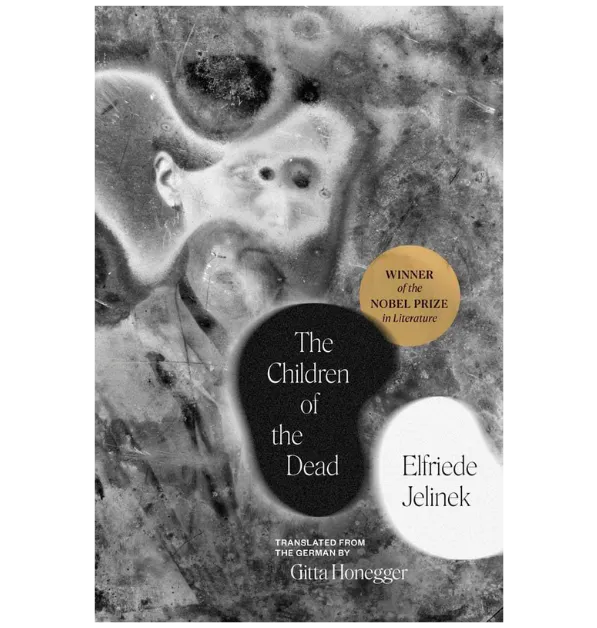
Book cover for the Yale University Press edition of The Children of the Dead (2024) by Elfriede Jelinek, translated from the German by Gita Honegger.
Translated into English for the first time in 2024 by Gitta Honegger, The Children of the Dead defies classification. Running to 666 pages in the original German, it fuses the conventions of gothic fiction, splatter cinema, experimental theatre, phenomenological philosophy, and slapstick into one of the most singular works of contemporary European literature. It also features a great many sex-obsessed zombies. The novel’s plot, if it can be called that, is simple. Over the course of a few days, Karin Frenzel, a secretary at an international office supply company, lies dying after a car accident, while a disparate cast of holidaymakers, locals, and mysterious strangers gathers at the Pension Alpenrose, an inn nestled in the Austrian Alps. Karin is joined by two other principal figures. The first is Gundrun Bichler, the archetypal eternal student, forever searching for knowledge that remains beyond her grasp. The second is the delusional Edgar Gstranz, a keen sportsman and local celebrity who runs as an FPÖ candidate, leaving little doubt that he is a stand-in for Haider. Both are well and truly dead. Incapable of speech and prone to acts of violence, they drift among the living as decomposing corpses, returning obsessively to fragments of their former lives while attracting little more than passing curiosity from those around them. As the novel progresses, the boundaries between the living and the dead, the natural and the unnatural steadily dissolve. Animals die without explanation. Infants are stillborn. An elderly couple come to a grisly end. The weather swings violently from sunshine to snow to torrential rain, while inanimate objects appear to acquire a life of their own. But even this summary risks making the novel sound more orderly than it actually is. Some critics dismissed it as wilfully chaotic, all but unreadable. Others have ranked it alongside Ulysses and Gravity’s Rainbow (which Jelinek herself translated into German) as one of the great modern experimental novels.
Part of what makes the book so demanding is that every paragraph contains more than one voice. No perspective or discourse is permitted to stand on its own for long. Storylines proliferate and buckle under their own weight. Terrible puns, bureaucratic jargon, philosophical rumination, and Austrian vernacular pile upon one another in a vertiginous verbal cascade. There is no respite. Reading the novel often feels less like following a story than being caught in an unstoppable mudslide, much like the one that engulfs the landscape near the book’s conclusion. But once the initial disorientation subsides, something else begins to emerge. Beneath its calculated grotesquerie and formal excess lies a sustained engagement with Austria’s twentieth-century history and the crimes it has struggled to recognise. It is Jelinek’s most ambitious meditation on the Holocaust and its aftermath, one in which her country’s unacknowledged dead refuse to remain buried.
Here’s a choice example of the book’s style:
Meanwhile, a ghastly site reveals itself to me, the basement of the so-called Art History Museum (across the street one for good Völkerkunde — only good old ancient ethnicities are exhibited there), come, take a look, but not close up, we don’t have much time, later we still have to see the glazed brains at Steinhof Psychiatric Hospital; well, what can I say, the museum is simply megahuge, the entrance alone! Inside, in hall after hall after hall, the cracked molds of humans are exhibited. You can see how they were intended, had they been able to escape us and our insecticide. As it became apparent that it was not good, we, the Gods, smashed these beautiful molds but never got around to making new ones. Thus, those people could have never existed before either. But before that, before they were never there, we could still photograph as well as measure them and their life spans so that they would find out before their death how they, in order to please us, should never have looked.
History is not narrated from a distance but reconstructed from the overlapping vocabularies through which it once justified itself. The seemingly offhand reference to Vienna’s Museum of Ethnology, housed in a wing of the Hofburg Imperial Palace and now known as the Weltmuseum Wien, immediately evokes the classificatory logic of nineteenth-century anthropology and empire. (When Jelinek was writing, it still bore the name Museum für Völkerkunde.) From there, the passage moves towards eugenics and ultimately mass murder. The invocation of the Volk carries unmissable echoes of Nazi racial ideology, while the image of humanity as a series of cracked moulds, fashioned and discarded by omnipotent deities, transforms the language of creation into a grotesque fantasy of racial perfection. The passing reference to ‘our insecticide’ collapses the language of hygiene, pest control, and extermination into a single murderous vocabulary, recalling Zyklon B, originally developed as an insecticide before being used in the Nazi death camps.
The reference to Vienna’s Steinhof Psychiatric Hospital then anchors these abstractions in a specific history. During Austria’s Nazi period, Steinhof became a major centre of the regime’s involuntary euthanasia programme, known as Aktion T4, in which thousands of psychiatric patients and people living with disabilities were murdered in the name of racial hygiene. Within the hospital complex, the Spiegelgrund clinic became one of the programme’s most notorious killing centres, where approximately 800 children were systematically put to death through lethal injections, deliberate starvation, and medical neglect. Many of their bodies, including their brains, were retained for medical research long after the war. What begins as a whistle-stop tour through Vienna’s museums steadily reveals itself as an anatomy of intellectual traditions and institutional logics that led to genocide.
Jelinek then widens the historical scope, situating Aktion T4 within the broader programme of Nazi annihilation:
To day no one would believe what raging frenzy had once taken hold of his city, and this because of people who from today’s standpoint appeared normal, ordinary from the outside. No dogshit on it, hands not yet grilled on a charged chain-link fence, no whip marks, the postage that could have got them to the Kingdom to come, nothing would have done them any good. Luckily, we never had to pay a surcharge later, we got off uncharged. Those folks, after having been counted by big, soft motherly hands were sent to vacation camp, where work was for free.
The extract’s allusions to deportation, camps, and forced labour are not generic invocations of the Holocaust but point to Austria’s central place in the development of Nazi Jewish policy. At the turn of the twentieth century, Vienna was home to the largest Jewish community in the German-speaking world. Four decades later, that community was in the process of being destroyed. Vienna was the laboratory in which Adolf Eichmann refined the administrative machinery of homicidal persecution. The city’s Central Office for Jewish Emigration became the model for similar institutions across the Reich, while the Jewish Community of Vienna was transformed into a prototype for Jewish councils established elsewhere in occupied Europe. Beginning in October 1941, tens of thousands of Viennese Jews were rounded up and transported to the ghettos of Łódź, Minsk, Riga, and the Lublin district of occupied Poland; many were then shot by Einsatzgruppen or deported to extermination camps. More than 15,000 were sent to Theresienstadt. By the end of 1942, only a fraction of the city’s once thriving Jewish community remained.
It is this history that returns, if obliquely, in the passage. ‘Vacation camp’ echoes the euphemistic language through which the Nazis disguised the reality of deportation and extermination. Likewise, the claim that ‘we got off uncharged’ condenses several meanings into a single phrase. It evokes the electrified fences of the concentration camps, while also echoing the language of invoices and surcharges, recalling how Jewish families were systematically stripped of their property before deportation. At the same time, to get off ‘uncharged’ is to escape culpability altogether. The pun therefore reaches beyond the crime of the Holocaust itself to Austria’s post-war insistence that it bore no responsibility for Nazi atrocities. The people who ‘appeared normal, ordinary from the outside’ are not monsters but neighbours, civil servants, and bystanders. Jelinek’s target is the exculpatory claim that genocide was carried out by a handful of fanatics rather than by an ordinary society whose institutions and citizens made it possible.
Jelinek has repeatedly described The Children of the Dead as the central achievement of her career. Looking back a decade after its publication, she remarked in Müller’s documentary that it contained everything she had ever wanted to say and that, had she just written this one novel, it would have been enough. Everything that has come since, she suggests, amounts to ‘extra credit work’. Yet, while The Children of the Dead may stand at the centre of her oeuvre, the decades since its publication have hardly been an extended epilogue. Alongside four further novels, she has responded with remarkable speed to successive crises in the political life of contemporary Europe, from the global financial crisis to the resurgence of authoritarian nationalism. What distinguishes these later works is not simply their topicality but their method. Jelinek repeatedly returns to what she calls her ‘secondary’ or ‘parasitic’ mode of writing, attaching herself to canonical texts in order to expose the ideological assumptions they continue to carry. Classical myth, in particular, becomes a means of thinking through the present. In Charges, Aeschylus’ The Suppliants becomes the vehicle for an excoriating response to Europe’s refugee crisis. On the Royal Road rewrites Sophocles’ Oedipus the King, recasting Donald Trump as a blind Oedipus and Miss Piggy as Tiresias. Written in the aftermath of the Charlie Hebdo attack and the siege of the Hypercacher kosher supermarket in Paris, Fury returns to the legend of Heracles to meditate on terrorism, religious violence, and the antisemitic hatred that underpinned both attacks.
These commitments also complicate Jelinek’s place on the contemporary left. In October 2024, she signed an open letter opposing the pledge that writers such as Sally Rooney, Arundhati Roy, Rachel Kushner, and Percival Everett had made to boycott Israeli literary institutions ‘complicit in violating Palestinian rights’. Reviewing The Children of the Dead for the Cleveland Review of Books, Carl Denton found a disturbing gap between Jelinek’s political allegiance and the implications of her fiction, asking whether its account of historical violence might not also resonate with the violence being inflicted on Palestinians ‘every day on our screens’. Her familial history makes her attachment to Israel intelligible, but cannot settle the political questions that follow from it.
Jelinek has since brought that attachment under scrutiny herself. In an essay published on her website in August 2026, she condemned the seizure of Palestinian land in the West Bank, Gaza, and Jerusalem, warned of ethnic cleansing, and called for European Union sanctions against land confiscation and settler violence. It also returns to a problem familiar from her writing about Austria: the chasm between reassuring language and the violence it conceals. Talk of a Palestinian state, Jelinek reminds us, becomes meaningless when the material conditions for its existence are being razed to the ground. Here, historical responsibility places a demand on the present that professions of solidarity alone cannot discharge.
When Jelinek won the Nobel in 2004, her collaborator and champion, the theatre director Claus Peymann likened her to Cassandra, the Trojan prophetess condemned to foresee calamity without ever being believed. Arguably, the comparison has only become more apt with time. In September 2026, the AfD won the largest share of votes in Saxony-Anhalt’s state election, although it fell just short of winning an outright majority. Had it done so, it would have become the country’s first far-right state government since the Second World War. Now, as Jelinek turns eighty, with right-wing extremism resurgent and democratic institutions once again under strain, the mythical Cassandra re-asserts itself as a potent figure for historical recognition, for the ability to perceive, beneath the apparent normality of the present, the festering conditions from which catastrophe emerges.
No longer appearing in public, she nevertheless prepared a text to be read aloud at a January 2024 demonstration against Alternative für Deutschland (AfD), the far-right party whose plans for mass deportations had prompted protests across the country. Jelinek’s speech arrived as the history she had spent decades confronting began to echo with renewed force. In May 2023, two men broadcast one of Hitler’s speeches over the public address system of a train travelling from Bregenz to Vienna. In Douglas Smith’s account of this incident in City Without Jews, no one seemed especially shocked. That November, Martin Sellner, a leading figure in the European New Right and the Identitarian Movement of Austria, addressed a secret meeting attended by AfD members in Germany, outlining plans for the forced removal of asylum seekers and others he deemed insufficiently assimilated. Sellner’s stance aligns with that of Alice Weidel, the co-chairwoman of the AfD, who has spoken openly of the need for ‘remigration’ and forced repatriation.
Jelinek’s speech opens with an account of Walter Benjamin’s famous description of the eighteenth-century chess-playing automaton, whose apparent intelligence concealed a hidden operator beneath the table. The metaphor becomes a way of describing Jelinek’s own position as a writer who feels condemned to keep repeating the same warning:
I have been sitting under the table for so many years, but I always play the same match because I must play it, I play it, so to speak, under the threat that something terrible might happen if I stop. Of course, I thereby totally overestimate myself. But now this doll emerges from the shadow of a tablecloth and speaks for itself. As me. Yes, talking doll, they’ll say disparagingly.
It is an extraordinary image of authorship. Jelinek does not imagine herself as a Cassandra standing above history, but as a hidden, almost anonymous presence, compelled to continue making the same moves because the danger she has spent half a century describing has never disappeared. The speech ends with a stark warning: ‘I can hear a monster breathing; I can hear the breath of democracy weakening. I am glad that you are all here and want to breathe new life into it. I hope it is not too late.’