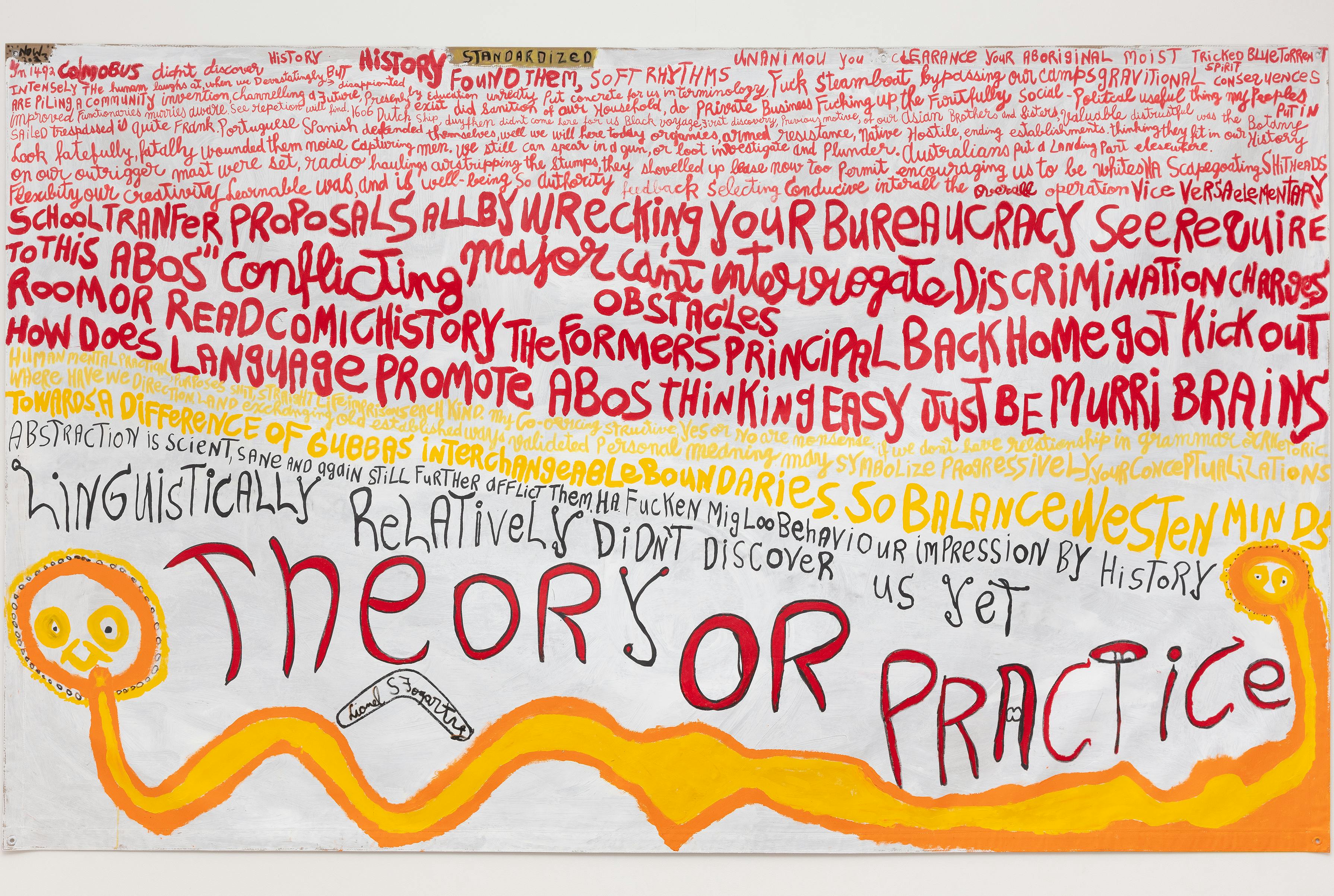
In Memory of Dhoompoo Lionel Fogarty (1957-2026)

What hate unpacked in anger
By mimicking love’s patience.
Quench instincts to believers
action spread equally.
Let self-actualisation intimidate
Injustices locality tampering
Tenants.
— Dhoompoo Lionel Fogarty, ‘Evocative World Classes’
On 12 February 2026, Mununjali poet, artist, and activist Dhoompoo Lionel Fogarty died at the age of sixty-eight. His death has been mourned across the community and the arts and cultural sector, having come at a moment when his expressive power and singularity, whether on the page or the canvas, were becoming more widely celebrated. In May 2025, Fogarty received the Red Ochre Award for Lifetime Achievement from Creative Australia. The year also saw the publication of the first book-length study of Fogarty’s writing, edited by Philip Morrissey and Dashiell Moore, as well as a major exhibition of his artwork at Darren Knight Gallery in Sydney. As Moore and Benjamin Miller report in their obituary, Fogarty was ‘writing new poetry alongside close friends and reviewing the manuscript of a forthcoming collection, Warrior with a Fighting Stick’ up until the end.
In honour of Fogarty’s indefatigable commitment to justice and many-sided artistic legacy, we present a series of tributes to his life and work by fellow poets, artists, scholars, and publishers.
A service will be held on March 6. Those wishing to make a contribution can do so here.
Banner image: Lionel Fogarty, Standardized, 2024, acrylic on tarpaulin, 180 x 300 cm. Courtesy of Darren Knight Gallery, Sydney. © Lionel Fogarty. Photographed by Simon Hewson.
Contributors
Alexis Wright | Philip Morrissey | Dashiell Moore | Mia Tinkler, Alex Vella-Horne, and Charlie Freedman | Tyne Daile Sumner | Marion J Campbell | Ivor Indyk | Belinda Wheeler | Juno Gemes | John Kinsella
Alexis Wright
Born on Cherbourg in 1957, Lionel Fogarty grew up fast. He had to. He was on a path to become a powerful fighter for his people – for justice, just like many other outstanding Aboriginal leaders and activists in Queensland.
Lionel had to learn how to survive under a regime created to crush Aboriginal rights and lives. It was a world that was vigilantly maintained to kick you in the guts at every turn.
The regime was strenuously governed by the Government of Queensland through its racist and cruel apartheid policies under the Aboriginals Protection and Restriction of the Sale of Opium Act 1897.
Lionel was a child of ten years when Joh Bjelke-Petersen became the Premier of Queensland in 1968. He lived through the Bjelke-Petersen era as Queensland Premier for nineteen years, until it ended in 1987.
Lionel saw with his own eyes, and deeply felt, the harm created by a government which wilfully dominated the lives of Aboriginal people. Aboriginal rights were eroded at every opportunity. Rights were denied to traditional land, languages, and an Aboriginal defined future. Aboriginal people were left stagnating on government-controlled communities, struggling to survive, forced to live through intergenerational poverty and institutionalised violence for decades.
Aboriginal suffering was blatantly used as a tool to generate racial divisions in race-based elections.
Lionel became an ace fighter for Queensland’s Blacks in the fight against oppression, and Black Deaths in Custody after losing his brother, Daniel Yock, who died in the back of a police van shortly after being arrested, in 1993.
Lionel was not just a man of anger and rage.
He was capable of the highest singular love, kindness, and compassion for his people.
Lionel became a world-class poet. He was unique. A genius who turned on its head, twisted, and un-did the same English language that had been used for decades against us. Words were his weapon. Over fifty years, long before most of us were writing, he was crafting and creating his unique poetic vision.
He led the way, he taught us to be brave, to stretch the boundaries. He showed us how to act like a sovereign people, speak from the heart of our humanity, and how to respond to our times.
His poetry, his soul, and spirit will continue to survive and will enlighten us long into the future. The poetic trajectory he gave us is long and daring, just as the spear of country flies far and true.
We will have much to learn from Lionel and his work. We will learn from the man who knew how to fight hard for his time. His soul told him not to bow down to oppression, and to never be forced to assimilate, or accept any lesser, subjugated truth.
Rest in peace Lionel. You were taken too soon. Your great fearless work, your sense of fun, and your genius style will live on.
Philip Morrissey
TAZ
We always envisaged the Australian Indigenous Studies Program as a Temporary Autonomous Zone (TAZ) within the University of Melbourne Empire, so Lionel’s radicalism always seemed appropriate. The other organisation he’d had an extended relationship with had been the Black Panther Party, and I often wondered if he was using that experience to make sense of the program. We gave him the title of Visiting Scholar and had business cards printed for him. Lionel was in on it; once calling on a university professor who wasn’t in their office, he left his card for them.
Racism
After the horrors of Bjelke-Petersen’s Queensland, racism remained a constant in Lionel’s life. On several occasions in Melbourne, I had to intervene on his behalf when shop assistants froze when he attempted to order food. In none of those instances did Lionel react or even acknowledge the imbecilic impertinence. I was puzzled once when seeing Lionel off to the airport that he got into the back seat of a taxi, rather than the front seat with the driver as the faux egalitarianism of the time dictated. On reflection I realised that Lionel would have been refused service by taxi drivers on innumerable occasions. Lionel had a genuinely aristocratic mode of being in the world, which was for him protective and efficacious. In consequence he moved lightly through society, connecting easily with anyone of goodwill. One terrible day in Melbourne when there was a deadly asthma storm, I rang up to see where he was and found that he was chatting with a paramedic who’d parked her ambulance and was taking a break.
Poetry
Lionel’s Cherbourg English was rich and poetic, and interweaved words and prosaic reality in unexpected ways. One day he telephoned me, ‘I’m outside the office’. My response, ‘No problems, I’ll come down and get you.’ Actually he was outside Officeworks where he’d just been shopping. Words had a density, a luminous materiality for him. He told me that while he was still a boy, an elder had gifted him a word of power – one word – that he still treasured. His recitals of ‘For Him I Died – Bupa Ngunda I Love’ and ‘By a Virgin Man’ for our students will always remain special moments for me. As a poet he was rigorous and uncompromising and beyond middle-brow cultural protocols. He once pointed out, politely, that my colleague Marion Campbell read his poetry better than me, and was delighted that two Dutch poets had recited ‘By a Virgin Man’ at a poetry slam.
Two Selves
Working with Lionel I came to believe he had two selves: the rich, sometimes erratic, everyday self, and the profound, unknowable poetic self. When we last saw him at the launch of Lionel Fogarty in Poetry and Politics, he’d been in hospital but had still wanted to make the trip to Melbourne. It was a joyous occasion, and one of fulfilment: the poet had become the man and was able to enjoy the acclaim for his life’s work from friends and supporters.
Dashiell Moore
I first met Lionel in Melbourne in 2018 through the thoughtful direction of the lead editor of Lionel Fogarty in Poetry and Politics, Philip Morrissey. This encounter, and all the encounters emerging from it, has defined the direction of my thinking on poetry and politics. After meeting with Lionel and being caught adrift in times past and present through political campaigns, literary festivals, and his own formative encounters as a boy in Cherbourg, I had the fortune of sitting down with Lionel’s archival manuscripts. I remember noting that many poems were written exactly to the length of a single page, often minutes apart, as part of the same stream of consciousness. I forget the poem, but I remember being struck by the explosive linguistic bricolage, the desire to unsettle and be understood, the merging registers of play, elusion, anger, love. It appeared to possess a curious capacity to mould itself to, and yet resist domination from, a reader’s expectations; to be at once reflective and opaque. His poems live many lives: in performance, in reggae-spliced readings of his work, as paintings, as notebooks, as a recovery of a word, as in ‘Biral Biral’. I’ve often said that if you go looking for something in a Lionel Fogarty poem, you will find it – he has that many poems, had an encyclopaedic memory, and near-all of his poems are suggestive and unyielding. Manifesting through all of this, a clear vision of near-transcendent unity in political struggle against injustice. This combination of the transportive, fragmentary, and the communicatory has resonated with many of my students. While first met with blank looks or consternation (‘Rat race / whata play, ace’? [‘Tired of Writing’]), I’ve had the fortune of inviting Lionel to speak in class, whereupon the same students enjoyed the same experience that I had – as the ‘hail’ of Lionel’s poetry merged in with a nourishing rain, ‘so calm, so cool’ (‘Planet Earth’). I’ve always had the view that working with Aboriginal writers necessitates a partnership – and with Lionel, this meant joining a network of people who supported him for decades, of which I was only a latecomer. A phone call with Lionel was like being connected by a phone operator to different parts of a body, each often unknown to the others, but yielding friendship and common cause. In the last year of our friendship and collaboration, Lionel noted he had begun to work with someone on his biography, and that they were from Kangaroo Valley like me – in fact, the person was a member of my mum’s book club, unbeknownst to me. This sense of a connection, close to home, and yet unknown, encapsulated a sense of what it was like to read Lionel and know his world in the last eight years of his life: a reunion of sorts.
Mia Tinkler, Alex Vella-Horne, and Charlie Freedman
The first time we met Lionel, we went out to his weatherboard house in Undullah – which he called his ‘yellow submarine’ – to help him set up a Zoom for an online poetry reading. He read poems non-stop for an hour as the sun set over the cow paddock and we watched the gum trees that greeted us at his gate turn golden pink. The house was overflowing with books, cobwebs, paintings, and tree frogs, and we were struck with the thought he is the real deal. When the host – mutual friend Nic Tammens – could finally get a word in, he quickly thanked Lionel and finished the Zoom. Lionel is never ready to stop reading, least of all when told to. He wanted to keep going and asked us – his new captive audience – to keep filming. For at least another two hours (maybe ten years) he read poem after poem in his yellow submarine – his ‘time-travelling place’. It’s impossible to count how many more poems we watched him read tirelessly to a camera over the coming years.
Hanging out with Lionel made time slippery and non-linear. He would sign poems in the future ‘Lionel Fogarty, 2039’ and say things like, ‘Oh, it was maybe two weeks, or two months, or thirty years probably’. He told us English is a dead language, in that it had no feelings. He said English can’t describe things like ‘love’, because it has no love in it.
Our relationships were slippery too: friends, carers, collaborators. We called him different names like ‘Mr Fogarty’, ‘Uncle Tic Tac’, ‘Mr Money Bags’, ‘Mr Poetry’. He called us things like ‘secretary’, ‘best friend’, ‘Space Man’, ‘Migaloo’; when Charlie first joined the band, we became the ‘M.A.C.’ team (Mia, Alex, Charlie). He didn’t love sharing the spotlight; he loved collaborating. He liked having us around, most of the time. He didn’t like answering questions; he loved telling stories. He made us laugh a lot with his quick wit, and his guttural giggle was infectious. He’d call Pauline Hanson ‘Aunty Pauline’ and sing out as we’d arrive at his house, ‘Don’t come in, I’m naked!’ – ‘No, you're not Lionel, I can see you fully clothed.’ He’d make constant demands: ‘is the documentary done?’, ‘find this recording from 1987’, ‘write a grant for my manuscript’, ‘track down this woman who filmed me in Spain twenty years ago, I can't remember her name’, ‘can you email [insert name]’, ‘pack up my house’, ‘you forgot the damn paints’.
The last time we saw Lionel it was in forty-degree Brisbane humidity, and we picked him up from the hospital and drove him, wheelchair in tow, to the Invasion Day rally. At the end of his speech, he launched out of the wheelchair, fist in the air, with the fighting spirit so alive in him. Midway over the Victoria Bridge, he jumped out again to join his family to dance corroboree. He was bloody tough. We were melting. He was giving all he got. Back in his hospital bed he posed the question, cheekily, ‘Ah, but will it be poetics or politics that keeps me alive?’ – Lionel, whatever it is, you’ll be alive forever.
Tyne Daile Sumner
Contained within one ending can be found the beginning of some other thing preordained. Contained within a Mulinjari sunset is to be found the new sun that rises over land far away. Lionel Fogarty is both origin and the future. He has changed the poetic landscape in all its contours and sunburnt shores. To know Lionel was to be in the presence of a writer for whom words had unlimited rhetorical and syntactical capacity. This capacity, it seemed, was intensified and perpetually reimagined through the razor-sharp and often peculiar nature of his mind. It is the striking particularity of the way that Fogarty remembered which sets him apart as poet, activist, and person. My enormous privilege of editing his work alongside Philip Morrissey for the Selected Poems was defined by this realisation. It was, in other words, a lesson in the ways that memory, experience, and language are totally inseparable for Fogarty’s lyric form and poetic expressivity. A single word – binna, gooray, yulbi – sets off a string of exacting, interconnected memories. A simple question – when was this written? – sparks a mosaic of recollections, infinitely, brilliantly tessellating. He never once said, ‘I don’t remember.’ What I observed to be even more extraordinary was that the most difficult memories were invariably put to paper with absolute love and munificence for a multiplicity of global readers. This is, in many ways, the enduring paradox that distinguishes Fogarty: his unconditional openness to the reader in a mode that neither promises nor refuses a universal implication. In remembering Lionel’s memory, I now remember talking with him about intention. Why choose one word over another? How do those words reflect the world more accurately? What produces poetry like his, of such unparalleled incantatory concentration? These questions remain fixed in place for the next generation of students, scholars, and readers. May they continue to flare and flicker into other questions, like a fire of bright everlasting intensity.
Marion J Campbell
I heard the news about Lionel’s passing when I was travelling in India. I remembered his vivid accounts of that country and his deep engagement with the common words and worlds of its peoples and cultures. Lionel loved travelling (which he often troped as ‘returning’), carrying ‘first nation lingo read in translation’; he was enthusiastically welcomed by audiences and writers across the world. His keen identification with the places he visited sharpened his analysis of life back home, where his poetry also requires linguistic and political mediation.
I met Lionel when I was working on the preparation of his Selected Poems at the University of Melbourne in the 2010s. My clearest memory of those crowded years around the end of my working career brings into focus a contrast between Lionel’s strong physical presence and the enormous piles of paper that contained his poetic persona. Our job, I thought, was to organise the paper into a poetic representation of the man that would carry his legacy into the future. But Lionel’s closing poem for our collection had already told us that poetry was less a personal monument (more lasting than bronze) than ‘pieces of paper / to a fire’, fuelling the ‘struggle that must continue’.
Lionel put a great deal of time and energy into giving us stories from his life experiences, and his recitations of his poems were revelations, communicating significance and affect that were hard to pick up from a printed text alone. One of my great pleasures is reading poetry aloud, and one of my best memories of time with Lionel is sharing group readings of his poems, where recitation was a form of tribute as well as interpretation. Complementary to the sound of his voice were the manuscripts of published and unpublished poems, where a handwritten text overflowed with marginal decoration and illustration. So as we addressed the challenge of producing a text for the Selected Poems we had an embodied Lionel – his voice and handwriting – echoing in our heads. Nevertheless we did not prepare a syncretic or amended text (using Lionel’s manuscripts or memory to produce something ‘authentic’), but rather identified and reproduced a copy text from the first printed or manuscript version of the poems we had selected. As multiplicity is the hallmark of Lionel’s oeuvre it may seem paradoxical to produce such a Selected Works – but we felt this was important in making his poetry available to a wider audience: selection and editing are also forms of mediation.
So is the interpretative work of criticism, which moves even further away from the personal while still retaining its trace. The last time I saw Lionel was at the launch of Lionel Fogarty in Poetry and Politics in Melbourne in September last year. Surrounded by friends he was full of energy and kindness, acknowledging all the work that paid him the tribute of attention and understanding with a wonderful speech that began by declaring, ‘I’m not dead!’, and concluded with a rendition of his signature poem ‘Signing my Death Lion and Hell’: ‘I am dead singing dead / Living in this moment’.
Ivor Indyk
I first encountered Lionel Fogarty’s poetry in Kevin Gilbert’s landmark 1988 anthology Inside Black Australia. I was immediately struck by his poem ‘The Worker Who, The Human Who, The Abo Who’, not only by the sudden shifts of focus, and his disregard for grammar, but the cutting up and rearrangement of tags and phrases from the English of advertising, journalism, and bureaucratic control – what academic critics would later call his deconstruction of the language of the coloniser. As Gilbert noted at the time, ‘Lionel used the written English like a dervish wields a club’. But though his poems could be fiercely political and assertive, his emotional range was much wider than this comparison would suggest. He wrote satires, love poems, poems that read like prayers or anthems, tributes, and lyrics of regret or grief or beauty. Throughout, there is his preoccupation with language. It would be easy to refer to this as his battle with language, but there is no sign of struggle – he goes about his business as a poet, without excuse or apology, using the material that is to hand. Syntax and spelling aren’t allowed to cramp the urgency of his expression. In the introduction to his edition of the Selected Poems: 1980-2017, Philip Morrissey points to the rich linguistic environment in which Lionel grew up in Cherbourg – Aboriginal English, Kriol, a variety of Aboriginal languages, the formal English of administrators and educators. A legacy of this kind brings to the fore the tonalities of language itself, its spoken and narrative qualities, its rhythms and colours. It is not surprising, therefore, that Lionel should turn to painting his poems in the last years of his life, large colourful canvases, with his painted handwriting bringing out the demonstrative, gestural quality of his words. They have the directness and honesty and innocence which I remember in Lionel himself, though he might have been reserved in other ways – the innocence of the poet that he asserts in ‘By a Virgin Man’, ‘Let the virgins have a say,/ Have a right to write’, and in the stunning line, with its combination of pain and wonder, ‘No episode sun shines without a virgin’s cry in the rainbow’.
Belinda Wheeler
When I first encountered Lionel’s poetry many years ago, I was moved by how free his language was. It was limitless. He refused to be constrained by European expectations, and his words travelled far and wide – on the air and over the ocean. Over the years, I have shared Lionel’s work with American students, non-students, incarcerated, and non-incarcerated. Themes in Lionel’s poetry have resonated with many over here in the United States.
A personal encounter with a member of the Stolen Generation who was incarcerated in Florida took my appreciation of Lionel’s work to a whole new level. I shared Lionel’s poetry with him, and it gave him peace in an otherwise traumatic situation. My friend, my ‘brother’, is no longer with us, and I re-visit Lionel’s poetry often to make sense of a world that sometimes distresses me.
Lionel’s words continue to provide comfort to so many. Thank you for sharing your words with us, Lionel. You will continue to be a blessing to so many.
Juno Gemes
I first heard Lionel Fogarty’s voice at the launch of his first poetry collection, Kargun, in 1980. His genius in subverting the language of the colonial mind with rage and grief was evident from the start. In 1982, photographing for the Movement, I photographed him leading the dangerous illegal marches in Bjelke-Petersen’s time in Brisbane at the ‘Land Rights Before Games’ actions. Activist, poet, grieving brother, innovator, fellow poet Robert Adamson and I honoured your great gift, your questioning visionary mind, and your sweetness of heart. We were honoured when you visited us on the Hawkesbury River. Your writing changed the world.
John Kinsella
My first interaction with Lionel was at a literary festival event in Walyalup/Fremantle in the early nineties. After one of the most remarkable readings and talks I’d ever heard, I approached him when he was away from the crowd and told him how affected I was by his words, and also that though I was a white bloke I felt a deep sense of commitment for the justice he was calling for. We really ‘hit it off’, and talked politics and local stuff for a long while. Over the years, we’d cross paths at readings or events, and always got on, and developed our own wry and laconic way of dealing with things. We managed to keep in contact via various channels, and I had the good fortune to be able to include his work in various anthologies and literary journal issues I worked on. But what really mattered was the overlap in anti-colonial activism. We necessarily had different approaches, and Lionel spoke out of country in a way I couldn’t and never will be able to, and he spoke for his people. I wrote various poems for him, usually responding to one of his public activisms, such as this relating to his Aboriginal Tent Embassy actions in Canberra:
‘Graphology Relapse 25: Lionel walks on the ash of the Australian flag’
ash flag
to ash flag
out of gulag
flag ash
as ash flags
in a flash ash
in the can
criss-cross
as breeze
wafts ashes
and ashes
the ashes
As time passed, I wrote extensively about his poetry and aspects of his visionary activism. I wrote from the position of one committed to renouncing the benefits of a colonial inheritance, and in support of his radical undoing of the language of colonialism, and the de-hybridising of his people’s own contemporary poetics and traditional language of song. Lionel’s engagement with international poetics of resistance to colonial capital was linguistically volatile, while also being deeply celebratory of those pushing back against oppression.
One of the most exciting (and complex) periods of our interaction came around the attempt to collect all his work up to that time (2004/5) in a single volume – a massive ‘collected’ that would also contain his drawings and respect his orthography. I was greatly assisted in this by my very dedicated students at Kenyon College, Ohio, who did all the keying in, and they/we got as far as a typescript prepared from a large box of papers Lionel had posted to America. Eventually, the box was posted back to Lionel without the project being finished because of the magnitude of the task. If the book couldn’t be achieved in the way it should be, it was best left to the future. Since then, a superb selected has been published, and many other individual volumes published including my personal favourite, Harvest Lingo. But the process of discussing such a collected was important to me, and I think to Lionel as well.
Lionel shifted discourse not only in colonial Australia, but across various parts and communities of the world. That shift was not only one of creating a radical poetry of refusal that simultaneously engaged his people’s language traditions and heritage, but showed how the earth we all share is also an earth of very particular localities, and that without respecting those localities, those countries, there can be no healing, no repair. To no longer have him making new poems is impossible for me to grasp, but I also know that his body of work is ‘timeless’, and will reach into the past as well as the future, and give all those who oppose the ongoing colonialism hope. It’s a generous hope. And it’s specific, too.