
the thick hunger and the shrouded depths of that hunger and the variegated history of that hunger and the chthonic force of that hunger and the recklessness and the willingness and the shamelessness, all mine, all undoing me, all bringing me to my knees.
Familiar Letters Betwixt a Lady and Two Gentlemen
Miriam Webster on desire, enchantment, and the epistolary mode
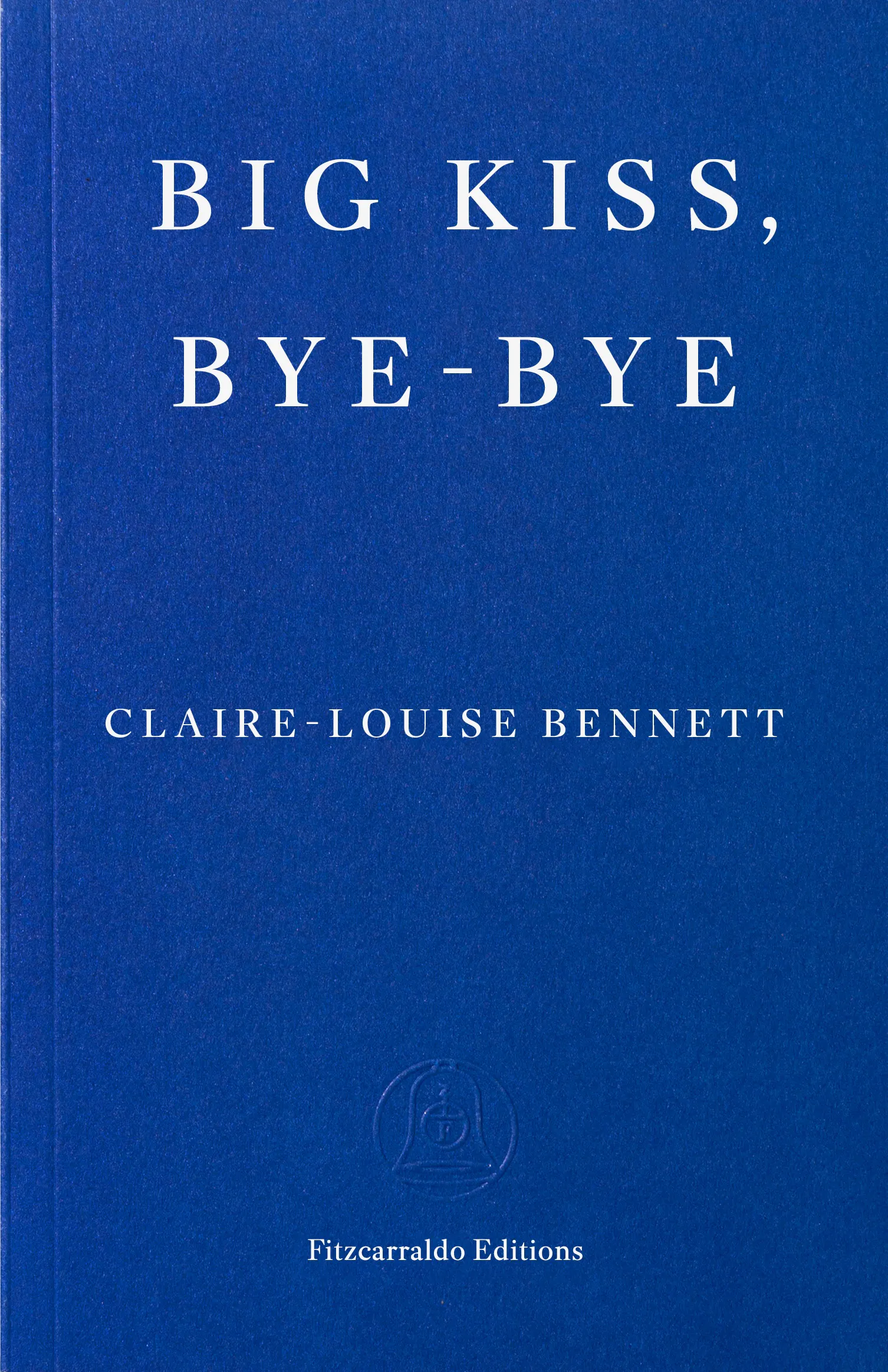
Setting Claire-Louise Bennett’s Big Kiss, Bye-Bye in dialogue with eighteenth-century epistolary fiction, Miriam Webster contemplates the empowering and erotic pleasures of language – of reaching for 'the glorious ready thing'.
In London on a rainy Sunday, just as it is getting dark. A ‘quick biblical shower out of the blue’ has left things static. Nothing moves. No, what am I saying – a man and a woman duck behind a column. All is grey and ‘silent as the grave’: ‘dismal, then, and slightly erotic’. The pair are being very matter of fact about it, looking ‘business-like, corporate really’ – if not for the fact of an erection straining at the zipper of his pants. The column is sizeable, ‘broad enough for [them] to disappear behind’. The syntax here is likewise erect: tense and angular, lines crossing and recrossing like the shadows thrown by the Corinthian architecture or the woman’s leg, cantilevered, ‘lifted up and out’.
This bristling, imaginative sex scene occurs about halfway through Claire-Louise Bennett’s third and latest novel Big Kiss, Bye-Bye. It begins with none of her usual ebullient, ranging verbosity but with a grammar standing to attention, the sentence tightly wound. ‘Everything is closed. Silent. Shut tight’. The description is coarse and images repeat bluntly, the columns and her ‘rotten bra’ and ‘the crotch of my knickers, black. The black crotch I take hold of either side and pull across’. Bennett is in control of her prose, and yet the knickers, pulled aside ‘with no preamble’, are also ‘soaked right through’. As in all of her fiction, desire saturates the landscape. When its presence is revealed – once Bennett has ‘shimmied out the full extent of it’ – the prose suddenly dilates. Details swarm and are revised. Did she grab the crotch of her wet knickers or did he do that? Will the narrator reach for the man now, ever, later? We are told she ‘can’t reach for him yet’. Everything is trembling madly, her ‘whole body biding’, the percussive sentences thrumming like an incantation. ‘Like listening then,’ she tells us. ‘Just like listening’.
Readers of Pond (2015) may recall an episode in which its narrator – possibly the same woman – finds it ‘something of a lapse indeed that I don’t possess the first idea of how to go about casting a spell’. This spell would be written in a language all her own and might be used to beguile her wayward imagination into corresponding with reality, or – and this might actually be preferable – to beguile reality into corresponding with her ‘fervid primary visions’. In lieu of casting such a spell, she writes in English, although she tells us it is not her native tongue, by which perhaps she means that it is not the language of her soul. The way this narrator describes her relationship to writing makes me think of enchantment in the postcritical sense, as Rita Felski has it – of ‘learning to surrender, to give oneself up, a yielding that is not abject or humiliating, but ecstatic and erotically charged’. Say what you like about Felski: this is postcritique at its most promising, suggesting that to be enchanted as a reader and/or writer is not to abnegate insight but to pay attention; to remain alive to the special kind of thinking only fiction can do.
Bennett herself has said in an interview that since childhood, ‘the act of writing felt intensely magical, sometimes frighteningly so: it was a way of transcending the everyday situation in order to commune with or at least remain open to the deeper energies of the universe’. The scene against the column in Big Kiss, Bye-Bye opens similar lines of communication, wherein yielding not just to ‘the situation’ but to its process of narration undoes the narrator’s resistances, awakening her to deeper forces. Although she remains clothed, her eyes are ‘naked… stripped and pelagic’, free to roam ‘beyond his erection and my arousal’. The ‘front of the eyes close’ so that the ‘back of the eyes open’ onto a place ‘further back and further back again’. Desire lives here, but also something like being: ‘he was all the bodies he’d ever been and that undid me I can’t tell you’. Now the narrator becomes cognisant of a rising hunger,
Eros limb-loosener whirls me. Bennett is deploying an age-old dialectic here between the ‘undoing’ promised and/or threatened by desire and the attendant opportunity, if only provisional, for reimagining oneself through writing. It is not a sex scene in the realist sense, but one in which the richness and immediacy of the style declares itself repeatedly, never not asserting its status as text. Instead of asking us to suspend our disbelief, the scene asks us to watch how it’s composed – how the writer frames the action, adds detail, edits and revises it, building to an almost unbearable climax. Perhaps this is why reading it is also disconcerting. We are never allowed to forget ourselves – it demands a certain vigilance.
Following Pond and her quixotic, polyvocal künstlerroman Checkout 19 (2021), Big Kiss, Bye-Bye refracts this question of enchantment through a prism of love, sex and letters. Set in Ireland shortly after the pandemic, it comes to us from a world where the need to maintain connection that defies estrangement is radically re-incentivised. Compounding this is the fact that the narrator is about to move from her apartment in the city to a woodshed somewhere so rural she will have to walk up a ‘very big hill’ just to get reception. She has also broken up with Xavier, an old man – recently consigned to a wheelchair – whom she used to love but no longer desires. For the past few years they have corresponded via phone and email, but following a lunch date on which she refused to kiss him, Xavier cuts off contact. In his last email, he also writes that reading her latest book was ‘some sort of HELL’. Believing she has nothing to say to this, the narrator does not reply, mobilising a chain of thwarted correspondence in which she ruminates obsessively over emails, texts and voicemails that remain largely unsent. Instead, she writes about them in her ‘journal’ – the one we are reading now. Perversely, her resistance to writing emails inspires a flood of writing in this book: ‘I haven’t written so much in aeons,’ she tells us, ‘yet I’m no closer to why I do it. Perhaps there is a story I am hoping to uncover and make mine.’
My first impression was that Bennett had written the Pamela for our times – an epistolary novel of desire which is really about writing. Novels of letters rely heavily on the presumed intimacy and candour of their narrator’s address, which makes them particularly generous sites for exploring questions of authenticity and desire as they relate to both public and private life. I have been waiting for such a novel, my wager being that besides all the texts and emails we send daily, epistolary fictions thrive in eras of political upheaval because they present ‘reading’ as a way of interpreting unreliable characters and texts. Reaching their peak during the mid-eighteenth century in England, America and France, epistolary fictions have been credited with cultivating sympathy and support for political revolution, with consolidating notions of an interiorised, gendered subject and with birthing the modern novel. They have also been linked to the emergence of a professional female writing class; as Dena Goodman argues, the craze for epistolary fiction filled a gap between literacy and publication, as more women capitalised on the daily practice of letter writing as an entry into writing novels. Much popular epistolary fiction written by women of the period, like Eliza Haywood’s Love in Excess (1719) and Mary Davys’ Familiar Letters Betwixt a Gentleman and a Lady (1725), turns around a seduction plot in which an innocent heroine is ruined by an aristocratic rake, thus enabling them to assert a moral lesson while covertly insisting on the pleasures of fiction and amorous exchange. Full of masquerade, performance and play, these novels habitually reveal that letters are just as disposed to artfulness and intrigue as they are to authentic presentations of the writer’s self. Readers, especially toward the end of the century, would have been aware of this. According to Samuel Johnson, ‘there is indeed no transaction which offers stronger temptations to fallacy and sophistication than epistolary intercourse.’
Happily for Bennett’s readers, fallacy, sophistication and intercourse are three of Big Kiss, Bye-Bye’s chief preoccupations. We wonder who exactly she is fucking on that rainy day in London. Is it Xavier, back when they were very much in touch? Is it another old man, her A-Level English teacher Terence Stone, who chances upon her books at the local library and promptly sends ‘a very nice letter’ to her publisher that is misdirected, scanned, rewritten and replaced before it finally arrives? Lurking in between the lines of both these failed and failing correspondences is another, shadier figure: the now-demented Robert Turner, a philosophy teacher and colleague of Stone’s with whom the narrator – then barely an adult – had had ‘dealings’. Turner is the true focus of her address, but an impossible one, having lost his ability to communicate, bereft of his relationship both to language and the past.
What is lost in our ‘dealings’ with others returns in the novel’s compromised missives. ‘I didn’t finish the email,’ she writes, or, ‘I wrote, and then I was stumped, had no idea what to say next’. But it is the past, rather than the ‘next’, that preoccupies the narrator, who cannot decide how what has happened ought to be narrated and contained. I am tempted to slot this neatly into Bennett’s oeuvre and suggest that it forms a natural triptych with the other two books; if Pond unfolds in a teeming, immediate present, and Checkout 19 fixes on a future where the young quixote will become the woman who is writing the novel at hand, then it makes sense for Big Kiss, Bye-Bye to be about looking back. This is done compulsively, the narrator ruminating on instances from her life with Xavier which often begin with stock romantic tropes (‘he made beautiful fires’; they used to lie in bed together late at night and talk; she still wears his cream cable-knit jumper; he sometimes entertained her with tales from his glamorous past; he was kind to her when she had her period) that only lead to disagreement later on (he refused to do the dishes; ‘they sit opposite one another and struggle to work anything out’; he cannot believe she no longer finds him attractive; she hates that he tried to write a memoir; he does not respect her work). In one virtuosic episode, the narrator transitions from writing a tormented email to Xavier that devolves into an imaginary fight, to possibly writing an email to Terence Stone that dilates into a hurtling field of green:
Where has the wonderful person I fell in love with gone! – It would be my pleasure not to see you ever again! – This is hopeless – Go to hell! – On and on. I did not finish the stupid email. It was stupid. I no longer needed to say anything high handed or deprecatory to Xavier. What for? It was all over now. Let him have the last word. Let him have the last word. ‘I pray you won’t regret this, love.’
Dear Terence Stone,
Green is life is poison is sickness is… health is vomit is absinthe is tarnish is labyrinth is melancholy is nature… is freshness is vitality is snot is lagoon is guilt is enchantment is mildew is vile is rampant is the colour of my ink, change, yes, instability, yes, life, life, yes, death, yes. Death. And the days, I write the days in green, and the things I need, the things I need – I write those in green too.
Again the rhythm here is incantatory, less an email than a spell, invoking a circuitous chronology in which death is life, and need is both sickness and enchantment. Bennett is fond of dialectical pairings such as these, which always lead back to the mutually constitutive relationship between wanting and writing. But can a novel of letters, where none of the letters actually get sent, truly be called epistolary?
Samuel Richardson’s novel Pamela; or Virtue Rewarded, which garnered immense popularity when it was published in 1740, tells the story of a fifteen-year-old servant who piously resists her boss’ attempts to seduce and rape her until she eventually succeeds in getting him to propose. At first, Mr. B contrives all manner of ways to possess her, including locking her in a garden shed and masquerading as his housekeeper in order to sleep in her bed, but Pamela usually escapes, or faints (which for some reason Mr. B considers a deterrent). He resorts to stealing and reading her letters, which produce a most remarkable effect: as he reads them, his desire is displaced from her body onto that of her text. In response, Pamela starts stashing her letters beneath her clothes, and the erotic crux of the novel occurs when Mr. B threatens to strip her in pursuit of them:
I have searched every place above, and in your closet, for them, and cannot find them; so I will know where they are. Now, said he, it is my opinion that they are about you; and I never undressed a girl in my life; but I will now begin to strip my pretty Pamela; and I hope I shall not go far before I find them.
As Nancy Armstrong famously argues, Richardson grants Pamela’s letters ‘the power to form desire’ as well as to reform the rakish Mr. B. ‘The more he tries to possess her, the more he subjects his behaviour to Pamela’s view’, thus affording her repeated opportunities to assert her subjectivity as well as convert him to her ‘mode of narration’. In reading her letters, he ceases to see her as his servant and possession, and begins to see her as a woman he could love.
I said that Big Kiss, Bye-Bye reminded me of Pamela, and that is because certain features struck me as oddly similar. The affair with an older, aristocratic man. The narrator’s psychic blind spots. The rich, material description of domestic life. The tension between a blocked or resisted writing, in the form of unsent letters, and a writing that exceeds, overflows and overcomes this blockage in the form of prolific journal entries. How we readers are given privileged access to the journals, and how this forges a particularly intimate relationship not just with the supposed content of their writers’ hearts and minds, but with the intricacies of their texts: we see how they are composed, how certain words are selected or omitted, how the text is edited and revised as the writer’s desires change or she learns more about herself. The effect is remarkable, shifting the amorous gaze away from bodies, sex and obstacles to love – the stuff of conventional romance plots – to refocus writing as the subject of fascination and delight. Richardson wrote conduct manuals before he got to Pamela, and despite what looks like transgressive content, the novel’s marriage plot turns out to be conventional and boring. What Pamela did for the English novel, however, and what remains exciting about reading it today, is that it introduces a female subject who becomes known to herself and others through her own writing. Big Kiss, Bye-Bye hinges on a similar conceit. Like Richardson’s, Bennett’s novel presents its narrator in a complex world of address that is at times surprising, often rarefied and frequently ‘some kind of HELL’. It registers the ambivalence of the writing life: how it may be as alienating as it is enlivening for a woman to make herself known through her text.
In Freud’s view, wherever there’s ambivalence there must also be desire, and vice versa, ambivalence being our way of recognising when something has become significant. Reading Bennett I am always struck by an abiding, deep ambivalence, which is the prevailing affect in her fiction as well as the feeling I get from engaging with her work. I cannot decide if I love it or hate it, if it infuriates and drags or pleases and excites me. I do know that it makes me want to do some writing of my own. This, I think, is what Bennett is getting at. Ambivalence, in her fictional world, is not just the swing between apathy and exhilaration epitomised in the unsettling rape fantasy of Pond’s ‘Morning, 1908’, or the precarious jobs and even sketchier boyfriends of Checkout 19, but the thing that sustains a compulsive practice of writing. In fact – or as Bennett’s narrator might say, if you want to know – the ‘not quite rightness’ of the writing is exactly what motivates it, forcing the narrator’s thinking and, we might extrapolate, Bennett’s own experimentation with prose in weird directions.
This ‘not quite’ finds full effect in Big Kiss, Bye-Bye, both in terms of the plotting (premised on the not quite right relationship between the narrator and Xavier, and the not quite sexual abuse perpetrated by Robert Turner) and in terms of the form, which is loopy and recursive, comprised of repeated events, impressions and scenes the narrator keeps revising. There is the time a hapless lover spills coffee on her Moroccan slippers. Scenes with Xavier in Mallorca. A run-in with Robert Turner in a graveyard; his shirt of pink and duck-egg blue. Some of these moments are banal and others momentous, although the narrator’s obsessive revising makes it hard to tell the difference. If she makes herself known through her writing, this self-knowledge is presented as fragmentary and fleeting, full of lacunae. But these gaps are important, these encounters with the ‘dark’. Like the kisses bookending the text, they carve out space for curiosity. I could try and mimic their ambivalent momentum. Here we are, almost, not quite but almost, almost yes, at the end almost, the darkness – yes, the beginning – yes, there in the dark yes there. The gaps are not lacks, but openings, places to fill with words. The last kiss, although it closes the novel, does not quite finish either. ‘I want it to go on and on,’ she chants. ‘I want to stay here’. The novel’s palindromic form can tell us something about relationships. It can also tell us something about fiction. Adam Phillips talks about endings that go on happening, revealing ‘just how haunted we are, in spite of ourselves, by other selves, by bits and pieces of others. It is impossible, though, to know when a relationship has ended. Or what it is for a relationship to end, rather than change’. Big Kiss, Bye-Bye is a novel of false starts and fuckups, of letters never written and endings that go on happening long after they have stopped. For Phillips, ‘the language of completion is unsuitable for what goes on between people’. It is also inadequate for describing the impression a good novel – an interesting novel – leaves once we have finished reading; its aliveness once we’re done.
There is an episode late in the novel when, out walking with her friend Maeve, the narrator is interrupted by a couple asking for directions to ‘the Loop’. The women don’t know how to get there, tell the couple so and keep on walking. But this small uncertainty, this little annoyance, is enough to throw them off course. Afterwards, their walk, as well as their conversation, takes an unexpected route. When I say that this novel is loopy, I mean that its style is surprising and sometimes annoying; that its form is knotty, doubling back on itself; that its narrative is irregular, and that because of its constant reassemblages of character, scene, impression, sense and plot, its coordinates are never fixed. Uncertainty, for Bennett, might be an ideal condition for writing. Remember that bit from the start? ‘I haven’t written so much in aeons, yet I’m no closer to why I do it. Perhaps there is a story I am hoping to uncover and make mine’. Bennett invites us to worry this question along with her, positioning her reader as playmate, lover, analyst, co-conspirator, foil, antagonist, friend. And she invites us to worry language, as in this revelatory passage where ‘you’ (meaning her, meaning we)
begin to discover that having certain words in your mouth can make you feel the most extraordinary and exhilarating sensations. These sensations are occasioned by little flares going off inside you, briefly illuminating that dark space, plethoric and phantasmal, that you don’t know much about but sometimes feel yourself sinking into.
That dark space is the novel’s true destination, as in that scene in London on a wet, dark Sunday. Back against the column, the narrator contemplates her old, discoloured bra and ‘court shoes that could be described as cheap and ill fitting. Sort of baggy round the instep could slip a finger in quite easily’. There is abjection lurking here: in her tacky attire and his and her shamelessness, in the bad weather and the asphalt everywhere, in the absent comma between instep and could that echoes the unsettling diction of Ann Quin. But the lacuna left by the missing comma is also an invitation. Her foot dangles, the court shoe gapes, our attention slips into the gap and it is here, in the dark, ‘pressing back and forth along the underside’ that we’re invited to begin.
What do I mean, begin? I mean begin to notice, begin to doubt, to start something, to wonder, to look, to beguile, to wander, to want. Critics always rave about Bennett’s originality, and while I tend to think originality is a redundant category, I believe that Bennett impresses people because of how she attends to language, which is one way of attending to desire. Big Kiss, Bye-Bye is a novel about the muddle one woman makes of wanting and the writing that comes out of that mess. It is also a novel about the pleasures of language and the enchantment of reading, which can take us beyond our usual circumstances as a way of coming back to ourselves. Together, we finally reach for ‘the glorious, ready thing’. The description fails – the sex itself resists narration – but the narrator’s inability to firmly take hold of it in language alerts her, and us, to something ‘beyond his erection and my arousal’. Here, Bennett vibrates at her most enchanting frequency. And it is here, finally, that we are invited to ‘go in, and go in deep’.
Yes, she tells us.
‘Go in, and get as much of me as you can’.