
I have always felt close to a Spiritual presence – I call that presence God. God and Bleeding Jesus and Mary with her flaming heart garlanded with flowers are important to me – I am fond of them… I have always felt close to God. I have a strong belief in what I do – I have always known I was meant to live the life that I do. It would have been wicked – evil – if I had tried to do otherwise, to escape my responsibility to my talents.
Ah, Sunflower!
Isabella Gullifer-Laurie on Barbara Hanrahan’s Sea Green
Last year saw the re-release of two novels by the iconic feminist artist and writer Barbara Hanrahan. Isabella Gullifer-Laurie reads Sea Green through the lens of Hanrahan’s life – her immense talent, sensuous spirituality, and burning ambition.
Barbara Hanrahan wore a tangerine teddy-bear coat when she left Australia in 1963. Twenty-three years old, she was on her way to London to study at the Royal College of Art. Born and raised in Adelaide, Hanrahan was a searching, ambitious young woman. Her exit was the fruit of years spent teaching in technical colleges and schools after excelling in her fine arts education. Paper streamers pulled at the ship departing the Melbourne berth, then broke. She was ploughing towards the world beyond, a future concerned with images and words.
Hanrahan became an artist and writer. She wrote fifteen books, many of them rich with autobiographical detail. The Scent of Eucalyptus, published in 1973, was her first. An account of childhood, it is fresh and lively with beginnings. ‘My mother hedged about my birth’, the narrator writes, ‘said she found me in a rose. And I believed her – saw myself pink and perfect as a rubber dolly, added some modest gauze, even a little crown.’ A lie, she finds out: ‘I was born like any other.’ Hanrahan’s subsequent autobiographical works – Sea Green (1974), Kewpie Doll (1984), Iris in Her Garden (1991), and Michael and Me and the Sun (1992) – dwelt, too, on scenes of infancy and youth, on childhood unfurling into adult years rife with decision-making, experience, consequence. Her other books hewed closely to the lives of people she lived alongside, biographical fictions. Others were almost Gothic, queer parables surreal and dreamlike, with evocative titles: The Albatross Muff, Where the Queens All Strayed, The Peach Groves.
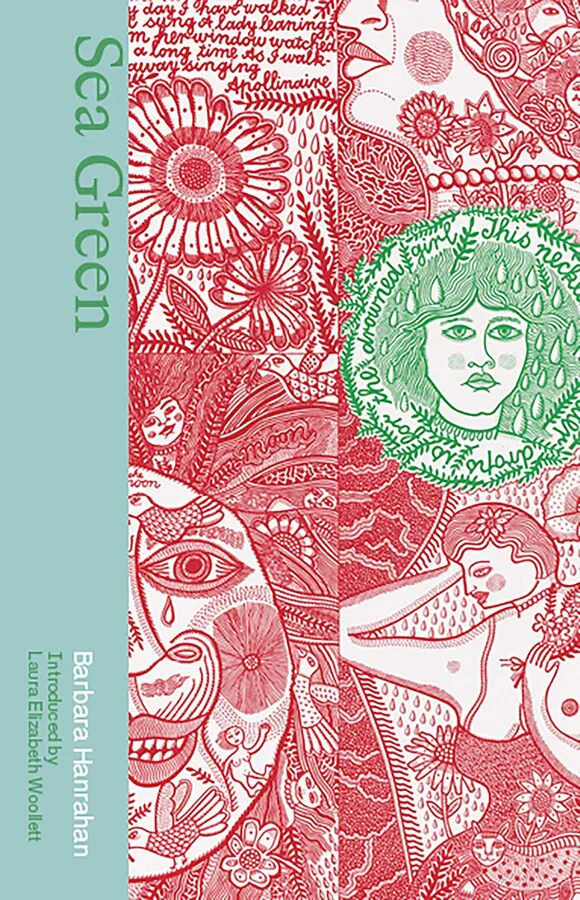
The colourful prints and artworks, for which Hanrahan is best known, are mesmerising in their elaborate, seductive surfaces. Like illuminated manuscripts, the prints contain detailed flourishes in miniature, recurring motifs and symbols, embellishment and illustration. Her works depict hearts of love, the grape-like eyes of God, curling vines, furred beasts, exploding florals. Children are exultant creatures, of peace, and also violence, some angelic, some unborn. Men and women are alternately delighting, pleasure-seeking figures, or passionless and ashamed. When she was a student, some of her classmates derided her work as ‘feminine decorative pretty stuff’, a bit too ‘arty-crafty’. Alison Carroll produced a short monograph on Hanrahan in 1986, drawing on their correspondence and conversation. She analysed Hanrahan’s visual language as ‘combin[ing] elements of folk art with the densely linear elegance of Victorian illustration to create an original naïve style’.
It was through the absorbing technical training she received at the South Australian School of Art that Hanrahan began to produce delicate drypoint etchings and sturdy woodblock prints of women in states of joy and sorrow. These early years of adulthood were a period of exploration. At the Royal South Australian Society of Arts she saw a print by the Uruguayan-American artist Antonio Frasconi; it was to be a formative image. The Storm Is Coming is a colour woodcut on paper, an image of either panicked escape or pagan glee at the prospect of rain. It shows a big-footed woman in flight, a newspaper held aloft in her arms like a whirling cape, her floral skirts a mess of action. Her body and clothes are angular, soft folds and curves gone serrated in the coming squall. In Hanrahan’s work, the women are similarly monumental, big-mouthed and heavy breasted, their ages spanning generations. Whether mere girls or mature women, these figures are represented as enchanted, light-hearted creatures amidst a backdrop of blooming flora. Another strand of her work shows women in states of stress, their physical bodies undergoing changes wrought by pregnancy, and also as the prey of hostile men, as vulnerably contorted by desire and destiny.
Hanrahan’s interest in literature and art came early. She made little books, one about a girl who loved grandfather clocks and patchwork quilts; another modelled on a medieval manuscript, strewn with real herbs. Under a berry bush she would sit and observe the moon and the stars, reading from the Old Testament, poring over Thomas Bewick’s volumes of engravings, and Songs of Innocence and of Experience. William Blake was an artistic and spiritual model for Hanrahan, who identified as Christian. In Blake’s unsettling imagination she found a real, sensuous connection to spirituality through art. In the Marriage of Heaven and Hell he likened the corrosive processes of intaglio printing to stripping the body away from the soul, ‘melting apparent surfaces away and displaying the infinite which was hid’. Her diary entries are filled with quotations from the psalms and references to her belief:
Communion with nature was a rich spiritual experience, while persistent labour and sacrifice were key to her ideas about making art, writing, and maintaining her faith. Throughout her life, she would illustrate Blake’s poems with her own prints, among them Ah Sunflower! and The Tyger. The former she reproduced more than once, tracing the lines – ‘Ah Sun-flower! weary of time / Who countest the steps of the Sun: / Seeking after that sweet golden clime, /Where the traveller’s journey is done.’ – in linocut, wood engraving, and screenprint. Blake’s poem is adorned with a tiny illustration of a human form emerging from petals and roots – imagery Hanrahan repeated in her own interpretations – and shares Hanrahan’s themes of spiritual lassitude and lost innocence, resonating with her own experiences of burning ambition and heavenly desire.
Once in London she moved schools in order to study at the Central School of Art with the engraver and sculptor Gertrude Hermes. A friend and contemporary of Henry Moore and Barbara Hepworth, Hermes produced works of liquid elegance, full of darkly shaded blossoms, animals, and body parts in hypnotic, swirling formations. It was the swinging sixties; Hanrahan came across the work of British Pop artists like David Hockney, Peter Blake, and Eduardo Paolozzi, and also the commercial work of fellow Australian Martin Sharp. She continued to admire the work of Robert Rauschenberg, Marc Chagall, Georges Rouault and, through her training, the woodcuts of the German Expressionists. And she read: D.H. Lawrence, Katherine Mansfield, and Virginia Woolf.
Hanrahan affirmed, in an interview in 1987, that ‘it was the printmaking that saved me from doing what all the other stereotypes did – getting engaged, then married in white’. In Sea Green, the narrator would opine, as Hanrahan herself did, the ‘terrible mediocrities of an outer Adelaide suburb. But underneath the polished veneer of habit something untoward smouldered; had to have an out.’ In 1960, before she left for London, she wrote in her diary: ‘there seems to be some beastly restless pushing thing inside of me that won’t let me be the same as the other people I know’. Something to do with not sticking out, behaving, being good! Her early protests against conformity can be found in her bold choices in outerwear: the orange shag, a red plastic raincoat worn in Adelaide’s Rundle Mall (to her grandmother’s unease).
Through both her written work and visual art, Hanrahan spread her fan widely. She covered a disparate trinity of themes: the family, her spirituality, and sex. Writing and printmaking competed for her time, and while her practices were richly interwoven, they required of her different things. ‘Printmaking is a much more sensual activity, like swimming almost, though still exhausting. You have to give it full attention. The passion is going in, shutting everything else out so that the pieces of paper and the images in your mind are there.’
In her second book Hanrahan recovers and transforms this period of her life. Sea Green was published half a century ago, and has been re-released (alongside Annie Magdalene) by the new Adelaide-based publisher Pink Shorts Press, who are intent on widening the reach and readership of South Australian writing. Something of a künstlerroman, Sea Green centres on a young woman named Virginia – both protagonist and narrator – setting out for London to further her arts education. Hanrahan’s biographer, Annette Stewart, writes plainly that ‘Virginia is based on Barbara’. The two share commonalities: Virginia is a recently graduated student headed for England, raised in the suburbs of Adelaide. Sexually naive and creatively talented, she is ready to see and explore the world for herself. ‘She was twenty and the lovely world of make-believe was ripped away. Twenty, and life seemed dull […] Where was the mystery now?’
Virginia’s choice of distinctive outerwear is a coat made of kangaroo. She emerges from youth touched by bohemianism, but remains a hardworking, shy girl in flat shoes and nylon stockings. Her parents are sidelined as failures with nominal aspirations. Their world is artless, suburban; their house full of arguments. Her mother ‘dried her eyes, embalmed her face with dabs of a swans-down puff; went out to buy a ceramic frog for the garden or a fake bouquet of lilac for astrakhan lapel or a china argosy galleon or something of similar ilk’. Her father is dismissed as ‘a sensitive plant that early withered’.
A dead room, a safe room: mock-leather that almost looks real, threepiece draped in tasteful chintz, china flamingoes teetering in a peagreen bower, the child Virginia safe for ever in dotted Swiss in a frame of scalloped gilt […] I never felt a prison wasn’t natural.
Like many young people, sequestered in her bedroom, Virginia is waiting for her life to start. ‘Abroad is a wonderful word.’ The offer to attend art school in London pulls her from the miry wasteland of adolescence. When she boards the ship with her friend Kate, she is pushed with force into the emotionally violent, sexual world of adults.
Sea Green is split into two halves, the first of which is set on the ship bound for London, the latter in London itself. Sailing on the ‘ruched satin sea’ for six weeks, the girls transform. The ship, a ‘coiled animal’, swallows them up, ‘without unseemly anguish or pain; indeed, they embraced it gladly, for once inside its capsuled bosom they were absolved from guilt, gave up their burden of identity as easily as their tickets’.
Kate takes the upper bunk. In their shared cabin the girls sprout like potatoes exposed to the light. The air is thick and heavy with perfume and shaving lotion, the bedsheets sweaty, soiled with errant hairs and smudges of lipstick. Virginia’s relationship to Kate has the hot afterglow of a queasy adolescent infatuation. She observes the way Kate shamelessly pulls on her underwear after sniffing ‘greedily at the crotch’ and ‘excuses herself as she stoops to slip cottonwool tampon under hoisted skirt’. ‘While I pretend to sleep in chaste blue cotton, [she] stands before the mirror, surveying with approval and a queer smile breasts and buttocks painted strangely pale on a terracotta body.’ They are joined by other women – Judith, Faye – their conversations circling around the seemingly inexhaustible subject of men.
Somehow, these young women read as girlish and naive. Newly freed from the bonds of education and family rules. They fretfully play-act as liberated, sexual adults, replacing the stuffy, conservative laws that have governed them in school. Passivity, goodness, and diligence are shed. They greedily devour chocolate gâteau on the ship instead of dinner. They drink. Clothes are important, and shoes. In fact, these girls are obsessed with clothes. They communicate in cuts and colours. Broderie, calico, flannelette, drill; zippers, hooks and fastenings. Clothes hint at their frame of mind: a dress thrown on slightly damp or rumpled, pleats stretched wonkily, buttons oddly done. Clothes can make up for a lack of beauty, but more importantly, they herald sex appeal. Anxious to please in a libidinal marketplace, they compete in hopeful emulation of one another. They dress too maturely, like little girls wearing their mothers’ heels and lipstick. Each wants to remain as shining and distinct, a gold button in the bottom of a bag.
Virginia tries her hand at this glorious, youthful fuss – thrusting limbs into stockings and slips, trying to be spritely and dazzling in the same way the other girls are. Next to them, Virginia seems nervy, tremulous. She fixates on Kate – and the other girls on the ship – with an intensity that weds their circumstance to her own psyche, as if she can gobble them up and metabolise their experience as her own. In her reticence, she is most alert to the parochialism that lingers in their affectations. She sits with them ‘before a crinkled cloth rayed with knives that cut so sharp, forks with cruel prongs, smug-faced spoons, coldly gleaming plates’. Of Virginia, they take little heed. She is merely a friend or rival, another badly dressed girl slumped at the dinner table, brushing cigarette ash from her lips. Unlike them, she lacks confidence. Thawing into adulthood, the lesson Virginia has learnt from her rigid adolescence is to feel shame.
Virginia wants to be an artist, and wants to fall in love. She wants the world, its magnitude. As a young woman in Adelaide she sat under a nectarine tree and imagined herself alone in the romantic style of a ‘Blessed Damozel, something Pre-Raphaelite, something from Beardsley’. She admits it would be hard work to ‘[b]e something goitrous from Rossetti in a heatwave’. Yet she cannot commit to a particular image of herself, and considers herself something waiting to germinate, like a seed or pip. (‘I will sink with the red apple of the sun – the waves will be our orchard.’) It is a reminder of her own smallness, the diminutive scale of a life reduced to suburban sunrooms, airless cabins, and shortly, a basement flat in London.
In London, the girls split: Kate and Judith to Italy, Faye to Earl’s Court. Virginia’s new life is dismal – a picture of grimy dustbins, uncollected mail and empty milk bottles. Living on a shoestring, she cooks for one. (‘Virginia had beefburgers for tea that night. She fried them in the pan beside an egg; covered them while she did the peas; ate them sitting on the bed reading a book.’) She walks the streets, and is reminded of the fixtures of Adelaide suburbia: ‘dead hyacinths drooped brownly in window-boxes; washing hung on zigzag lines; a forest of TV aerials flourished’. Reminders to obey remain: ‘PLEASE, WIPE YOUR SHOES PROPERLY BEFORE ENTERING THE HOUSE THANK YOU FOR RESPECTING CLEANLINESS.’ In the shared bathroom of her basement flat there were other notices (‘please turn out the light… please shut the door quietly… no baths, no visitors, no wirelesses, no telephone after eleven… thank you for respecting COURTESY’).
Sea Green’s prose has a feverish quality but remains a characteristically temperate novel, in thrall to the mellow ambiance of order and discretion. Virginia is most articulate when observing, watching, creating controlled, articulate matter out of the disparate particles of what she sees: ‘mists and rattling seed-pods, a carpet of ragged leaves, trees sparked with orange berries, creepers turning pink’. She goes about in a dreamlike state, withdrawn but deeply alive to the ordinary things which surprise her. Virginia has an artist’s eye – moody, sensitive, nostalgic. The teapot ‘left to languish under its pomponned purl-stitch dome’ stirs within her feelings of remorse and desolation; the churchyard graves she wanders over are ‘heaped with fresh brown clay, plastic palm leaves, rusty flowers tied with satin ribbons – violet, purple, mauve’, a nauseating tableau that signifies the hapless disorder of her romantic relationships. On every page Virginia is pinpricked, stamped and punctured by the sight of something. An apple-pip, an astrakhan coat, an acanthus leaf. She cherishes detail with the reverence of transformative prayer.
There is a domestic quality to all this, a ritualistic need to settle things in place to stave off irritation and sadness. Stuff takes on totemic significance, cosmic potential. To Virginia, there is something equal parts crushing and necessary about the labours of domesticity. Hanrahan herself was sensitive to the class stratifications of post-war Adelaide, a site of snobbery and division. ‘Ghastly ’50s Adelaide… the world that put you in your box.’ Yet mid-century domestic toil was also freighted with a kind of private creativity. Hanrahan’s women and girls, across her written work, are of humble beginnings, with creative ambitions that lead them along paths of resourcefulness and industry. In Annie Magdalene, the titular Annie makes a living as a machinist and dressmaker, beginning her career as a teenager stitching buttons and pressing seams in the Perfection shirt and pyjama factory. Hanrahan’s women are at once ordinary and exceptional. They scrub verandas, prepare tea and dinner, clothe children; acts of unusual magic and originality. From Annie Magdalene, the preparation of a dish is comical and sincere, spectacular:
sometimes she’d prepare some grapes for me and I’d eat them with her in the kitchen – she’d take the skin off every grape and split it open to remove the seeds, then put the halves together again and serve them up to me on a saucer.
Hanrahan grew up in the working-class suburb of Thebarton, near the railway yards. She lived in a household of women. Her father, who worked in a Holden bicycle workshop, died from tuberculosis when she was an infant. Her mother, Ronda, moved them in with Hanrahan’s maternal grandmother Iris, and her great-aunt Reece, who had Down syndrome. Their house on Rose Street was typical for the suburb, with no hot water and an outside lavatory. To Hanrahan their house was ‘strangely original’, the vantage point of childhood imbuing it with a mystical power. She loved its veranda, its wooden furniture, the roses and Mallee gums and tea-tree bush. Iris took Hanrahan bacon and egg sandwiches at lunchtime, raising her while Ronda worked in advertising at a department store. Iris gossiped with neighbours over the fence while Reece maintained the household. The Scent of Eucalyptus describes Reece at work: ‘She likes ironing. She unpegs the dry washing, collects it in the wicker basket; sprinkles a benediction over handkerchiefs, table-cloths, bloomers, petticoats, night-dresses – reduces them to the same tight sausage bundles’. In this scene, handkerchiefs are triangled, tablecloths quartered, and bloomers are ‘folded to sexless halves’.
In an interview with the ABC, Hanrahan recalled the significance of these women on her life and life’s work. Memories streak through her answers like cool rays of sun. Her mother, returning from work, smelling of Elizabeth Arden’s Blue Grass Eau de Parfum. Iris, bent over in the garden like a ‘big Earth-mother’. Her aunt, knitting away in a chair, sweeping under the table, boiling napkins. And she, baby Barbara, cast as the principal observer of this pretty, enclosed bubble of a world.
In a diary entry towards the end of her life, Hanrahan expressed a wish to return to ‘the secret child world again. What I was meant for. Never the terrible grind of the thinking mind. The awful rational thing.’ At the time, she was suffering from a cancer that would eventually prove fatal. ‘I want my women to be strong legendary beings,’ she said, ‘I have to create my own world – a world that’s a combination of the inner and the outer, the physical and the symbolic. A world that isn’t merely “today” but which is the past as well. To me the past is never dead.’ Hanrahan died in 1991 at the age of fifty-two.
Sea Green captures the way that adult life replaces the one of childhood. It’s a sticky transition, fraught with growing responsibility and discomfort. In many ways, it is a book about a young woman and a changing relationship with her body. Virginia is aglow with self-criticism and discomfort. Hanrahan pairs a third-person narration with Virginia’s first, the former circling the latter amorously, like the skin encasing a fruit. Virginia’s ‘I’ is baggy, slippery, prone to parentheticals and meandering, trailing ellipses. The ‘she’ is dissociated, a formal choice that sets Virginia against her past and present selves, one of more knowing and declarative intelligence. This third person imposes a narrative on Virginia with the summary gesture of a hand closing over a fist: resolution, might, strength. The singular ‘I’ collapses under this structure, just as Virginia yields to the dogged will of various women and men throughout the novel. Her great struggle is in resolving this disunity between how she sees herself and how others treat her.
At the crux of this problem is sex. Between the girls on the ship, sex is classified in competitive terms: the getting of it is an achievement itself, quality be damned. For Virginia, ‘sameness’ is a harbour of safety, and sex has the potential to fulfill her ambitions at normalcy, to be like the others. On the ship with Kate she pursues an Italian crewman, drawn to the ‘seductive pastiche of buttons and braid and epaulettes’, the ‘brilliantined cap’ and ‘starched collar and pointed toe’.
Sexually inexperienced, Virginia quests for something more than the fumbled groping she knows from her university days. These early trysts are brutal scenes of humiliation: collaged images of rough kisses, forceful fingers, cars parked along a barren strip of beach, limbs moved about like those of a puppet. In the sweaty, smoke-filled box of Vincenzo’s cabin, Virginia’s encounter is estranging and embarrassing. Their subsequent assignations are difficult: rough and unpleasurable fucking under the fluorescent light. Her fear has wings; premarital sex has an unsavoury moral valence in her eyes, she still believes in ‘Love and Romance and Marriage’. She submits to the act with half-baked feelings of desire, as if performing a necessary ritual of maturation. Her feelings are ambiguous and contradictory. Shedding her virginity, Virginia thinks herself grossly indebted, obedient and glad.
When she alights at Southampton, with one of Vincenzo’s gold buttons as a promise, Virginia still thinks of her life in dramatic terms, and wishes that her heart would break into a thousand shards. In London, she works away at her printmaking, spending long hours at the college studio. But the problems of art are peripheral to the problems of sex. Her affair with Vincenzo has loosened some deep, animal discontent in Virginia. Any optimism she had about her future, however uneasy or minor, has been dashed on the rocks of sexual and romantic failure.
She tries to remedy this disquiet by taking up with another man. Dannie is rich and pathetic, advice his favoured form of speech. She describes his body with distaste; it is ‘dully pink and white like a grubby fondant kept too long in someone’s pocket’. (In another of Hanrahan’s books a lover reminds the narrator of ‘condensed milk and the whites of cold fried eggs’.) In Dannie’s apartment he ‘lumber[s] about her bearishly, flicking her face with the towel. His pink fondant body was jigsawed with Meadowsong talc.’ Pleasuring him in the bath, ‘she clasp[s] the side so she [won’t] fall in. How boring it was. Her wrist began to ache; she thought: Is this a man?’ Her physical abhorrence winks with humour: ‘lying beside him under the electric blanket, and he was her dear little baby. He whimpered, his voice sunk to a lisp, he suckled at her breast. She sighed, looked at the ceiling, counted the days to her freedom.’ Virginia counts because she is pregnant and needs Dannie to organise her abortion.
Much of Hanrahan’s writing and art focuses on unpleasant sexual experiences and unwanted pregnancy. She thinks of sex in a plain, burnt way; satisfaction is tangled up with a sense of punishment and risk. In her diaries there is a prudishness in her writing about sex, a certain inhibition. Michael and Me and the Sun is based on her sexual encounters in London with a series of horrible men. The narrator, like Virginia, is naive, girlish. To her first sexual rendezvous she wears a pair of delicate pyjamas embellished by her grandmother with appliqué butterflies. When she hears a girl orgasming in the flat above, she is frustrated and perturbed: ‘the moaning got worse, and if it was supposed to be ecstasy I didn’t want anything to do with it’.
Hanrahan had an abortion in 1965, and several of her prints from this period depict mutilated babies, pregnant women, and the figure of a doctor washing his hands. One image, Waiting Room, is subtitled ‘A Picture of Cynical Sex and Violence, Kicks and Sudden Disillusion – A Story of Today. They aren’t Nice People.’ Hanrahan’s artworks depict some nasty scenes: death, injury, childbirth and abortion. Some of her figures – trapped in the bright, flat planes of a screen print – have rubbery limbs, their features prosthetic and exaggerated. These works are densely packed, like a Liberty print fabric, studded with demented eyes and greedy voracious mouths. Emblems of femininity are crammed into every available space, heaped like trash. These are coiling and creepish images. Ophelias, Virgins, Divine Mothers, but witchy and vampirish, their vaginal openings blossoming gashes, their skins leathery cicatrices. Babies sprout from clothing and orifices like demented weeds. She is intent on making us look, to watch on with a participatory awkwardness and complicity.
In Sea Green, Virginia, suffering from morning sickness, makes an etching of ‘a tight-clenched foetus flying over Kensington Gardens’. Cruel sex, bad sex, unwanted, despised, ripping apart her safe, suburban mindset, swaddled in traditional notions of marriage, masculine authority, wifely dependency. For Virginia’s discomfort is not just physical, it is also domestic: the young man coming home to guilt her about having left dirty dishes undone. He is acquitted of everything, the penalty is hers. She gets no reward. Her pregnancy puts her in an appalling dilemma. She is worried about her changing flesh, about money, pain, and God. She has terrible dreams of children quaking her body with wrecking power. She is penitent, the arrow of blame bending back towards herself. She wanted romance, dreams, love! Instead, real life swoops in with its rubber apron and anaesthetic syringe. ‘This was the only reality: lying on the table and those probing hands.’
Yet the termination of her pregnancy offers Virginia a way of reformulating herself and her circumstances, shaking her preconceived ideas and ideals: ‘Something in her she had never known was summoned into being, something hard and ruthless. All she cared about now was herself. No more was she afraid of being alone. Now she craved aloneness.’ The language here has a sprawling, distressed rhythm that surges and breaks like the swell of the sea. It’s either sink or swim. So she takes up her art with the devotional rhythms of solitary, meaningful work.
‘I go through the oddest struggle all the time in my head, in my body,’ Hanrahan wrote in her diary. ‘It is a struggle, I think, to curb my mind – to make my mind and body accept this life. To be ME – so that the world may not be this fearful torment. To accept ME, and my spiritual purpose. To defeat fear and loneliness.’ Beginning on the water, Sea Green orients itself towards the wake and wash of aftermath. Virginia’s getting of experience is imperfect, painful. She must build a life despite its wreckage, and develop the muscle to sustain its blows. The armour of experience is quiet stoicism, the pulling of a protective sheet over one’s exposed, vulnerable self. The divided self bends forward to the future and back to the past, giving shape to artistic commitments, and the commitment to live one’s life. Virginia lies on a great grey beach in Cornwall, content and worried, dreaming of Adelaide.