
[S]oon it is no longer clear to him whether in truth he is painting his original dream, or dreaming a painting, which, thus entering dream, now directs the painting he does upon waking.
At the Cusp
Luke Beesley on David Brooks, early and late
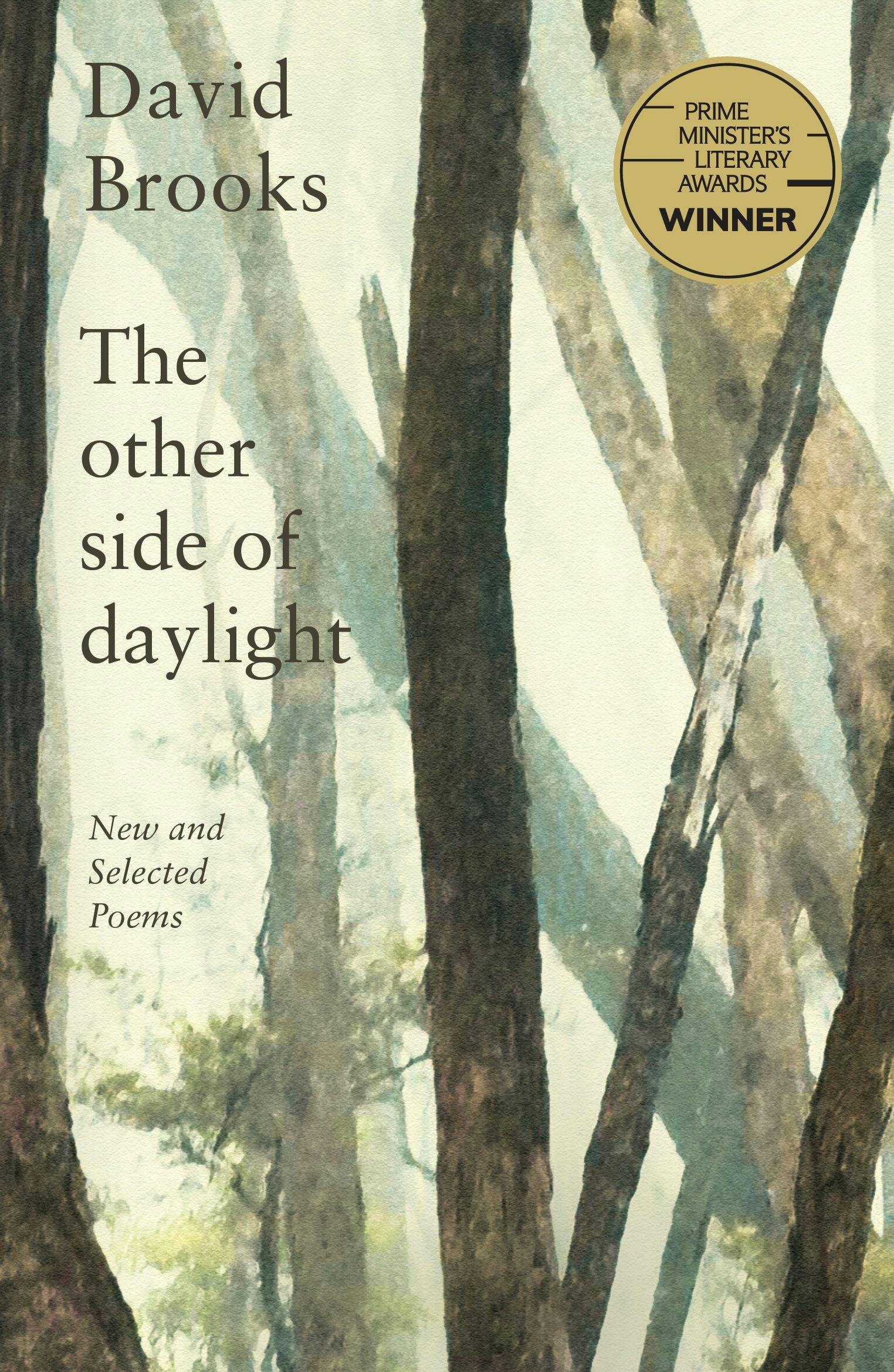
An encounter with David Brooks’ fiction proved pivotal for Luke Beesley as a student in the nineties. Reviewing Brooks’ new and selected poems decades later, Beesley samples a corpus as conversant in avant-garde poetics as it is in animal rights.
The mid-to-late 1990s was a cathartic time for me. I’d only recently found literature and abstract painting and art-rock, and was suddenly taking art history classes at the University of Queensland. The brilliant Rex Butler was waving his hands in the humid Brisbane air, eyes closed, explaining postmodern painting via endless diversions to Borges, among others. I was in a heightened philosophical hold – tight until it cleared to four walls and light in a room – that you can sometimes experience in the communal effort to understand.
Enter David Brooks’ early collection, Black Sea (1997), in which I found a very short story about a character infinitesimally turning into straw, while in another story, lovers twisted and writhed in an effort to reach what Brooks mysteriously described as ‘the mooncalf’, an affect also conjured by Cezanne’s apples or the Rothko Room at the Tate. To discover a Sydney-based Borges was to find oneself in the sort of intellectually piquant weather trough floating, ungraspable but oddly familiar, in Butler’s lectures.
Brooks’ early short stories are parenthetic – his sentences contain pockets and side-tracks, via commas, em dashes, and brackets; one of his stories, ‘Alexandria’, has a 125-word diversion accentuating sexual tension in an English author’s long-winded novel (a story within a story that is abandoned by the frustrated lovers who appear quietly to escape the actual text for ‘the sky beyond the page-edge’). All this was fascinating for my naked brain. The stories philosophically sidestep, with questions, pauses, and hesitations. A signature of this style can be found in the opening to an enigmatic story called ‘Gauguin’s Dream’: ‘Gauguin has a dream of Gauguin dreaming.’ Excitingly, we slip, one level again, from the dream Gauguin dreams to ‘the even deeper dream’, an ambiguous place that casts a shadow in which the shallower dream resides. In Brooks’ story ‘Elk’, about waking in the middle of the night, nowhere, on a night train, he writes: ‘There is an inside to this inside. And inside that there is a further in.’ The stories of Black Sea contain painterly, ephemeral, erotic encounters and meta-written structures that I found utterly unique in my acquaintance with Australian literature.
The opening act of ‘Gauguin’s Dream’ turns out to be a shimmery introductory metaphor. Gauguin, next day, begins to work on a painting of the dreams, but night after night, the painting he is making is sieved by more dreaming.
The rest of the story slips into a philosophical, essayistic mode, diverting to questions about what we derive from art and art making, and the impossibility of capturing our original intent: ‘the thing upon which we work can never be the thing in our mind’. He returns to the dream layers and their fragile borders to introduce the ‘paradox of the present moment’. Unlike Borges, who approached these impossibilities with an elliptical dryness, Brooks leans into aestheticism and sensuality – a sudden pathway through fog, rather than a labyrinth twist.
My curiosity was piqued to discover Brooks had published a poetry collection called The Cold Front, way back in 1983. ‘The Gap’, from that collection, included here in The Other Side of Daylight, is a good example of Brooks’ early poetics – in its overt and disciplined spareness; quiet haunting images flutter in the white space of the page, giving weight to the poem’s abstractions. (It’s important to understand this early style because Brooks will later depart from it.) Here’s the poem in its entirety:
On the pond path by Campbell’s
amidst the wheel-ruts and the fallen leaves
a gap nothing fills
it gets late
birds
cross in the half-light
lugging their haul towards Tumut
Bimberi
Kosciusko
the great lake of silence beneath them
flight after flight after flight
The poem begins conventionally, but you abseil suddenly into that page-space where the ominously rich ‘it gets late’ floats. Brooks retains, through his oeuvre, a cusp – of day, of wakefulness – and here the clue is ‘half-light’, conjuring an opening to the writer’s imagination out of this pitch-black ‘lake’ of endless nothing below.
As a twenty-something new to writing poetry back then, I read this poem and read it again, searching out its affect. Because there was an affect, I realised, but I was still learning to articulate it linguistically. I would turn the book in my hands and read on the back cover about Brooks’ use of the deep image and go back to the poem to try to parse those images and peer deeply into them. I wanted to learn exactly how Brooks, with few words – with just one naked word as a line, often – managed to make the reader hear the heaving wings of the unnamed birds and how they, frighteningly, seemed to signify an infinite absence. I watched the poem work – naming and dropping into doubling – and saw, of course, the ‘gap’ either side of ‘it gets late’, which nothing filled. I noted the throaty, weighty diction of ‘lugging’, seeming to deepen the silence, as does the unusual, heavy word ‘haul’. The silence or lake symbolised ink, and how, ‘late’ and ‘in the half-light’, creativity is signalled. This meta-writing, conscious artmaking at the cusp, is a trait Brooks carries with him through his career; though, in the new poems, the writing clarifies and animals acquire names and move to the foreground.
Along with this cusp, Brooks also makes a lot of a sense of intermission, which is represented by Robin Wallace-Crabbe’s wave illustration on the cover of, and throughout, Black Sea, and by the curled serif symbol between sections-within-chapters of the novel The House of Balthus (1995). They frame the page’s texture and its meta-written characteristics, signifying his early-career preoccupations: the oblivion gap and the low rumble of duration.
After The Cold Front, Brooks wouldn’t publish a collection of poetry again until 2005’s Walking to Point Clear: Poems 1983 to 2002. Perhaps the success of his short fiction – he wrote several of these innovative and highly regarded collections along with Black Sea, in the 1980s and 1990s – slowed his output. The poetry then came in a rush, with Urban Elegies (2007) and The Balcony (2008), and later Open House (2015).
Brooks has written four novels, too: in addition to the enigmatic The House of Balthus, a novel-length version of his painterly, unstable, dream-infused fiction, there’s the less foggy but just as mazy The Fern Tattoo (2007), shortlisted for the Miles Franklin, along with the slightly more conventional The Umbrella Club (2009) and The Conversation (2012). Brooks also wrote an utterly convincing and original recast of the Ern Malley affair called The Sons of Clovis (2011). He speculates about a French mirror hoax – a book by someone called Adoré Floupette mocking Symbolist poets that might be connected to Malley via the painting ‘The Sons of Clovis’ in the Art Gallery of NSW. As with his meta-fiction, this book managed to present the affair as containing something of a deeper myth, another inside to the in.
Since he wound down his academic commitments at Sydney University in 2013 and moved to the Blue Mountains, Brooks’ recent poetry and prose (his preferred recent form is the essay) have increasingly focused on animal advocacy. He’s written a sensitive book-length memoir-like piece about his time with animals called The Grass Library (2018) and a collection of essays Animal Dreams (2021).
Brooks’ new poems at the beginning of The Other Side of Daylight: New and Selected are brought together under the title, ‘The Peanut Vendor 2016 to 2023’. Why peanuts? He dispenses them to his beloved sheep.
The poetry appears unfussy and conversational. These are the opening lines of the opening poem ‘Wild Duck Sutra’:
Eight wild wood ducks
greet me at the gate,
follow me down to the feed-room, wait
while I get them a handful of seed
before taking hay to the sheep
who descend upon it as if it were the last
lucerne in the country
Compared to Brooks’ early writing, there is a more intimate clarity here. At first the unsubtle rhyme of ‘gate’ and ‘wait’ made me nervous, along with the antiquated ‘upon’, but I slowed to the pace of the poem, the pace of that lippy whistly wild-wood-duck opening, and by the time I reached the last line of the poem I’d become fascinated by the sounds and timing, as if the casualness, and the piece’s simplicity, were a knowing ruse.
There’s something about a poem’s music – it can be so pleasing and effective if it eludes you, sidesteps familiarity, as the music of this opening stanza does. Compare the wispy clipped ‘Eight wild wood ducks’ to the almost unseeing four-peat of the ‘ee’ (‘greet’, ‘feed’, ‘seed’, ‘sheep’), its music leading into a satisfying luxuriation in the long adjacent ‘ooh’ and ‘ur’ sounds of ‘lucerne’ (before you surmise that ‘lucerne’ is some complex long-dead noun only poets use – it’s just hay: food for the sheep). There’s texture created via syllabic distribution, too – the poem carefully sets down, like a swaying leaf, at the disyllabic stems of ‘lucerne in the country’. There is a subtle opening-out – harmonious easy language – as the country or a paddock might.
On the topic of seed, I read just yesterday this gorgeous metaphor for the feeling of heading abroad, from Rachel Cusk’s travel memoir Last Supper:
I feel as if we are being held in the last moment of compression, like seeds held tightly in a hand before being scattered[.]
That’s a different way to write well. Both Brooks’ restrained style and clarity and Cusk’s metaphoric flourish dazzle. I find myself comparing these approaches because I’m aware of my personal tendency towards, say, New York School-inspired witticism, hijinks, and surrealism – the flourish. But when confronted with Brooks’ simplicity, and when coaxed, over the years and by the architecture of the poems themselves, to slow to his gentle poetics – coming through directness, parallel to the animal – I find it exhilarating, especially given the more avant-garde fictional spaces Brooks has emerged from.
Here’s another stanza, from a new poem called ‘Bower Bird’, infused with that transparent, dexterous, late-career mellifluousness, and restrained flourish:
Someone has been eating the peaches
with Mukimono finesse – not
the white cockatoos, who most likely
would have taken one bite and left the rest to rot, or,
balancing deftly on one leg, turned the plucked fruit
carefully in the other claw
until they’d finished the lot, but a bird
with a taste for miniature, diadem.
Two moments here: the witty and pleasure-to-ski ‘Mukimono finesse’, and then the pause-and-fold music of ‘miniature, diadem’. The reader decelerates at the comma before entering ‘diadem’ with its three-syllable inward-fold wobble. These two-word moments fuse the stanza. There is a casual tone, but the poem sparkles at these diadem bends, the stanza’s glinting edges. Brooks observes carefully to set the image, so we can then surface to the architecture and music of language.
As if to ruminate on the theme of clarity itself, the ‘Wild Duck Sutra’ continues with:
… all
things are full of meaning, so
they say, you just
have to wait for it;
what they don’t say
is how much you have to clear away
before the simplest things become evident
as this, for example,
dripping from the tank lip
Tankwater-clarity but also what a sound: tank lip. This seems a symbol for that interstitial moment – that cusp – as the poem moves into a commentary of its own making on the page. This meta-writing exists with the more immediate reference to the deictic ‘this’, though, as we see later in the poem, the ‘this’ also denotes the idea of humans and animals living in a shared ‘refuge’. There’s a connection being made here, in the first of the new poems, between art and Brooks’ day-to-day ethical considerations. The poem here manages to contain the imaginative daring of his early career while coalescing with a new and careful and direct personal truth. The best new Brooks poems tend to have an inky wet subtext, where we observe him creating what might be called an honest metaphor – unhooked from artifice or performance – but dazzling in its simplicity. The metaphor can then play the double roles of truth and beauty precisely.
While inhabiting Brooks’ casual, domestic settings, his unhurried, simple scene building, you’ll suddenly notice that ‘diadem’ bend, or a lyrical ‘dove-white bowl of the moon’ (‘Tablelands’) or a ‘daffodil bright’ (‘Stolen Lemons’). There is great patience here to modulate excess. The lemony poem serves the memory of the poet Martin Harrison. It ends:
When I look at my lemon tree now, so
bare in the half-light
without their glowing there,
it’s hard not to think that an almost-friend
hasn’t also been stolen somehow.
I thought hard about why Brooks chose to tell the reader what the lemon-tree metaphor was about, or why it works to tell it; why present an image-as-metaphor and, although it’s obvious, explain it? It’s treacherous, but it’s that line: ‘without their glowing there’. Within a half-thought in the ‘half-light’ of the ‘almost-friend’ – three cusps, in the context of epiphany – there is a ripple, a skipping record needle, quick revision, delicate. For a brief flash, the last flicker of the day, ‘their’ is both a set of lemons and the presence of a friend, until it’s suddenly merely ‘there’, the lacuna of the glow on the grass. It’s stunning the strange transformation, something that feels unique to language, to poetry. We have the metaphor and then the metaphor transformed, language flickering amidst reminiscence – death of the ‘almost-friend’ (not the old friend or a hackneyed emptiness, but something more unusual).
As with ‘Stolen Lemons’, Brooks’ poem titles, particularly the new poems, are direct. A poem called ‘On a Photograph of Sheep Killed by Bushfire’ is a description of just that. The poem ‘Overcast’ begins ‘Overcast, a weak / front passing through’. This tends to work better for stand-alone poems encountered in journals rather than poem after poem in an entire collection, but it’s as if, when needing to talk straight about destruction and cruelty, embellishment isn’t an option – the charred sheep have their eyes open.
I can see, now, checking back on The Cold Front, features present in Brooks’ recent poetry: that noted surfacing to meta-writing (‘troops’, suddenly, ‘breaking through syllables’), a sensitivity to landscape, compost, lemons, birds, an interest in the sensual, but there’s a detail-obscuring mist. Compared to his recent poems’ determined desire to chisel towards truthfulness, many of the early poems, like the early fiction, are like lullabies that have lost their particulars as they’ve been passed down. In these recent poems, the focus is more local and personal and political. You can certainly read the title of Brooks’ long-awaited second poetry book, Walking to Point Clear, as a gesture towards eschewing opaqueness: a path out of mythology, philosophical abstraction, into clarity, directness.
In The Other Side of Daylight, there are new poems against neo capitalism (a bottle of wine sells for nearly a million while governments in northern Africa can’t fund digging people out of earthquakes), quiet elegies, and poems of complex intimacy (‘Late Love Poem’ complements several love poems from Brooks’ 2005 collection, The Balcony), but the dignity of animals, on the cusp of creativity, is central. ‘Leaping Towards Boston’ describes families of kangaroos tearing through Australian bush, slaughtered and skinned, it seems, on the way ‘towards the frames, the lasts, the stitchers’ bobs’ of sports-shoe manufacturers. It’s a poem for those who might baulk not only at blurry violence against the iconic kangaroo, but the ubiquitous movement of animals for profit, as if it were a race, or carnival of blood.
There are a few new poems of a simple formal fittedness, which afford a private image of care; sitting alongside more prickly poems, they contribute to an overall sensitivity toward animal life but don’t go too far beyond that. This exposes just how delicate Brooks’ poetics can be. ‘Spider Night’ is one of these clear but less layered poems:
Morning warm and dry for once
and spider webs everywhere,
hanging from the branches of trees
slung across the feed-room door
covering the paddock gate.
Makes you wonder if there might be
such a thing as spider night, moon
low and bright to the west
plenty of small winged creatures about
slant of the light
almost perfect
breeze just right.
Is there a metaphor there? It’s carefully expressed, and the shorter lines sweep us out of the poem nicely, but the music of ‘night’ and ‘light’ and ‘just right’ falls too suggestively. Though, at this point, I imagine Brooks saying fuck it, leave this little song for the spiders in.
There’s another new poem, ‘Gang-Gang’, that’s just as hymn-like, but a little more subtextual – it’s got a stunning image in it, as if made by a painter’s brush. It begins with a local fellow checking the septic tanks of the neighbourhood and ends with the sight of a gang-gang cockatoo ‘clambering’ in the foliage of a ‘peppermint’ ‘bright orange head / diving over and over / into the depth of it / coming up blazing’. The deliberate abbreviation of the common Blue Mountains eucalypt to ‘peppermint’, pure pale green colour, taste musky, encourages us to see a painterly orange and taste citrus in it, all this sensation ‘blazing’.
In ‘Afternoon of the Fauns’ we witness the poem itself slipping through the author’s fingers, out of reach – ‘passed through, gone / almost soon as I noticed it’. In place of this vanished poem, we have description of the moment of realisation: ‘Mid-afternoon, white / cockatoos / ripping fruit from the peach tree’ – not the poem but its slipstream, or in other words the deeper dream. So, there is a link to the story ‘Gauguin Dreaming’, but the excess – the showmanship, if you like – has been stripped like fruit ripped from the tree. Brooks eventually makes his way to the poem’s uncanny denouement where two ‘orphaned fauns’ wake him from sleep in a painter friend’s spare room. It’s one of several poems on the theme of a poem’s fleeing and faltering in The Other Side of Daylight, such as ‘So Little’ from Walking to Point Clear which contains ‘images / still fleeing the grasp’. And utilising that parenthetic obfuscation of his earlier stories, ‘Afternoon of the Fauns’ has an ambiguous moment where it seems the passing-through poem, the poet’s flight of attention, might double as a cockatoo inspecting a garbage collection up the street or distracted by lorikeets.
This ambiguity is no accident. In ‘An Invasion of Clouds’, you realise Brooks is referring to four stinky, inquisitive sheep, not puffy cumuli pressing through his studio door. So, the animals are emblems of a style and linked to the creative cusp – they are, you could say, a flare-light to locate the late-poetics’ artistry. Often the poem has already started by the time Brooks has decided he is documenting or recording something, and often an animal registers the shift – a dog-bark or a swooping bird. This from the poem ‘Requiem’:
I heard, for half an hour, an unfamiliar bird-call,
and tried to record the shape of it
in my notebook in the bedroom dark.
When you read ‘I don’t know where they come from / those fluttering wrens at nightfall’ (‘Wrens at Nightfall’), we see where the natural world and creativity touches. At other times, he poetically makes a point of interrupting the act of creation to acknowledge the animals ‘breathing the same air’ and then continues with his language-music.
But sometimes the music is all-consuming. In the new poem ‘Wild Weather’, Brooks and his sheep are drunk on Shostakovich. In nine lines, he describes the previous few days of rain and dust storms before the second stanza casually notes Brooks’ beloved sheep at the foot of the veranda. The third stanza is as follows:
It’s all
part of a vast symphony, I’d tell them if
I could, by Shostakovich most likely: mighty
batterings, great crescendos, skeins and
fugal progressions, small
wisps of melody or sudden
silences,
some of them haunting.
The whole aesthetic of this stanza is caught in the sound Shostakovich – a revery and revelation in diction, and Brooks’ letting go, for a moment, of the burden of concern, about cruelty, in the company of his animals.