
Society as a notion doesn’t exist in Russia. No one believes that there are things in the world that depend on them. On the contrary, everyone thinks that nothing depends on them.
– Maria Alyokhina, Riot Days
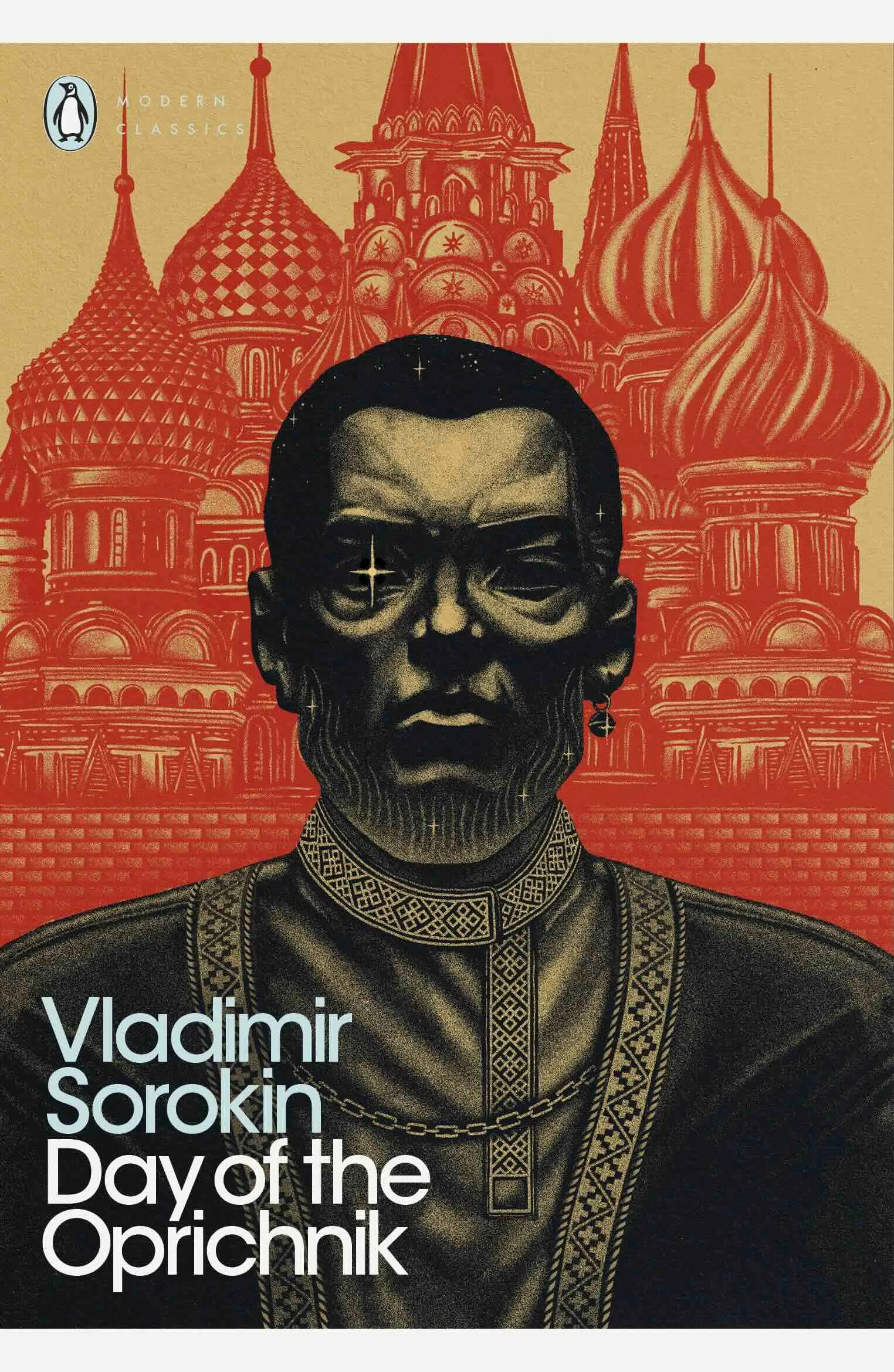
James Ley on Vladimir Sorokin
James Ley surveys the career and work of Russian avant-garde satirist, Vladimir Sorokin. With a Sadean virtuosity of violence and cruelty, Sorokin’s novels expose the complicity of Russian literature in upholding ideas of national exceptionalism.
Society as a notion doesn’t exist in Russia. No one believes that there are things in the world that depend on them. On the contrary, everyone thinks that nothing depends on them.
– Maria Alyokhina, Riot Days
Three days after the Russian invasion of Ukraine in February 2022, Vladimir Sorokin published an essay in which he noted that power in Russia has long had the form of a pyramid with an autocratic ruler at its apex. The creator of this enduring structure was Ivan the Terrible, who in the sixteenth century established the foundations of the modern Russian state on the firm principle that power must be ‘strong, cruel, unpredictable and incomprehensible to the people. The people should have no choice but to obey and worship it.’
Sorokin’s target was Vladimir Putin. The essay denounced Putin as ‘a man corrupted by absolute power’, an unappeasable threat to world peace, and a vicious despot who gloried in ‘corruption, lies and trampling on human freedoms’. His devious character was attributed to the dismal Soviet regime that nurtured him. As a KGB functionary, Putin absorbed the organisation’s culture of secrecy, duplicity, paranoia, and ruthlessness, along with its undying hatred of the West. But on a deeper level he represented the atavistic political principle, built into the archaic machinery of the Russian state, that condemned its people to the sinister vicissitudes of authoritarian rule.
‘The principle of Russian power hasn’t even remotely changed in the last five centuries,’ observed Sorokin. ‘I consider this to be our country’s main tragedy.’
Sorokin was born near Moscow in 1955, two years after the death of Stalin. This makes him a close contemporary of Putin, who was born in 1952. While Putin was slithering to the top of the pyramid, Sorokin was immersing himself in the artistic underground and cultivating a singular literary vision, the origins of which can be traced to his involvement with an avant-garde movement, active in the 1970s and 1980s, known as conceptualism.
The conceptualists responded to the stultifying atmosphere of the post-Stalin era by creating art with an emphasis on detachment and objectification rather than personal expression. Their guiding principle, in the words of Sally Laird, was that ‘the writer or artist had no language of his own’. The artist was thus compelled to work within an imposed system of meaning from which he was estranged, making creative use of received signs. In conceptualist art, writes Laird, ‘the language and symbols of Soviet culture became aesthetic objects, deprived of their original meaning. At an extreme, words ceased to function as such, but were transformed into elements of meaningless sound or arbitrary components of graphic design.’
‘Conceptualism gave me a great weapon,’ Sorokin would later claim: ‘a distance between myself and the text. It allowed me to look at the text as a thing.’
As is often the case with such movements, the conceptualists regarded their unconventional art as a repudiation of the prevailing culture, while affecting to be above mere politics. In the Moscow underground, Sorokin recalled, ‘it was common to be apolitical. This was one of our favourite anecdotes: as the German troops marched into Paris, Picasso sat there and drew an apple. That was our attitude – you must draw your apple, no matter what happens around you.’
‘I held fast to that principle until I was fifty,’ he added. ‘Now the citizen in me has come to life.’
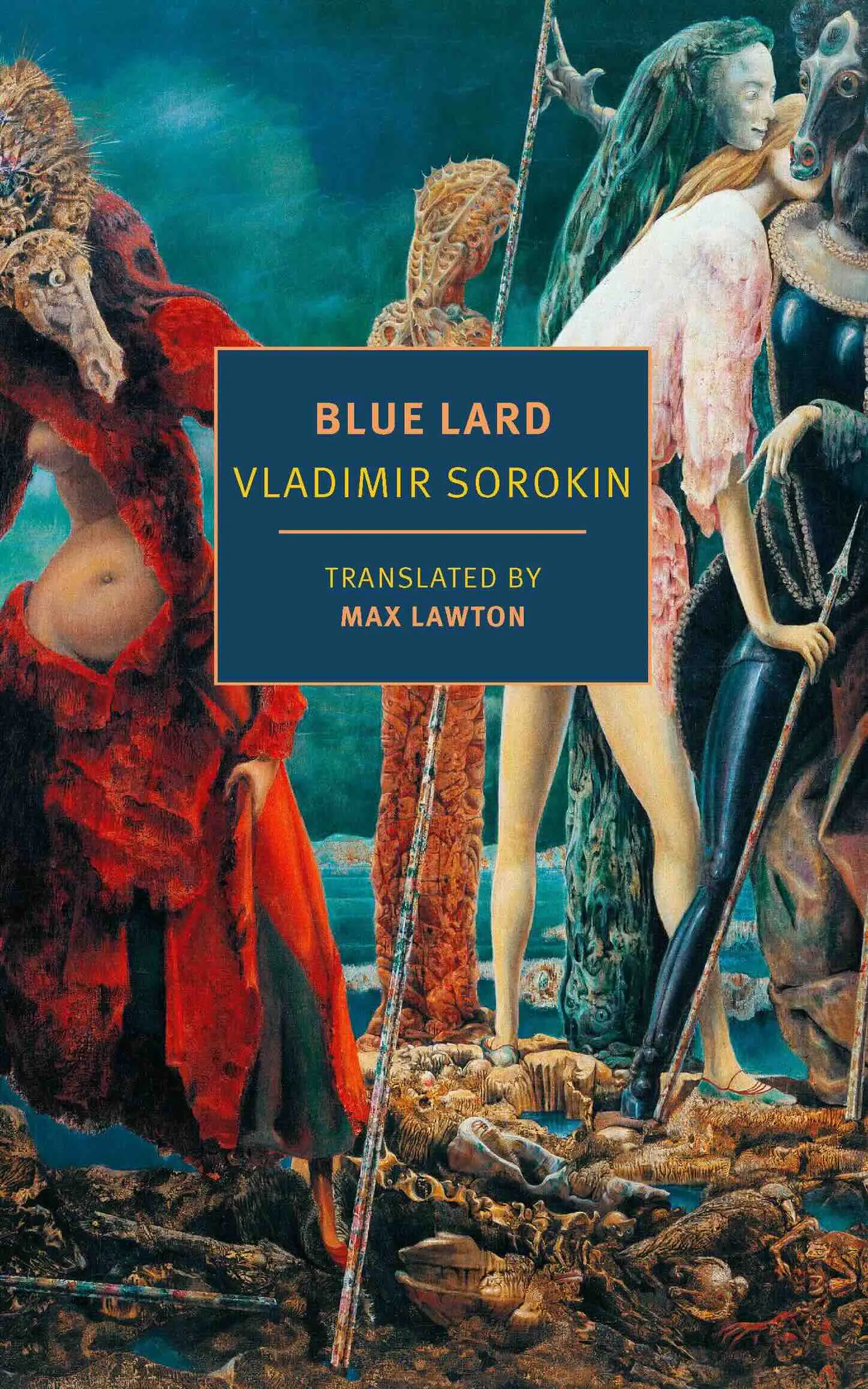
The satirical quality of Sorokin’s fiction has been evident from his earliest stories, a good selection of which can be found in Dispatches from the District Committee. His work is steeped in the grim political realities of Russia’s modern history, overt in its mockery of nationalist myths. Its strangeness has been interpreted as a reaction against the mandated socialist realism of the Soviet era and an attack on the venerated tradition of Russian literature more broadly. Laird observes of Sorokin’s early stories that they present us with a ‘schizophrenic world in which the stock characters of Soviet literature – solid officials, eager young men, wry old codgers who have seen a thing or two – turn out on inspection to be monsters and perverts, and where everyday Soviet language – the language of apparent sense and morality – is seen as no more meaningful than the raving of lunatics’. Sorokin has said that Blue Lard – perhaps his most notorious work, though not necessarily his most gruesome or outlandish (there are several claimants to those titles) – is about the ‘destruction of literature’.
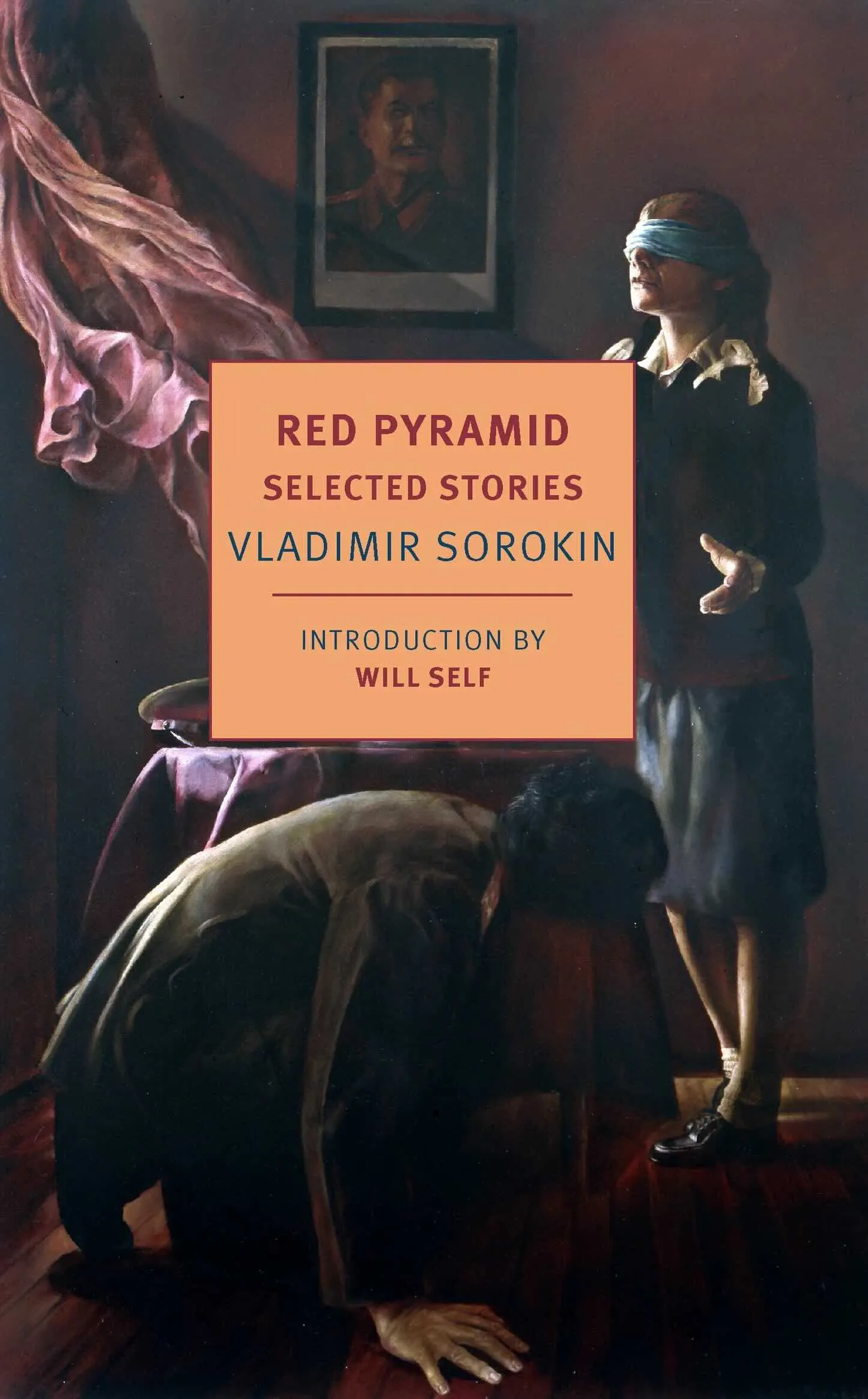
There is a formal dimension to this satirical assault. Sorokin is by all accounts a gifted mimic. His talent for scrambling genres and imitating the styles of other writers has been brilliantly captured in Max Lawton’s translation of the polyphonic Blue Lard, which includes wicked parodies of Dostoevsky, Tolstoy, Akhmatova, and Nabokov, among others. Sorokin’s fiction often positions itself as a response to another writer’s work. The title of his staggering story ‘A Month in Dachau’ – collected in the Lawton-translated volume Red Pyramid – is a sly echo of Turgenev’s A Month in the Country. The premise of Day of the Oprichnik, which imagines a future Russia that has reverted to monarchism and shut itself off from the rest of the world, has been recognised as a reworking of Behind the Thistle, an obscure untranslated novel from 1922 by the exiled counterrevolutionary and Nazi collaborator Pyotr Krasnov. The Blizzard is a Gogolian romp that shares its title with a Tolstoy novella. Sorokin has said in an interview that Roman, an early novel that is yet to be translated into English (Lawton is reportedly working on it), was an attempt to appropriate the naturalism of provincial fiction, its narrative unfolding ‘in the space of the Russian novel’.
There is hardly an abomination that does not appear in Sorokin’s fiction. It is replete with scenes of torture, rape, murder, cannibalism, pederasty, and coprophagia. The swerve into extremes of violence and depravity is something of a signature move. Roman – the title is the Russian word for novel and the name of its protagonist – culminates in a wedding scene where Roman murders his bride and all the guests with an axe. ‘Nastya’, another extraordinary story collected in Red Pyramid, begins in a mood of romantic innocence with a girl waking on the morning of her sixteenth birthday, flushed with happiness and anticipation. We soon learn that her eminently respectable family intends to mark the occasion by chaining her to an enormous shovel and roasting her in an oven.
The satirical purpose of such horrors can seem quite legible. In the short story ‘Obelisk’, for example – a parody of a patriotic tale of the same name by Vasil Bykov – a widow and her daughter visit a memorial for the widow’s husband, a fallen war hero. As they weep and lament, they begin to give thanks for all the disgusting abuse and degradation he inflicted upon them, their recitation taking on a catechistic quality that makes the tableau seem ever more bizarre and disturbing. As in ‘Nastya’, which features a banquet scene where family and friends engage in polite philosophical discussion as they savour the choicest morsels from the freshly roasted teenager furnishing their table, the introduction of extreme aberrance into an otherwise conventional scene is a way of desecrating a sentimental narrative.
A similarly satirical purpose might be discerned in the literalism and corporeality that numerous critics have identified as features of Sorokin’s work. In Their Four Hearts, a grisly action-adventure story about a de facto family of four stereotypical Russian characters on a mission (the purpose of which never becomes clear), there is a scene where the group liquidates their leader’s mother – which is to say, they strangle her, drain her corpse of blood, mince her flesh, and for the rest of the novel carry around a container of ‘liquid mother’. Mark Lipovestsky has pointed out that a particularly hideous scene later in Their Four Hearts is a literal depiction of a Russian idiom for bullshit: ebat’ mozgi – ‘to fuck the brains’. Another early novel, The Norm, which has been partially translated into English by Keith Gessen, is set in a world where people consume processed human excrement.
Being fucked and eating shit: familiar metaphors for common experiences, simple enough to translate easily across cultures. The restoration of their literal meanings would seem to be a straightforward technique to make the obscenity of power relations explicit.
The literalism might bring to mind Samuel Johnson’s complaint about Gulliver’s Travels that once you have grasped the concept of big people and little people the rest is easy. But in defence of Swift and Sorokin (whose novels also make use of comical distortions of scale), a certain conceptual bluntness is often no more and no less than an obscene reality demands. And there is, in fact, a great deal that remains obscure and ambiguous about Sorokin’s work. In an afterword – or rather an ‘extroduction’, as he styles it – Lawton describes Blue Lard as a novel ‘built around incomprehension’. He reports that Sorokin himself claims to be uncertain about its meaning. The imitations of Dostoevsky, Tolstoy, Akhmatova et al. – attributed not to the famous authors themselves, but to comically malformed clones – are not meant to be parodic, as such. According to Sorokin, they are ‘more like essence hunts’. Lawton cautions that searching for coherence risks missing the point – or more precisely, the absence of a clear point. He claims ‘you don’t need to understand’ Blue Lard, because its ‘quiddity’ is its ‘own reward’. The novel ‘isn’t here to be read so much as borne witness to’.
The hapless critic who makes the mistake of reading Blue Lard (twice) is thus placed in an awkward position. Obligated as he is to salvage at least a few scraps of understanding, if only to preserve a modicum of self-respect, he would appear to have little choice but to embrace misunderstanding. And it is not as if Blue Lard can escape meaning entirely. A novel about the ‘destruction of literature’ is also, inevitably, a contribution to literature. In a work of fiction, details have implications whether you want them to or not. ‘An allusion in everything’, a character remarks near the beginning of the novel, having noted that some nearby hills resemble buttocks.
The significance of Sorokin’s conceptual two-step as a response to the distorting pressures of autocracy starts to become apparent in this deliberate ambivalence. ‘I have always been fascinated by the interdependence of cruelty and humiliation,’ he has said. ‘Generally speaking, the ability of one person to humiliate or abuse another is such a horrific phenomenon that it not only provokes me emotionally, but also stimulates my writing.’ He has suggested on more than one occasion that the theme of his work is violence. More specifically, he claims to be concerned with a ‘fateful question: what is violence and why can’t people break away from it?’
So we do have at least one clearly stated theme, and a moral one at that. And yet, on a conceptual level, the satirist-as-moralist also claims the boundless creative freedom of the text-as-thing, which grants him the protection of a certain discretionary deniability. In 2002, a pro-Putin group staged a protest in Moscow, during which it denounced Sorokin as a pornographer and, in a somewhat ambiguous symbolic gesture for such a scatological writer, threw ripped-up copies of Blue Lard into a giant papier-mâché toilet. Sorokin has offered a measured response to such objections: ‘When people talk to me about morality in literature […] I just don’t understand it […] These are just letters on paper.’
A brief summary of Blue Lard is a slightly tricky necessity at this point to give a sense of Sorokin’s aesthetic. The novel is not necessarily typical or representative of his eclectic fiction, but it is rightly regarded as a major work, and it does incorporate many recurring ideas, techniques, and symbols. So let us bear witness.
The first third of Blue Lard is set many decades in the future in a remote Russian research station, where scientists are busy cloning famous writers. This opening section is epistolary. A scientist named Boris composes a series of letters in which he recounts various goings-on at the station and the progress of the experiments, occasionally including samples of the amusingly wonky and intermittently profane writing produced by the clones, who are themselves amusingly wonky. Tolstoy has a bulbous head, unusually thick eyelashes, and enormous hands. Nabokov looks more or less normal, but displays ‘monstrous aggression’ and insists on writing in his own blood. Pasternak, for some reason, has the body of a lemur.
The letters are written in a futuristic Russian that incorporates Chinese words, a smattering of German, invented slang, and a pseudo-technical lexicon that burlesques science fiction. The frequently used term ‘rips’ has, for reasons explained in an endnote, entered the language as an all-purpose swear word, often paired with the Chinese phrase ‘ni ma de’, which translates roughly as ‘your mother’. This invented argot, as virtuosic as it is disorienting, would seem to owe some kind of literary debt to Anthony Burgess, who created the menacing language of A Clockwork Orange by importing Russian words into English – a debt Sorokin appears to have acknowledged indirectly (via Stanley Kubrick’s film version) in a later story ‘White Square’, which features a notable cameo by Alex and his droogs.
The purpose of the scientists’ project is not to harvest the clones’ writing, but the blue lard their bodies produce when they write. This strange substance has been found to have the property of a superinsulator. No matter what you do to it, its temperature remains constant: it is always ‘exactly as warm as the blood of a man’. The blue lard is intended for use in the construction of an enormous power station on the moon in the shape of a pyramid, but at the conclusion of the project, militants storm the research station, massacre the scientists, and steal the lard. The militants turn out to be aligned with an ultra-nationalist sect known as ‘earth fuckers’, whose members have massive genitals with which they literally fuck the earth as an expression of mystical love for their Russian motherland. One of the earth fuckers is eventually seconded to be frozen inside a large cone of ice with a suitcase full of lard and sent back in time to 1954.
At this point, we are about halfway through the novel. From there, things only get weirder. In this alternative version of 1954, Stalin is still alive. So is Hitler. Germany and Russia won the Second World War when they destroyed London with an atomic bomb; the United States is said to be responsible for the Holocaust. When the frozen earth fucker materialises in the Bolshoi theatre in the middle of a performance, Stalin’s nervous subordinates debate the implications of this bizarre occurrence. Stalin, who is exasperated at the disgraceful misbehaviour of his cross-dressing sons and periodically revives himself with injections of unspecified stimulants beneath his tongue, eventually wearies of his mealy-mouthed advisors and leaves to seek the counsel of Khrushchev.
On the way, he meets a filthy, foul-mouthed crone wandering the Moscow streets, who turns out to be a heavily pregnant Anna Akhmatova. She dutifully licks his boots. When Stalin departs, Akhmatova encounters a deranged Osip Mandelstam, freshly released from prison, who raves for a while, expectorates hugely, then hails a taxi. Akhmatova scrapes up Mandelstam’s spit, returns home, and invites her substantial brood of urchins to partake in the ‘communion of the sublime loogie’. She then goes into labour, gives birth, and dies, her final act being to anoint an urchin – named, like Stalin, Iosif – a future ‘great poet’.
Meanwhile, Stalin has found Khrushchev relaxing at home after his usual fashion by torturing an actor to death in his basement. When Khrushchev’s victim finally expires, the two Soviet leaders enjoy a fondue made with the dead man’s flesh, then engage in mutually satisfactory coitus, with Stalin assuming the submissive position. A Russian delegation subsequently flies to Germany to consult with Hitler, who is overcome with lust for Stalin’s daughter in the middle of the official dinner and brutally rapes her, with Stalin’s knowledge and approval, in an adjoining room. When some double-dealing over the blue lard erupts in violence, Stalin seizes a syringe full of liquified lard and injects it straight through his eyeball into his brain, which expands until it crushes the earth.
This rough outline elides a great deal, but it does suggest something of the profane quality of Sorokin’s imagination. He is adept at combining horror and disgust with grotesquerie, irreverence and a genuine sense of the ridiculous. His virtuosity and eclecticism, which have their playful and even whimsical sides, are deployed in the service of a blackly comical vision: insinuating symbolism and pointed ridicule suggest the depravity and absurdity of a world distorted by power, while the narrative’s baggy contingency and preposterous conceits, which tilt the novel’s travestying of history towards pure farce, have a destabilising effect that makes it difficult to know how seriously to take anything.
Intrinsic to Sorokin’s preoccupation with cruelty, humiliation, and violence is an explicitly Russian conception of authority and submission. His characters are always conscious of their positions within the pyramid of power. They know their place in the queue, even when they are not entirely sure why they are queueing. Cruelty and humiliation are recognised as assertions of hierarchy, so abuses are expected and tolerated, even accepted. The many and varied atrocities that occur throughout Sorokin’s work are disquieting not simply because they are scrupulously depicted, but because they are normalised within their fictional settings, often in ways that are ritualised or institutionalised. Sorokin is certainly not a psychological writer in the established Dostoevskian mode, but he is alert to the dark insight of Dostoevsky’s observation that people can get used to anything.
In this way, Sorokin presents Russia as a nation corrupted by its peculiar brand of exceptionalism. The philosopher Nikolai Berdyaev, whom Sorokin has cited in interviews and alludes to in his fiction, wrote about the ‘Russian idea’ – a term he took from the nineteenth-century theologian Vladimir Solovyov to encapsulate a deeply ingrained belief in the nation’s divine mission. Promulgated by no lesser figures than Pushkin and Dostoevsky, the Russian idea is said to be embodied in the uniquely paradoxical character of the Russian people, summed up by Berdyaev in an unhelpful list of ‘mutually contradictory properties’. Russians allegedly possess innate gifts for cruelty and kindness, humility and arrogance, despotism and anarchism, superstition and truth seeking, atheism and religious devotion, individualism and collectivism, nationalism and universalism. Most significantly, they are credited with an instinctive spirituality that infuses their sense of national destiny with a potent strain of messianism. Berdyaev maintains that Russians are ‘a people of the End’. They are ‘apocalyptics or nihilists’ with an ‘inclination towards totalitarian doctrines and a totalitarian way of looking at life’.
The violence and absurdism of Sorokin’s fiction carry this absolutist principle as philosophical baggage – which is to say, his work does not simply lampoon patriotism and vicious authoritarianism, but recognises these phenomena as manifestations of the Russian idea. The physical violence has its origins in the metaphysical violence. The idea is a form of entrapment, an inability to escape the nation’s intoxicating and destructive dream of itself. The ‘totalitarian’ way of looking at life and its accompanying sense of fatalism are the continuities between Russia’s Tsarist and Soviet pasts, its post-Soviet present, and its imagined future; they are the underlying reasons for the nation’s paranoid insularity, its historically conflicted, and often extreme, responses to westernising influences, and its notorious resistance to the modern political forces of liberalisation and democratisation, which have arisen intermittently only for the principle of autocracy to brutally reassert itself. ‘Remember what Berdyaev said,’ a character remarks in Their Four Hearts, a novel published in 1996, but written in 1991, the year the Soviet Union collapsed: ‘Russian communism represents, on the one hand, the appearance of a global, international phenomenon, but, on the other hand, a Russian national phenomenon.’
The logic of exceptionalism bends the future back into the past. In Blue Lard, a wondrous substance sourced from the nation’s ennobling literary history, a tangible symbol of its imputed humanity (the lard is always ‘as warm as the blood of a man’, remember), is discovered in the future, only to be sent back in time on an ill-fated mission of national glorification and empowerment. Later novels Telluria and Day of the Oprichnik – works that similarly present themselves as generic mashups of science fiction, speculative history, literary parody, poetry, grotesque comedy, and even some fairy tale and fable-like elements – depict futures marked by the reemergence of archaic cultural practices and political forms. ‘I just imagined what would happen to Russia if it isolated itself completely from the western world – that is, if it erected a new Iron Curtain,’ Sorokin said of Day of the Oprichnik. ‘This would mean Russia would be overtaken by its past, and our past would be our future.’
The circularity creates a mutually reinforcing relationship between nationalist mythology, cultural insularity, and the perpetuation of state violence – with all their attendant neuroses. The term ‘oprichnik’ originally referred to the feared henchmen of Ivan the Terrible. The narrator of Sorokin’s novel, set in 2028, is an oprichnik named Komiaga, a loyal servant of the restored monarch, whose job is to terrorise and plunder the Tsar’s enemies for the greater glory of Russia. A great wall has been constructed at the country’s western border to keep out external influences, but the price of insularity and authoritarianism is eternal vigilance: ‘as soon as we began to fence ourselves off from the foreign without and the demon within,’ observes Komiaga, ‘opponents began to crawl out of the cracks like noxious centipedes.’
The point of convergence between Sorokin as a satirist of power and an avant-garde writer (if that is an appropriate designation – a point I will come to in a moment) is his sense that literature is implicated in Russia’s dream of itself. Near the end of Blue Lard, Hitler wonders aloud why Russia has never produced a world-class philosopher. Stalin merely shrugs, leaving it to Khrushchev to explain that in Russia ‘there’s no difference between the phenomenal and the noumenal. In such a situation, a philosopher can do nothing.’ Ribbentrop concurs: ‘Russian philosophers don’t philosophize, they dream. I tried to read Solovyov and Berdyaev, mein Führer. It was literature, not philosophy.’
Philosophy is literature and (one infers) vice versa. Russia has a long tradition of its writers assuming the roles of philosophers and prophets, agitators and dissidents, grandiloquent explicators of the national character and witnesses to the tragic suffering of its people – a tradition fatally entwined with its smothering history of state surveillance, censorship, and oppression. The indistinction of the noumenal and phenomenal means Russian literature, even at its most realistic, is generating and collaborating rather than merely representing. So when Sorokin speaks of the ‘destruction of literature’, he means something more than the dated and imitable styles of the great Russian writers; he means to call into question literature’s presumptive authority, its complicity with national myths. At the beginning of ‘A Month in Dachau’ – a story set, like Blue Lard, in an alternative reality where Germany won the Second World War – a character named Vladimir Sorokin leaves Russia to spend his holiday being tortured in the Nazi death camp, passing giant statues of Stalin and Akhmatova standing side by side at the train station: the murderous tyrant and the sensitive poet monumentalised as complementary antitheses, he in black marble and she in white, wreaths laid at the feet of both. The statues loom over him as ‘the apotheosis of bad taste’: symbols of a Russia equally enamoured of its suffering and its subjection, a squalid Russia where everything is ‘covered in dirt’ and ‘built on blood and tears’.
A literature that sentimentalises the suffering of its people and their ‘metaphysical nature’ serves to perpetuate their oppression and their fatalism. In Blue Lard, a character jibes that Novy Mir – the venerable Russian literary journal whose name means ‘new world’ – is not a new world at all, but a ‘very, very old one’. The idea that such a literature can be readily absorbed into the corpus of state-approved art is implicit in the symbolism of the blue lard, which can only be extracted from ‘people who had at some point written down their fantasies on paper’. It is made explicit in Day of the Oprichnik, where Komiaga rails against those noxious centipedes, the westernised ‘intelligentsia’. He denounces ‘underground intellectuals’ as ‘hideous polyps’ on ‘the body of our healthy Russian art’, reserving particular scorn for ‘CON-SEP-CHEW-ALISM’. Yet in the middle of these outbursts there is a scene where he visits a clairvoyant. Komiaga is taken aback to find her burning The Idiot and Anna Karenina in a fireplace. When the clairvoyant chides the ruthless oprichnik for his hypocrisy (‘You never burned books?’), he responds: ‘We only burn harmful books […] Obscene and subversive books […] The Russian classics are helpful to the state.’
Sorokin has been called a ‘postmodern’ writer – a shopworn label of limited utility these days, but one that accords with his age and at least some of his formal ambitions. If we take the term to designate a certain self-consciousness about genre and a foregrounding of textual artifice – informed by the proposition that writing is less a matter of representing reality than manipulating received literary forms and styles – it would seem to fit with the conceptualist origins of his work and his adroit use of parody and pastiche. ‘As soon as I see an obvious artificiality in literature,’ he has said, ‘I start to be interested in it.’
Why the text-as-thing should recommend itself as a ‘weapon’ is another question. In his Theory of the Avant-Garde, published just as Sorokin was beginning to dabble in conceptualism, Peter Bürger proposed that avant-gardism was a response to the reification of art in modern bourgeois society. The concept of ‘art’ as an autonomous creative realm, he argued, arose historically as a way to domesticate art, quarantine it from social and political realities. The notional independence of the artwork granted it the freedom to criticise society, but at the cost of any meaningful social consequences. Art that qualifies as genuinely avant-garde, according to Bürger, is not defined by its formal innovations or outré subject matter, but its attack on the ‘institution of art’. It seeks to expose art’s complicity with the existing order and, in doing so, reintegrate art into the ‘praxis of life’.
Bürger credits the twentieth century with three paradigmatic avant-garde movements: dadaism, surrealism, and pop art. Each subverted the category of ‘art’, only to be absorbed back into the corpus of art as a harmless set of naturalised techniques – the seemingly inevitable fate of avant-gardism in a bourgeois society. In the decades since Bürger advanced his theory, the avant-garde has faded away as the shock tactics of modernism and postmodernism have exhausted themselves. In anglophone literature, the term has been largely displaced by the loose concept of ‘experimental’ writing, the military metaphor abandoned in favour of a word that implies nothing beyond formal exploration. Such writing is no longer considered an attack on anything, but a mere dabbling unconventionality. Today’s ‘experimental’ writers are not ‘avant-garde’, in the sense that they aspire to the conventional status of high art. They assert their creative independence by refusing to pander to the commercial expectations of a bourgeois consumerist society, against which they remain effectively impotent.
Sorokin’s assault on the institution of Russian literature would appear to remain true to the spirit of avant-gardism. Traces of dadaism, surrealism, and pop art can be found in his work if one is inclined to look for them. But Bürger’s theory explains Sorokin only up to a point. Berdyaev concludes his list of contradictory Russian characteristics with an unequivocal statement: ‘never has Russia been bourgeois’. This fact alone sets Sorokin at a remove from western satirists, places his work at a different angle. At very least, it raises the stakes. It should be reiterated at this point that Sorokin, like many a Russian writer before him, has always had to negotiate the problem of state censorship. His debut novel The Queue – a far from incendiary comedy, written entirely in dialogue, that treats the eponymous social formation as a quintessentially Soviet phenomenon – could not be published in the USSR, even though the 1980s was a period of relative liberalisation, so it was first published in France. Sorokin has faced criminal charges for his writing. He currently lives in exile in Berlin.
‘Art exists in a separate world since anything whatsoever can belong to it’ – so says Jacques Rancière. The anything-goes quality of Sorokin’s fiction practises a form of estrangement that invites recognition of the pervasiveness of power, in defiance of crude attempts to assert that power in the private realm of consciousness, but it also seeks to disrupt the naturalised ideological assumptions that shape the submissive Russian sensibility. It is itself an assertion of power in the realm of consciousness. ‘Violence is a part of every literary avant-garde,’ Sorokin has stated. ‘Every text is totalitarian because it imposes itself on the reader.’
Authoritarians view art with suspicion for this simple reason: its authority directly rivals theirs. In a context where dissidence invites punishment, the affront of the text as an ‘art object’, whatever that might be taken to mean, is that it is tangible evidence of independent thought. It is thus ‘totalitarian’ in a paradoxical sense. There is an intrinsic manifestation of intellectual autonomy in the creation and consumption of imaginative work. Art always has this subversive potential, even when it seems to be safely domesticated, because it affects people on the level of individual consciousness, and the moment you reconnect people with their thoughts and feelings there can be no anticipating where those thoughts and feelings might lead, what unorthodox or inconvenient ideas might be sparked, what previously unthinkable ideas might become thinkable.
The point is not simply that words, images, symbols, and narratives can be endlessly reinterpreted. It is that they are not ultimately susceptible to interpretive regulation because they are held in common, beyond the final determination of any single person. Recontextualisation is as endless as it is inevitable. Even if a regime suppresses certain works, bans particular symbols, outlaws specific phrases, expression can always find a way around regulation. New euphemisms can be found; innocuous symbols and cultural forms can be repurposed; approved terminology can be treated ironically. This is why censors are always contemptible fools. Their demands are invariably confessions, interpretive failures that expose the narrow determinations of their own thinking. They assume art can and should be directed to specific ends, that its significance can and should be predetermined and approved. And they assert, ludicrously and entirely without justification, that they are the superior beings who can divine its precise meaning.
It is notable on this point that Sorokin’s destabilising combination of violence, fabulism, and pastiche is sometimes reminiscent of mid-period Angela Carter, a feminist writer who saw herself fighting a creative guerrilla war against a patriarchal system so pervasive and entrenched that its regressive assumptions were naturalised. The shared insight is that literary genres often dismissed as trashy and unserious – fairy tales, science fiction, fantasy – can convey the true moral squalor of systemic violence because they are liberated from the formal constraints of naturalism. Nor is it a coincidence that when Carter was writing novels as savagely imaginative as Heroes and Villains, The Infernal Desire Machines of Doctor Hoffman, and The Passion of New Eve, she was grappling with the potently reductive philosophy of the Marquis de Sade, who conceptualised all human relations in terms of dominance and submission. This Sadean theme is prominent enough in Sorokin’s work for the back cover of Red Pyramid to describe him as the ‘Russian Sade’ – a title Turgenev once bestowed on Dostoevsky. And there are certainly passages in Sorokin as explicit as anything in Sade. But, like Carter, Sorokin is preoccupied with cruelty for very different reasons.
Sorokin is a Christian, so it is of some significance that, where his symbolism has religious connotations, it remains pointedly implicated in the corrupting realities of power and the ideological contortions of exceptionalism. There is a profane travestying of eucharistic rites in the grotesque emphasis on ingestion: the cannibalism, the coprophagia, the ‘communion of the sublime loogie’. The symbolic substances that supply the titles for many of Sorokin’s books – the norm, blue lard, tellurium, ice, the eponymous confectionary in The Sugar Kremlin – are spirit made tangible, ideas de-idealised. The intoxicating delusions of nationalism, literature, and religion are frequently conflated and likened to drugs. Stalin discovers that the blue lard of the great Russian writers is literally mind-expanding. Komiaga enhances his nationalistic fervour with hallucinogens that inspire him with fantastic visions of Russian puissance. In the outrageous short story ‘White Square’, game-show contestants are invited to come up with metaphors for their beloved but enigmatic motherland – a country ‘unknowable to foreign sages for centuries and centuries’ – only for the show to run wildly off the rails when a patriotism-enhancing drug sends them so haywire they physically attack the host. In the atavistic future of Telluria, a strange mineral called tellurium has been found to induce a religious or perhaps quasi-religious state of blissful enlightenment, though it can only be administered in the form of a nail hammered into the skull at a precise angle. One slip and the blow will be fatal.
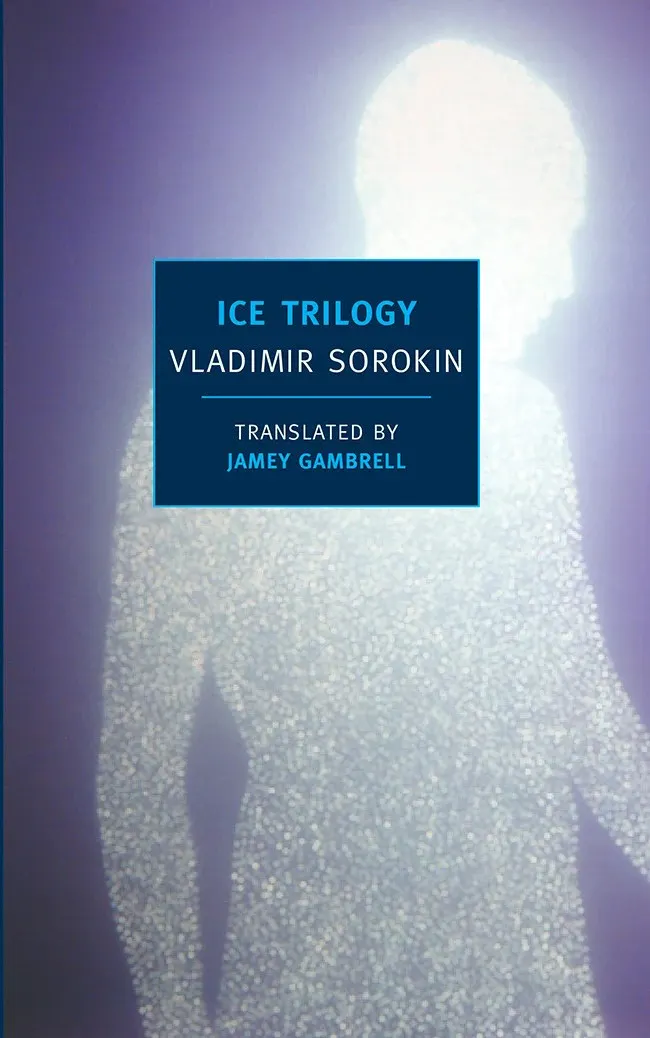
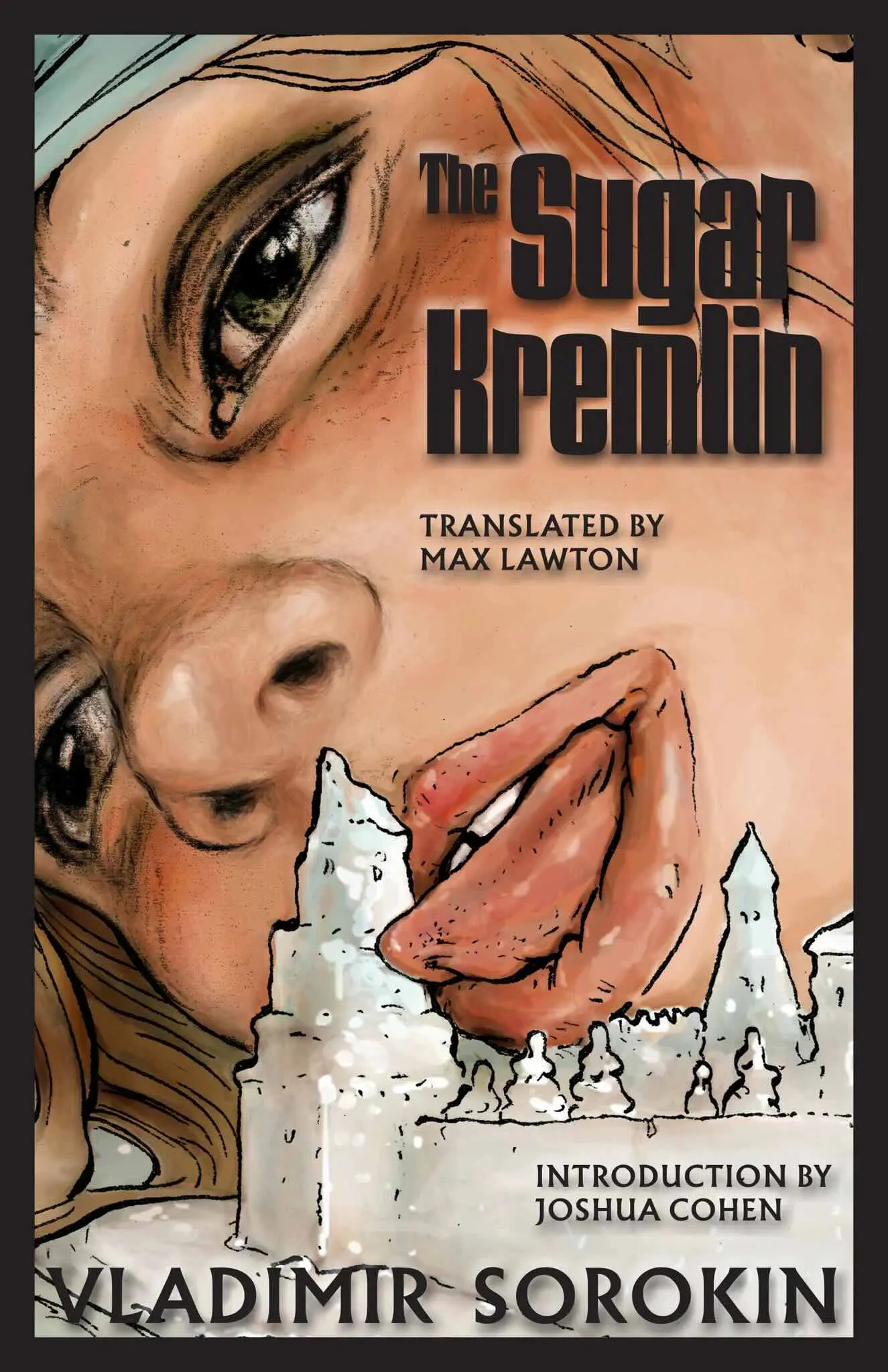
In an interview that prefaces The Sugar Kremlin, a recently translated collection of stories set in the future world of Day of the Oprichnik, Sorokin reiterates that the ills of contemporary Russia are attributable to its pyramid of power, adding that during the Soviet era ‘power took the place of God’. This misdirected religious impulse is the deepest perversion in Sorokin’s universe, the ultimate source of its brutality. His Ice Trilogy allegorises the perversions of power and exceptionalism with particular directness. It tells the story of the Brotherhood of Light, a secretive messianic cult with explicitly fascistic overtones, whose members – all of whom are blond-haired and blue-eyed – think of themselves as rays of cosmic light, superior to the common run of human beings, whom they deride as unthinking ‘meat machines’. They identify new members by chaining people to trees or walls, then smashing them in the chest with hammers made from the ice of a fallen comet. If the heart of their victim ‘speaks’, the person is recognised as one of the elect; those who do not speak the ‘language of the heart’ usually die.
As he traces the progress of the mystical Brotherhood across the twentieth century, Sorokin has its members insinuate themselves into structures of power. Their contempt for ordinary people, their immoral belief that people are exploitable and disposable, initially manifests as a willingness to finance their operations through theft and extortion, but members soon find positions with the Cheka and the NKVD. They collaborate with the Nazis. Later, they establish a global corporation and make a killing during the financial chaos that follows the collapse of the Soviet Union. They embrace snake-oil consumerism, turning ‘ice’ into a marketable product, and acquire sweatshop factories in China.
The trilogy’s imaginative conceit makes its point about systemic inhumanity clearly enough. What is less evident in Sorokin’s work is where one might find some kind of humane counterpoint to such arrogance and viciousness, though there are intimations at various points. At the very end of the Ice Trilogy, the last two characters left standing exchange some rapid-fire Beckettian dialogue, in which they agree that ‘this was all done by God’. Then, after a pause:
I want to talk to God,’ Bjorn said.
‘So do I,’ Olga declared.
‘I need . . . need to tell God. A lot of things. I have to talk to Him.’ Bjorn thought hard.
‘But how do I do it?’
Olga said nothing.
‘How to do it?’ Bjorn asked.
‘We have to return to people. And ask them.’
It is tempting to read this uncharacteristic passage as the expression of an underlying Christian humanism, an affirmation of the idea that the path to divinity, the only real way to converse with an absent God and make sense of our condition, is through one’s fellow human beings. As someone inclined to agree with Stendhal’s observation that God’s only possible excuse is that he does not exist, I appreciate the implication that, at very least, God has some serious explaining to do.
In the first book of the Ice Trilogy, a newly awakened member of the Brotherhood dreams he is sitting a literature exam. He is supposed to be writing an essay on Dostoevsky, whose ‘gloomy’ portrait has been placed at the front of the classroom, but he has gone blank – he can’t remember who Dostoevsky is. The boy at the next desk slips him a book and he realises that ‘this book, the sum of the life of the bearded man with the serious gaze, is only paper covered with combinations of letters’. This strikes him as absurd, as does the thought that people should be writing even more letters on paper in response.
Another character has a comparable experience in the third book, when he sees through the ‘veil’, past the ‘surface of things’ to their ‘essence’. Images – ‘paintings, photographs, movies, sculpture’ – reveal themselves as pure materiality. ‘Paintings became merely canvases covered with paint; on the movie screen all I saw was the play of splotches of light.’ The materialism strips art of its meaning: a dehumanising inversion of its revelatory potential.
Yet Sorokin also insists on our deeply compromised interconnectedness, a function of our awakened materiality. ‘Everything, absolutely everything depends on everything else – total mediation and unfreedom,’ he writes in ‘A Month in Dachau’. ‘We exist in this dependency like flies in honey and our slightest movement gives way to waves, waves, waves.’ He reiterates the idea later in the story: ‘every automatic movement is textual every text is totalitarian we’re in a text and consequently in totalitarianism like flies in honey and the exit exit can it be only in death no prayer prayer and repentance today’.
In ‘A Month in Dachau’, published the year before the Soviet Union disintegrated, the atavism of power begets an appalling religious atavism, a disturbing return to the harrowing fates of saints and martyrs. The story is Sadean, both in its unbearable cruelty and in the strict regulation of that cruelty. It is also an astonishing religious rite, terrifying in its suffocating fatalism, but with an underlying element of absurdity. It is an unsurpassed vision, a companion piece to Kafka’s astonishing story ‘In the Penal Colony’, published in 1914, just as the slaughterhouse of the twentieth century was opening for business. Its premise has an ironic grandiloquence. The murderous Nazi and Soviet regimes are united. The author offers himself as sacrificial victim, accepting the impossible burden of pain and degradation, only to end up married to his torturer (sort of – she has two heads and he only marries one of them). Its summation of the last century’s worst horrors anticipates the horrors of our own.