
In a shaft on the Gravel Pits, a man had been buried alive. At work in a deep wet hole, he had recklessly omitted to slab the walls of a drive; uprights and tailors yielded under the lateral pressure, and the rotten earth collapsed, bringing down the roof in its train. The digger fell forward on his face, his ribs jammed across his pick, his arms pinned to his sides, nose and mouth pressed into the sticky mud as into a mask; and over his defenceless body, with a roar that burst his ear-drums, broke stupendous masses of earth.
Critical/Mineral
Roslyn Jolly on the Australian mining novel
Much has been written about the pastoral as a theme in Australian literature. But what about the mines? Reviewing Verity Borthwick’s Hollow Air, Roslyn Jolly descends into the overlooked under-realm of Australian mining fiction.
The Australian mining novel: what comes to mind? Henry Handel Richardson’s trilogy The Fortunes of Richard Mahony, perhaps. Its first volume, Australia Felix (1917), has one of the most striking opening paragraphs in Australian literature:
This is mining fiction with a vengeance, face to earth and no escape as the young miner disappears into ‘a grave that fitted him as a glove fits the hand’. And there’s plenty more Australian literature with a gold rush background, although none so powerful as this; you might think of Catherine Helen Spence’s Clara Morison (1854) or Rolf Boldrewood’s The Miner’s Right (1890). But these are relatively minor works. Where, after Richardson, are our great mining novels?
A substantial body of mid-twentieth-century Australian mining fiction does, in fact, exist; but, as Philip Mead points out in his 2023 essay ‘The National Trilogy and Mining’, it has been mostly ignored by critics, because discussion of Australia’s literary history has tended to focus on novels and poems with ‘pastoral, agricultural and topographical’ themes. Mead writes: ‘There has been little critical recognition of the undercountry of mining as an overlapping literary paradigm to the one established for more than half a century by invasive pastoralism.’ Few readers today have heard of Katharine Susannah Prichard’s trilogy about the Kalgoorlie goldfields – The Roaring Nineties (1946), Golden Miles (1948) and Winged Seeds (1950) – or Vance Palmer’s trilogy about the social and political impacts of silver-lead mining at a fictionalised Mt. Isa – Golconda (1948), Seedtime (1957) and The Big Fellow (1959). Little wonder, since they have been so rarely discussed or taught. Yet for those who take the trouble to seek them out, these novels form an important bridge from the old story of gold (or tin, or silver, or lead) fever and the get-rich-quick schemes of individual ‘diggers’ to the modern mining era with its large-scale, systematic resource-extraction enterprises managed by national and international corporations. Prichard and Palmer engaged with questions that still concern our mining industries and the wider public response to those industries. Who gets the profits? Will the wealth generated simply be exported overseas? What are the environmental costs? What about the impacts on Indigenous people?
Australian novels about mining continued to be written in the later twentieth century, but these tended to fly even further under the critical radar than Prichard’s and Palmer’s works. (Mead helpfully lists some of the relevant titles, and Reba Gostand provides a fuller survey in her 1983 essay ‘The “Mining Theme” in Australian Literature’.) During this period, mining became ever more important to the Australian economy, easily overtaking pastoral industries as a generator of employment and exports – yet the ‘mining theme’ lacked visibility in our national literature, where outdated pastoral subjects continued to dominate.
Now, however, the twenty-first-century resources boom has prompted a resurgence of mining subjects in Australian fiction, often in novels written by women. Carpentaria by Alexis Wright (2006), The Yield by Tara June Winch (2019), Our Shadows by Gail Jones (2020) and Stone Sky Gold Mountain by Mirandi Riwoe (2020) are all significant literary works that engage to a greater or lesser degree with the question of mining in Australia. The industry’s legacies of Indigenous dispossession, environmental destruction, racial discrimination and workplace trauma, as well as the responses of families and communities to the economic realities of employment or investment in mining, are central concerns of these fine novels.
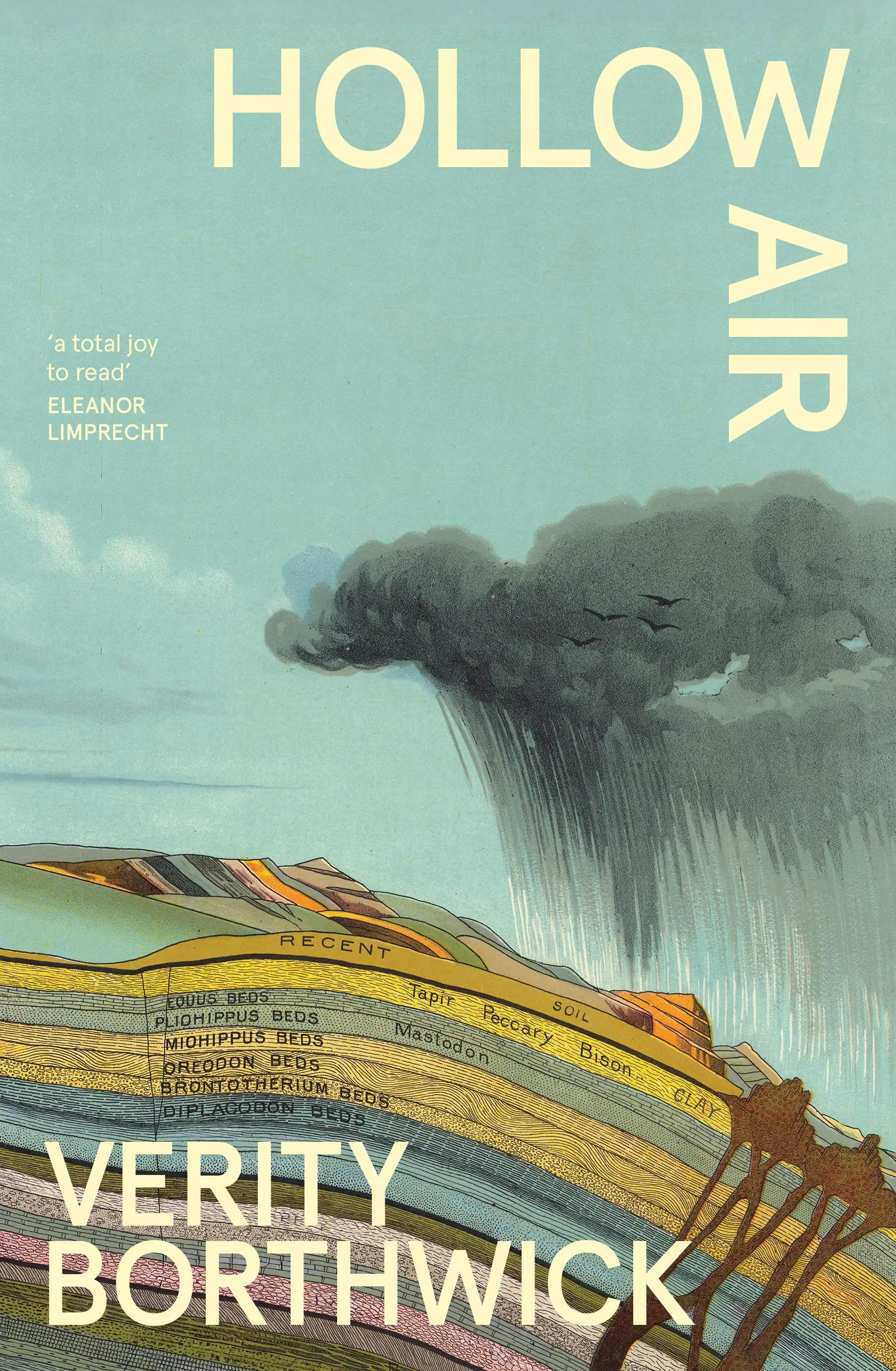
Verity Borthwick’s debut novel, Hollow Air (2025), is the latest addition to this currently flourishing field. Borthwick expertly juggles a past-and-present narrative structure which interweaves the historical story of two men killed in a mine collapse with the modern-day experiences of a female geologist employed to investigate the mineral potential of the same site for a possible re-opening of mining operations. The introduction of a female protagonist directly involved in mining work is the great innovation of Borthwick’s novel. Hitherto in this genre, female characters have been absent altogether, or present as witnesses, supporters or opponents of the work of mining, carried out exclusively by men. In Clara Morison, information about the goldfields comes only in the form of letters written by male prospectors to their sisters or fiancées. Women have important roles in Pritchard’s and Palmer’s trilogies, but as wives, girlfriends, mothers, cooks, boarding-house keepers, schoolteachers or political activists, not as miners or mine employees. The Yield has an Indigenous female protagonist, but her relation to mining is entirely oppositional. Borthwick’s protagonist, Sarah, on the other hand, is a proponent of mining, albeit at times a deeply ambivalent one. Her work as an investigating geologist puts her at the heart of the mining operation in a fully hands-on role. It also places her in a largely male world – ‘a woman surrounded by men’ – where she has to work hard to maintain her professional authority. Borthwick highlights the sexual politics of Sarah’s job, her fear of appearing weak and the pressure she feels to act like one of the boys. The novel also conveys a chilling sense of the threat of gendered violence that Sarah experiences, whether through her coworkers’ sexist language and constant sexual innuendos or in the fears of physical harm that grip her mind when she is alone at the mine site at night.
These psychological stresses are exacerbated by Sarah’s role as sole caretaker, for weeks on end, of a not yet functioning mining operation. The resulting isolation takes its toll on her emotional equilibrium, pushing her imagination towards paranoia. (Borthwick has a talent for creating moments of haunting uncanniness, but I did wonder in the novel’s first half if there were a few too many false alarms of threatening intruders.) In terms of personal relationships, much of the story is driven by the rhythms and strains of the fly-in-fly-out lifestyle so distinctive to Australia’s modern mining culture.
Reflecting the conditions of their time, earlier mining fiction tended to present the story of ‘the field’ as one of gradual feminisation, women and children joining their menfolk when a claim proved viable; this would lead to the introduction of shops, streets and schools, signalling the evolution of the original camp into a township. In twenty-first-century Australia, a different employment model prevails, with mine workers flying into and out of the mine site on regular schedules, leaving partners and families behind. The fragmentation of time and of self that results is one of the major concerns of Borthwick’s novel. As the older geologist Norm says, ‘It feels like a different life when you’re out in the field. You forget what you have back home.’ This is how emotional and ethical ‘mistakes’ get made, generating secrets, lies and infidelities, and, in Sarah’s case, stretching to near breaking point her sense of her own coherent identity.
Borthwick’s introduction of a central female viewpoint and her analysis of the psychology of the FIFO lifestyle are both significant innovations, but what to me is even more original and interesting about Hollow Air is the way it takes us into ‘the world beneath the ground’ – the world all mining is fundamentally concerned with, but few mining novels truly encompass. Both Sarah’s work as a company geologist and the historical backstory of Thomas and Samuel’s desperate scheme to extend the life of their mine result in considerable sections of the narrative taking placing underground. Borthwick writes well about the terror of darkness and also its lure; about things that hide or can be hidden in the darkness of a mine; and about the things that thrive there: ‘Eyeless shrimp-like creatures’ with ‘translucent’ bodies, ‘dank things growing in the absence of light’ and the ‘mushroomy, under-the-house smell’ they emanate.
This evocation of the underground world as a kingdom of blind things preying on other blind things justifies Samuel’s belief that ‘[t]here was nothing as grim as spending your life scuttling about in the dark’. And yet,
there was also a thrill to it that Samuel could never quite shake. To be right inside the rock. To walk through the middle of an ancient seabed and imagine the tidal shifts that had once ebbed and flowed, swirling these very sand grains into ripples and whorls. To feel his body held by the Earth, surrounded by it, whilst he plumbed its secret spaces in search of treasure. Yes, there was a thrill to it.
There’s a tension, too, which Borthwick draws out, between the miner’s or geologist’s sense of mastery over the earth and their sense of being mastered by it. To ‘plumb its secret spaces in search of treasure’ is to exert control through knowledge; to have one’s ‘body held by the earth, surrounded by it’ is to surrender control and possibly life itself.
The first of these alternatives feeds into the theme of decipherment which Hollow Air shares with an earlier Australian mining novel, Vance Palmer’s Golconda (1948). In Golconda, the engineer Keighley views the earth as a hermeneutic puzzle, which needs to be solved by human intelligence before the physical work of extraction can begin. Keighley explains to the union organiser, Donovan:
There’s that hill over there – a mystery box, a challenge to every mining-man in the country. Surface indications suggest that it may prove to be one of the greatest silver-lead shows in the world – perhaps the greatest – but all its secrets are locked up tight. I'm concerned with letting the light in on them – following up the lodes, measuring them, working out plans to drain out the ore – no matter who gets the ultimate benefit.
As the last remark shows, Keighley believes that his intellectual battle with the earth unfolds on a different plane from the well-worn class struggle of capital versus labour. For him, unlocking the secrets of the earth is a purely personal quest:
What stirred him, what gave an edge to his nerves, was the challenge the mountain presented to his technical knowledge and ingenuity. It was as if a treasure had been planted there ages ago and some mystical command had been laid upon him to find ways and means of bringing it to light.
Although not educated like Palmer’s Keighley, the miner Samuel in the 1910 strand of Borthwick’s narrative has, intuitively or experientially, ‘an understanding of how the rock behaved, the story it wanted to tell you if you would only take the time to listen.’ The geologists in the modern-day storyline of Hollow Air – Norm, Cole and, particularly, the central character Sarah – seek this same understanding, which they can only achieve through a laborious process of decipherment. Borthwick offers different metaphors for this process: listening, reading, divination and dissection. The last of these governs a powerful meditation, focalised through Sarah, on the experience of seeing a drill core pulled from the earth:
She could never get over the feeling of being the first human to lay eyes on this rock sliced out of the ground – was this how the early anatomists had felt when they cut into the body and saw the sinews tangled there? There were answers in this rock. Each core was part of a jigsaw, and as you drilled more, you could begin to put the pieces together. From the surface she could only give her best guess at what might be below. Like a doctor listening to a heartbeat with a stethoscope, you could feel the edges of the organ and wonder at its function, place your palm above it and feel the muscle pulse beneath your fingertips, but to truly understand its hidden chambers you needed to dissect. It couldn’t be done without blood.
And then there is the opposite action: not bringing a section of rock to the surface but going bodily down beneath the ground to see and feel for oneself. Despite misgivings on the OH&S front, this is something that Sarah’s geological imagination at times simply can’t resist: ‘she couldn’t deny the pull of that dark space and the promise it held. To be right inside the deposit you were trying to understand.’ A series of such unauthorised forays, in company with her even more reckless fellow-geologist (and illicit lover) Cole, culminates in the dramatic rockfall episode which supplies the plot climax and resolves the hermeneutic puzzle while drawing together the novel’s historical and contemporary narrative strands.
In both these strands, characters trapped underground in collapsed mine shafts experience a profound loss of personal identity as they are absorbed into the dark mineral world. ‘The edges of [Sarah’s] body blurred, becoming indistinct so she was no longer sure she inhabited herself, the mine becoming part of her and she of it. She was dissolving into the nothing of it.’ Cole, trapped under rocks, seems to have ‘begun to petrify, as though the mine was already claiming him as its own’. During her arduous journey to the surface, Sarah gratefully gulps down water in a flooded tunnel which ‘tasted of metal and of rock […] and soon her belly was full of it, and she felt she had become part of the mine, that it now flowed in her veins and pooled in her gut.’ And in the 1910 story, Samuel, asleep in the collapsed tunnel that will become his grave, dreams that ‘aeons had passed, and his body had grown one with the rock. Blind roots pushed through his limbs, and pallid creatures took shelter in the folds of his clothing. Moss grew on his skin.’
This is the territory of myth, that territory where the Golems of Jewish folklore rub shoulders with the Green Man of medieval Britain and Ovid’s metamorphosed women (Niobe a stone, Daphne a tree), all symbolising the dissolution of boundaries between human beings and the natural, elemental world. Such mythopoeic impulses may seem a far cry from the social realism that has tended to dominate Australian mining fiction, at least until this century; but even as Borthwick’s deployment of the trope of metamorphosis is, to my knowledge, unique within this tradition, earlier examples do tend, similarly, to attribute sentience and volition to the mined earth, as well as monstrous power. The astonishing ‘Proem’ to Richardson’s Australia Felix ends with a comparison of the violated country to a ‘primeval monster’ holding its invaders in inescapable psychological thrall:
It was like a form of revenge taken on them, for their loveless schemes of robbing and fleeing; a revenge contrived by the ancient, barbaric country they had so lightly invaded. Now, she held them captive – without chains; ensorcelled – without witchcraft; and, lying stretched like some primeval monster in the sun, her breasts freely bared, she watched, with a malignant eye, the efforts made by these puny mortals to tear their lips away.
In Golconda, Keighley looks down from an aeroplane at ‘the vast metallic outcrop that thrust itself up through the earth’s thin cover, an old crocodile’s back emerging from sluggish water’, and imagines the earth as an agentive force: ‘Now it was the mountain itself that had power and consciousness for him, now the myriad tons of ore in its heart, imprisoned there for ages, seeking release into the light.’ In The Big Fellow (1959), the third book of Palmer’s trilogy, the sculptor Neda Varnek recalls her feeling at Golconda that earth elements were struggling for release, and that ‘they’d a right to get out into the daylight. Even though they might prove to be monstrous or evil.’
In keeping with the environmentalist ethos of our time, Hollow Air eschews any such extractivist fantasies of mining-as-liberation, and imagines instead an earth-monster with the will and power to crush human invaders and expel their puny works:
As she pressed forward, Sarah felt a sudden sense of open space above her, of air where there should have been rock ceiling, and it felt so abnormal after the closeness of the tunnels that it made her skin crawl. She shone the torch upwards, and there was a stope opening into the rock, studded with wooden matchstick stulls fibrous as broken bones. Something about it was horrible in the gloom, like an open mouth with grinning teeth, like looking into a throat. As though the stulls were the only thing keeping the rock from snapping shut forever. Maybe that was what it wanted, to rid itself of these unnatural spaces.
Resource extraction has always produced demons and monsters as cultural by-products; think of European folklore’s evil trolls and terrifying dragons, guarding their mineral riches against the depredations of brave or foolhardy humans. Beowulf’s dragon, presented in Seamus Heaney’s translation as ‘an old harrower of the dark’, ‘the guardian of the mound, / the hoard-watcher’, is one of a long line of precursors to Borthwick’s imagined mine-monster.
Another, even older, literary precedent that bears upon both the plot and the symbolism of Hollow Air is the classical topos of the journey to the underworld. Two of the great classical heroes, Odysseus and Aeneas, engage in such a katabasis or ‘descent’, in The Odyssey Book XI and The Aeneid Book VI. In both cases the journey is both a quest and a trial, its object to gain knowledge that can only be obtained in the land of the dead. In the underworld, Odysseus consults the blind seer Tiresias about his return to Ithaca, receiving useful warnings about what not to do, as well as a reassuring glimpse of his later life. Aeneas speaks with his father, Anchises, who proffers a vision of the future of Rome. Although Sarah’s descent in Hollow Air is framed as an impersonal quest for ‘answers’ from the rock, it also involves a highly personal consultation with the dead: only by encountering the remains of the miners Samuel and Thomas can she solve both the mystery of their deaths and the decipherment challenge posed by the incoherent drill samples taken from the earth.
The hardships of Sarah’s journey through the underground world and, more particularly, of her perilous re-ascent after the rock collapse, easily qualify her for the role of hero in this narrative. But her character also calls to mind another archetypal figure from classical literature, one invested with meanings more potent than those attached to any mere adventurer or empire-builder. Persephone, kidnapped by Hades and forced to live with him as his wife in the underworld for half of every year, is one of the most persistently re-imagined characters of Greek mythology. Her story is an attempt to understand the mystery of fertility; the synergies of light/dark, life/death, beauty/beast; and the possibilities and limits of female agency in a world ruled by men. One of the many nineteenth-century retellings of her myth, Dora Greenwell’s poem ‘Demeter and Cora’ (1876), includes a meditation by Persephone/Cora on the ambivalences of her mystical, monstrous marriage with Hades, in a quatrain that resonates strongly with the concerns of Hollow Air:
The Lord is he of wealth and rest,
As well as king of death and pain;
He folds me to a kingly breast,
He yields to me a rich domain.
A modern-day Persephone, Borthwick’s female geologist-protagonist finds herself caught in a similar bind, simultaneously drawn to and repelled by the underground world which ‘yields’ such wealth only at the cost of great ‘pain’, both personal and environmental.
We are all, like it or not, ‘fold[ed]’ to the ‘kingly breast’ of the mining industry. In her writing, Borthwick forces us to acknowledge the intimacy of our relations with the outputs of mineral extraction. She uses the example of the coffee machine owned by Sarah’s city-boy fiancé, Scott:
[Sarah] thought of the spaces throughout the world that had been opened in the ground to release the materials to facilitate this act of creation; pipelines plumbed into primordial swamps, giant pits spiralling down from the surface, underground cavities carved into mountainsides, tonnes and tonnes of rock displaced to extract the small percentage that was of value. This was what humans did to make the things they crowded their lives with […] None of the things around her had been easily obtained. There was always a toll.
As we become ever more dependent on computers, batteries and smartphones; as we look forward to drawing retirement incomes that will likely have been funded in part by mining investments; and as the desire to control so-called critical minerals increasingly drives geopolitical decisions, it has never been more important to confront the enmeshment of our lives with an industry many of us love to hate. Through a powerful act of imaginative storytelling, Hollow Air asks us to do precisely that.