
Agitation is central to my politics because I don’t want to be palatable. I don’t want to be complicit in systems of oppression that come from the queer scene, from certain people’s practice of my religion, or from people in my own cultural community. I like to break things down and try to consider why they were assembled in that arrangement in the first place.
Even Heaven isn’t Big Enough for Us
Martyn Reyes on Bobuq Sayed’s No God But Us
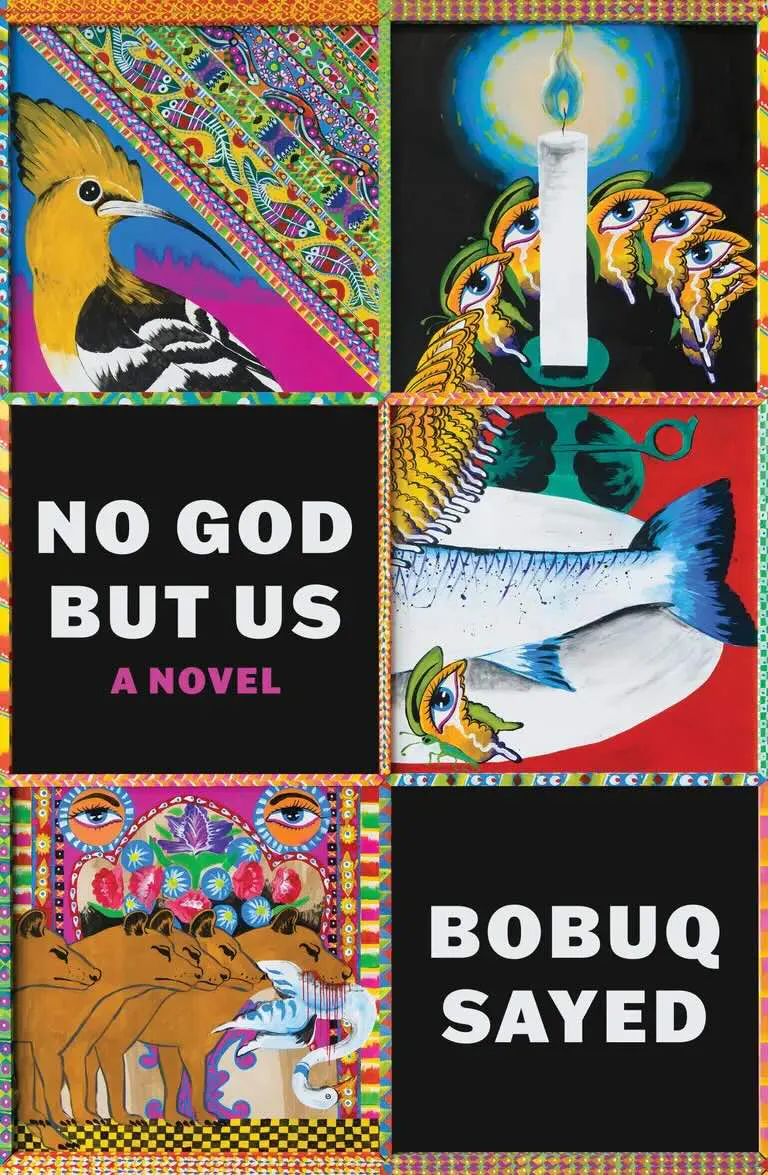
Bobuq Sayed’s debut novel unfurls across the borderlands of displacement and exile. Martyn Reyes unpicks the critique of uneven privilege and power dynamics woven through this layered tale of queer desire and community.
No God But Us begins with secrets and their unravelling. We learn that ‘among Afghans, all kinds of perversity happened behind closed doors’. As long as it remains within the realm of the private, desire can be pursued and pleasure explored without judgement or shame. There is, however, the risk of being caught, the humiliation of one’s private self being made public.
Delbar, a young, queer Afghan-American from Washington D.C., works the door at a drag bar stamping wrists, all while longing to perform onstage. In the opening chapter, we see him make the journey from work to a party his mother is hosting in the ‘little Kabul of northern Virginia’. Running three hours late, he makes sure he is equipped with elaborate excuses, since coming home always involves ‘an increasingly convoluted warren of lies’ that ‘straddle impressive and believable’. Soon after his arrival he is confronted by a gossiping aunt who claims to have seen a photo of him working at a bar with ‘men dressed as women’, which to his family is ‘synonymous to taking dick’. She exposes him in front of everyone, including his mother.
Mansur, on the other hand – the novel’s other protagonist – has lived with his paternal aunt in Iran, along with his mother and sister, ever since they fled Afghanistan. He is tired of being interrogated as to why he is not yet married. Working long shifts replacing lead pipes in the northern part of Tehran, Mansur catches the eye of a boy with a ‘silver jewel in his earlobe’, named Payam. Desperate to see him again, Mansur sneaks out and a friend drives him to a popular cruising spot – a roundabout in the university district. All he wants is a chance to talk, to learn the stranger’s name and exchange contact details. Eventually, he spots Payam in the back seat of another vehicle, and in a moment of recklessness, he jumps out of his friend’s car, unable to let Payam go. Returning home in the early morning, bloodied, bruised and ‘reeking of cigarettes and liquor and sodomy’, Mansur finds himself locked out, his sinful activities earning him banishment from his aunt’s house.
These inciting incidents make up the first part of the novel. Desire is the driving force and sacrifice its consequence, bringing both protagonists across borders, to Istanbul ‘where the people displaced by all the wars end up’. Delbar runs away from home to live with his progressive aunt Yosra, the ‘original family pariah’, who offers him a place to stay after his mother, Qandul, attempts to take her own life, unable to accept the disgrace caused by her child. Unlike Delbar who sees his move simply as an ‘opportunity’, for Mansur, who has nowhere to live, Istanbul is less of a choice than a means of survival. In an attempt to protect Mansur and his family from the Iranian morality police, Payam, who has developed a deep connection with Mansur, pays for him to be smuggled to Turkey, ‘more than a thousand miles away from everyone [he] knew’. ‘Could I make it?’ wonders Mansur. ‘And even if I did, what next? Would I ever come back?’
No God But Us is the ambitious debut novel of Afghan-Australian writer Bobuq Sayed. No stranger to the scene, the Brooklyn-based writer and University of Miami MFA graduate has had an extensive career across writing, editing and performance. Recent projects of theirs include the chapbook of essays A Brief History of Australian Terror (2024) and the anthology Nothing to Hide: Voices of Trans and Gender Diverse Australia (2022), co-curated by Sayed with Sam Elkin, Alex Gallagher and Yves Rees. In No God But Us, Sayed returns to the familiar terrain of their shorter fiction – which has appeared in Guernica, Joyland and New Australian Fiction – further developing the themes that have hitherto defined their practice: the Afghan diaspora, queerness, family, faith, politics and the enduring ripples of exile.
Spanning a timeline of six years and set across Washington D.C., Tehran, Istanbul, Berlin and Copenhagen, No God But Us unfolds within a tangled web of historical and political circumstances – U.S imperialism, ‘the war on terror’, Afghan migration to Iran, the Kurdish-Turkish conflict. It is also set in the midst of the 2015 European migrant crisis. According to the United Nations High Commissioner for Refugees (UNHCR), more than 900,000 refugees and migrants – mostly from Syria, Afghanistan, and Iraq – arrived on European shores that year and over 3,500 lives were lost during the journey. Though grand in scope, the novel never feels too intimidating. This is partly because Sayed helps fill in the gaps. Of Afghanistan, unaware readers learn that the country was ‘fucked because of the Americans, because of the Taliban, because of the war’, and that in Iran ‘it was more of the same’. We learn that ‘Afghans could be found on every corner of habitable land on earth’, and that ‘Afghanistan is every anti-colonial struggle in one’. The majority of the book takes place in Erdoğan’s Istanbul, against the backdrop of extreme nationalism, a corrupt government, and the mistreatment and displacement of Kurds. No God But Us is about the violent and lasting aftermath of war and the people whose lives it impacts, particularly women and queers. It tells the stories of these ‘transgressors of borders’, whom Sayed dedicates the book to, and examines the dynamics of their suffering and survival, kinship and community, intimacy and love.
The novel has a polyphonic structure. The chapters, told in first person, alternate between Delbar's and Mansur’s perspectives, and within them are embedded the stories of other trans and queer characters. This form feels central to the novel’s impact – it would be hard to imagine the story told exclusively through one protagonist’s point of view or the other’s; the differing points of view create tension, complementing and challenging one another, building depth and richness that the narrative would lack otherwise. It also allows Sayed to paint a more nuanced picture of the disparate realities of the expat and the exile. To quote Edward Said, the distinction lies in the expatriate’s voluntary decision to live in an alien country. They ‘may share in the solitude and estrangement of the exile, but they do not suffer under its rigid proscriptions’. In contrast, exiles ‘are cut off from their roots, their land, their past’, and suffer the impossibility of returning home.
Delbar and Mansur share many commonalities: their sexuality and motherland; both of their families left Afghanistan as refugees; both are children of single mothers and both have one sister. However, the pair couldn’t be more different, as Sayed reminds us that shared culture is a fragile foundation on which to build a sense of belonging, failing as it does to account for the complexities of individual experience.
Delbar is well-meaning, college-educated and liberal-minded. He is snarky and quippy, and at times annoying and unlikeable. He is another American abroad, a much-explored trope both within the literary canon and in other queer novels, from James Baldwin’s Giovanni’s Room, to Garth Greenwell’s What Belongs to You, to Bryan Washington’s Memorial. Characters within this genre are mobile and often privileged, typically finding themselves overseas to study, work, travel or escape. They experience awe and alienation amid their foreign surroundings, which ultimately shapes their sense of self. Additionally, Delbar’s identity places him within a certain category of diasporic fictional characters, who are typically concerned with their own positionality, hybridity, and liminality, and are trying to make sense of their transnational status. Like many of these characters, Delbar searches for meaning and reinvention.
Both traditions of ‘American abroad’ and ‘diaspora’ literature have had criticisms levelled at them. As Jody Lee points out in an essay on the expectations of Asian-Australian writing, diasporic stories are often forced to demonstrate a ‘yearning for homeland, cultural nostalgia, and the struggle to fit in’ to be viewed as marketable, and therefore, publishable. Writers are encouraged to follow a template, to take something that is culturally recognisable or representative of their homeland and repurpose it as ‘an artwork in and of itself’ (to quote this critique by Zarina Muhammad). The end result is often something that is purely surface-level, self-exoticising and lacking in originality. On the issue of ethnic credibility, Som-Mai Nguyen responds to writers who pose as authorities on the cultures and languages of the communities to which they belong: ‘whether by naiveté or narcissism, many diasporic writers seemingly cannot accept that The Motherland doesn’t care for them and their psyche’s under-processed, shapeless projections onto a culture to which they do not hold the keys alone, if at all, no matter what White people on committees think’.
Sayed seems aware of these traps and actively writes with and against them, using Mansur to challenge and critique the individualistic and Americentric point of view that Delbar as a character represents.
As the novel progresses, we become aware of Delbar’s ignorance – how limited his knowledge and experience are. The pair first meet at PeaceMeals, a regular dinner set up for queer and transgender refugees, where Mansur works as the chef and Delbar as a volunteer. When Mansur urges Delbar to eat the meal he has prepared for the group, Delbar refuses: ‘It’s not for people like me anyway’. Mansur calls him out for his patronising response: ‘No one here wanted to leave their home. We were forced, do you understand that?’ Another example of Delbar’s naiveté occurs later that evening when he tries to bond with Mansur over their shared identity. ‘I’ve never met another Afghan kuni before’, he says. Mansur corrects his use of the Farsi word ‘kuni’, a derogatory term for homosexuals. ‘That word is very bad. We use hamjensgara’, he tells him.
The inclusion of Mansur’s perspective challenges the assumptions of both his counterpart and the book’s Western audience. Through him, and other displaced characters, we get a glimpse into life lived in the imprisonment of exile, into the realities of trying to survive in what theorist Achille Mbembe describes as a ‘deathworld’ – a state of existence underpinned by brutality, dictated and determined by the political power of the state, designed to wither the bodies and spirits of those that inhabit them. No God But Us gives us some insight into the perpetual waiting games, the appointments with unengaged case workers, the humiliation, the isolation, the violence, the constant threat of deportation, the desperation and the paralysation. People like Mansur are denied dignity or shared humanity. They become a part of the living dead, perceived and treated as, to quote Mbembe’s Necropolitics, ‘a kind of hollowed-out entity, walking vaults concealed by a multitude of organs’.
Mansur arrives in Istanbul on foot, after a journey that involves ‘weeks of hunger’ and ‘bony bodies huddled behind suitcases in the hull of passenger buses’. Darkness clouds his first year in Istanbul. At his lowest we see him sleeping in a dorm in inhospitable conditions, working two jobs to send money back to his family, which eventually gets stolen. He gets taken advantage of by people he has grown to trust. Slowly, Payam becomes more distant, and more and more apparent is the fact that Mansur’s love for him is unreciprocated. Through Mansur we witness the unforgiving, relentless realities of displacement: ‘Every promise of safety had come at a price […] I’d sacrificed my mother and Elaha to come to Turkey […] What else did I own to give up now? […] What more could these borders take from me?’
Things begin to look up for Mansur halfway through the novel as he regularly attends and eventually works at PeaceMeals, where he strikes up a romantic relationship with Leif, the white German expat that runs it. At PeaceMeals, we are introduced to a few more characters: an Eritrean lesbian named Poppy, her girlfriend Deniz, and Anahita, a trans woman from Iran – perhaps the most fleshed out of all the secondary characters. Anahita is brazen and direct in nature (‘All of my drinks tonight are on you fags for making me join you here’, ‘My god, they don’t teach taste in America, do they?’ ‘Don't expect [Payam] to move to this shithole for you’). Readers, as well as the characters, are pulled into her orbit. Her fortitude intimidates and her barbed words leave wounds, but in unmasked moments, Anahita reveals her more tender side. She assumes an almost motherly role with Delbar, helping him explore his gender identity and setting him up with a gig to perform in drag. In Anahita’s storyline we learn of the cruelty and oppressiveness of the state, particularly to trans refugees. The ensemble attends a pride march in the second part of the book. At first Anahita is apprehensive about attending, but both Delbar and Leif reassure her that she will be safe. Soon after the peaceful protest begins, ‘the first round of bullets resounded in the air’, and chaos ensues. After Anahita tries to protect a drag queen from the violence, she is arrested by the police and spends the night in a men’s jail cell. The experience leaves her profoundly changed: she becomes withdrawn, increasingly volatile and eventually unravels into episodes of depression and mania.
No God But Us asks: how do disparities in mobility and security affect the power dynamics of desire within the confines of borders? What are the possibilities and constraints of intimacy in exile?
Delbar and Mansur first meet one third into the novel (although their timelines do not align until much later). From the start it is evident how much Delbar is infatuated by Mansur: ‘My hunger for this man overpowered every desire I had. No longer did it feel sensible, or even possible, to contain my impulse to be close to him.’ Delbar experiences desire as freedom. His love, unapologetic and optimistic, grinds against the jadedness and restraint of Mansur, for whom the scars left by Payam have yet to heal. ‘Only the young love with both feet in the air’, Mansur reflects. Delbar is determined to secure Mansur even if it means breaking up Mansur’s relationship with Leif. He can afford to pursue his desires without regard for their consequences because, unlike Mansur, his existence is not threatened by the choices he makes – Delbar will always have someone to go to and somewhere to live. Whereas for Mansur, his mobility and security rely upon his ability to bury what he may actually want.
Mansur’s romantic and sexual attraction to Delbar become increasingly clear, but it is something that he resists for the sake of his future. However, he gives in halfway through the book when he is nursed by Delbar after being badly injured by the police during the pride protest: ‘He kissed the turrets of my spine, the saucer of my neck, and the fresh bulge of my pierced ear, his hardness rubbing gently into the narrow crevice of my wounded buttocks.’ They go past the point of no return. ‘I had made a promise to Leif and he to me, and yet I was insatiable for the cycle of hunger and feast that Delbar ignited. Now that I’d dipped my toe in selfish desire, I was unwilling to return to the shores of restraint.’
In Leif lies Mansur’s freedom and safety. The material conditions that ensure Mansur’s wellbeing are entwined with their relationship. Leif provides the infrastructure of a possible future involving financial security, secure legal status, housing, mobility and the potential to be reunited with his family. Ultimately this dynamic traps Mansur. The confines of their home and their intimacy becomes a border in itself. Mansur cannot cross it without risking his survival: ‘I swallowed my impulse to lash out. Leif threw barbs, but he didn’t like to take them. We were a couple, but I never forgot whose name was on the lease.’ And while their relationship seems legitimate at first, we slowly become aware of Leif’s exertion, and exploitation, of power. The wealthy German expat comes across as dismissive and self-satisfied, his paternalism verging on a saviour complex. Whether he is asking everyone to perform for photos during the dinners (‘I only get paid if I send regular updates of everyone smiling’), bragging about making Mansur ‘Westernised’ and ‘modernised’, or reprimanding him for smoking weed because it might jeopardise his case, Leif emerges as the book’s quiet antagonist, using his position of authority to exert control and manipulate the very people he purports to help.
Loving freely is a luxury that Mansur cannot afford, and Delbar’s delusion blinds him to his own selfishness. He is able to separate desire from survival and views love as a choice. At one point, Anahita attempts to speak some sense into Delbar: ‘If they break up, he will lose a lot. Do you understand? It’s not easy to start again somewhere like this. Are you going to get him set up in Europe? Can you secure that apartment? [...] Find some other Afghan for your loneliness. He’s not the one to fix you.’ Yet Delbar persists, reminding us of his disregard for the consequences Mansur may face – something he is willing to overlook in pursuit of his own happiness. Mansur articulates this disparity most clearly: ‘Delbar had the luxury to think this way. He could break up a couple and deny his mother and still have a warm bed waiting for him. No matter where he landed, a home would receive him.’ The relationships Mansur forms with both Leif and Delbar are characterised by an unequal distribution of power – they can love who they like while Mansur cannot.
This difference in privilege can also be seen in Mansur’s and Delbar’s’ respective relationships with their mothers. In the novel’s third part, Delbar reluctantly agrees to meet his mother while she is in Istanbul for work. They meet at a park, accompanied by Yosra, her children and Mansur. Delbar and Qandul’s cordial exchange quickly deteriorates when it becomes clear they will not find common ground. Qandul wants Delbar to keep his private life private, afraid he will be punished ‘for being so open’ – visibility has its dangers. However, Delbar sees this as a threat to his ability to live and love freely and gives her an ultimatum: if she cannot accept Mansur, then he cannot have her in his life.
Mansur’s separation from his own mother, forced upon him rather than chosen, enables him to sympathise with Qandul: ‘She was teaching him something, keeping him safe the only way she knew. He acted as if she was endangering him.’ Mansur is haunted by the possibility that he may never see his mother and sister again. In exile, intimacy can be so quickly and permanently taken away. All he wants is to ‘be close to her, small in the presence of her greatness’. Under the constant threat of displacement, only able to access the love of his family through a blue screen, Mansur cannot fathom ending a relationship over the question of identity.
One of the most successful aspects of No God But Us is Sayed’s treatment of motherhood and parental sacrifice, similar in its impact to Santiago Jose Sanchez’s Hombrecito, which investigates the complex relationships queer children can form with their migrant mothers. Recurring in the novel is a story that Mansur’s mother, Mandar, used to tell him as a child – about a baby bird who could not grow feathers but longed to join the other birds. The mother bird told him to wait, assuring him that his time would come. Secretly anguished, the mother bird began plucking all of her feathers, slowly collecting them to give to her child. The baby bird ‘trilled ecstatically’ at his new, shimmering plumage. A few weeks after his first flight he returned to his mother who was ‘withering away’, unable to fly or leave the nest. ‘Before she died, she whispered to him. She had no regrets. She’d do it again a thousand times.’ The sacrifices that both Qandul and Mandar take are not to be taken lightly – they risk their lives in fleeing Afghanistan, giving up their ‘homes, their language, and their livelihood to cross these borders for a fleeting chance at another life, a better one’. Sayed reminds us that despite their misgivings, in our mothers is ‘all the history and the hurt’ they contain; every decision is made for the betterment of their children.
The threads of music and poetry woven throughout the novel are another highlight. They add a richness and sensitivity to Sayed’s explorations of desire and longing, particularly through Mansur’s chapters where they mostly appear in scenes with or about Payam. In them we are introduced to the work of Sa’di Shirazi, Forugh Farrokhzad, Omar Khayyam, Rabia Balkhi and Googoosh. Poetry shapes Mansur’s language – it comes alive with description and tenderness, qualities absent from his speech as he navigates surviving in Istanbul. ‘The light of his eyes were my navigational stars. His dimples were more profound than anything I had ever read’, he says. When he sees Payam at the roundabout, 'unfettered desire’ finally bathes him ‘in its light’. His words contain the yearning, hope and devastation that come with one’s first love and heartbreak. ‘Behesht’, the song by Iranian singer Googoosh, plays in the car when Payam and Mansur meet. Its lyrics follow Mansur around throughout the course of the book like a scar: ‘even heaven isn’t big enough for us’.
Despite the novel’s strengths, there are moments where its storytelling loses focus by over-emphasising markers of identity. On multiple occasions secondary characters are revealed to be trans or queer – revelations that begin to feel unnecessary and pull the reader out of the narrative. Viyam, for example, Yosra’s colleague, comes out as bisexual to Delbar after expressing interest in Delbar’s aunt. Similarly, Poppy's new partner in Denmark, Hussein, happens to be a trans masculine person. Yosra’s albinism, which might serve to emphasise issues of colourism and assist in illustrating her as different and another ‘black sheep’ of the family, doesn’t seem to contribute anything meaningful to her characterisation or the narrative. Compare these supporting characters to Anahita and Lief, whose trans identities feel lived-in and purposeful, integral to the novel’s exploration of the layered and complex dynamics of power.
The novel’s tendency towards ideological signalling extends into its dialogue. Nafas and Darya, Delbar’s pre-teen nieces, frequently function as vehicles for exposition. They are depicted as bright and inquisitive children, but their sophisticated grasp on the discursive nuances surrounding gender and sexuality seems almost implausible, and their observations often feel like lessons directed at the reader: ‘Just because someone is gay doesn’t mean they want to dress up as a girl’; ‘There’s a difference between gender and sexuality’; ‘Our family supports gay people’; ‘you’re not supposed to comment on people’s appearances’. When Nafas paints Mansur’s nails at the reunion between Delbar and Qandul, Yosra cautions her about ‘respecting other people’s autonomy’, and when Qandul tells her that nail polish isn’t ‘appropriate for a man’, Nafas responds by saying, ‘we don’t believe that here’. This may be Sayed’s way of depicting the progressive values of a younger generation – what is possible under the guidance of a politically engaged, intellectual parent. But Nafas and Darya are so consistently articulate and morally assured that their dialogue begins to read as didactic.
In an interview with LIMINAL magazine, Sayed responds to a question about describing themselves as an ‘agitator’:
No God But Us agitates. It decentralises and diverges from preconceived ideas of what it means to be Afghan, what it means to be queer, what it means to be Muslim, and what it means to be a refugee. Sayed takes an unflinching stance on state-based oppression, on the subtle abuses of power within queer communities, among our families, among members of our own cultural community. They challenge predominant diasporic narratives by rejecting the tendency to write towards American subjectivity. These are risks that many writers, let alone debut novelists, aren’t willing to take or pull off. A large part of the novel’s success is attributable to Sayed’s commitment to activism and justice, apparent in both their oeuvre and personal life. Sayed’s personal politics and experience as a cultural worker and organiser bleeds into their work, allowing them to pull off a rich, layered story that reshapes what a migrant or diaspora story is or can be.