
‘Phallus’ begins with references to the ancient worship of the penis as a source of fertility and proceeds through a range of analogies and metaphors for the sexual act before declaring that the phallus has no concern for the individual’s thoughts. The poem finds that love is merely ‘a romantic slime, / That lubricates its way’. The divinity of the phallus is reduced to biology and an utterly materialistic view of sex that provides a brief physical joy. This is the disillusioned Hope reducing all to the physical. Yet it is also a defiant challenge to sentimental notions of love and to the puritanism of Australian society.
Hope Against Hope
Damian Maher on the scabrous side of A.D. Hope
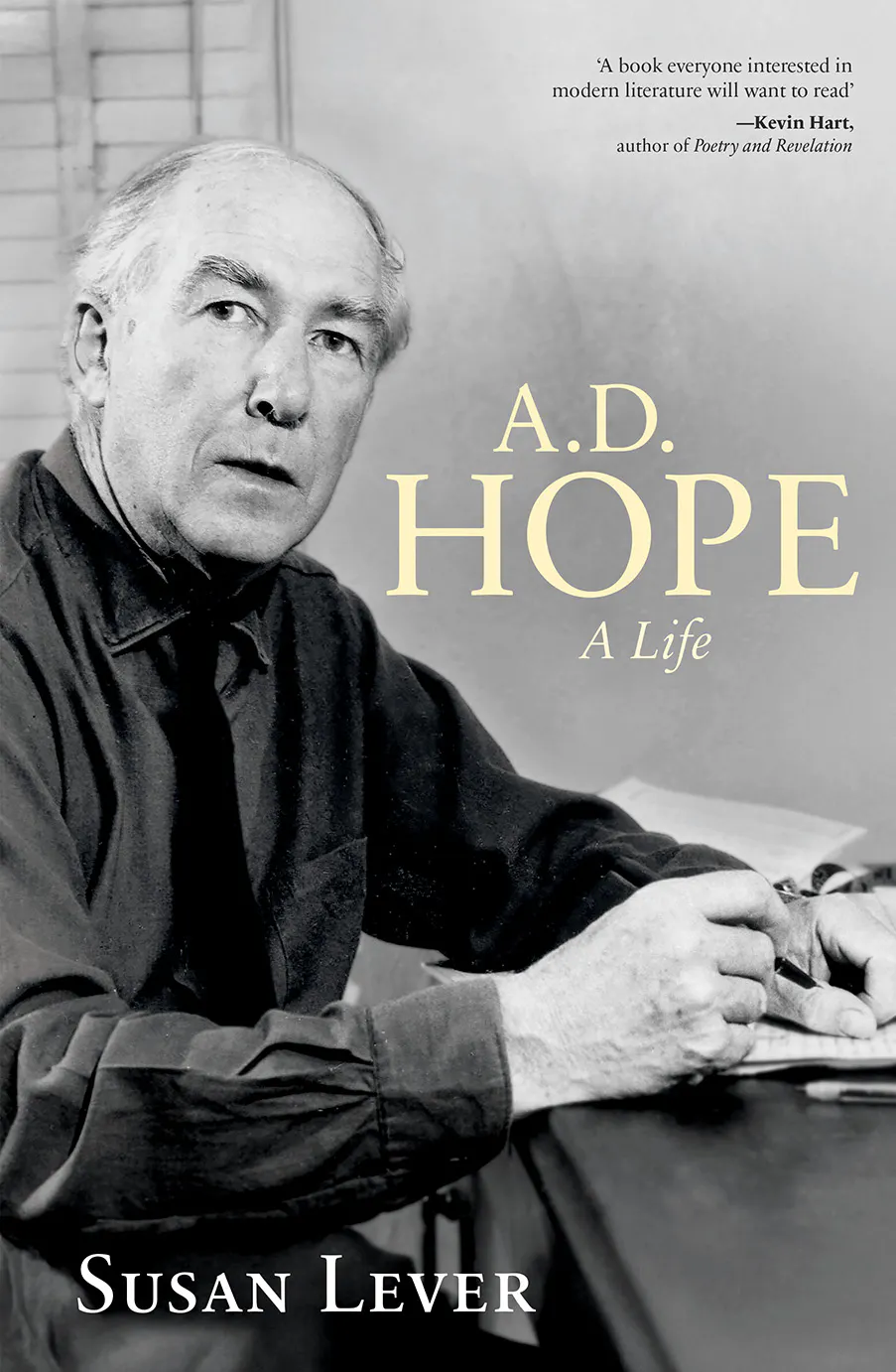
Damian Maher reviews Susan Lever’s biography of A.D. Hope, which rounds out the picture of a poet known for his caustic satires and reviews. Reading Hope’s verse alongside Lever’s account, Maher examines Hope’s sexual and cultural politics.
‘Huge irrelevance’ is less flattering than many of the other cock-conceits found in A.D. Hope’s poem ‘Phallus’: ‘the gods’ God’, ‘Divine divining rod’, ‘rigid pomp’, the ‘tongue of prophecy’, ‘Me within me’ (big M, mind you). It does, however, seem preferable to, although slightly smaller than, ‘his obelisk of woe’. In this rarely anthologised poem, the dick does not hog all the limelight; the vulva is variously ‘her wound’, ‘her Bab-el-Mandeb’, ‘the blood-sponge god’, and ‘the toothless mouth’. The two are coupled in one of the most spectacularly awful closing couplets ever written: ‘Stiffly my wooden horse / Receive into your Troy.’
Writing to rescue Hope from irrelevance, huge or otherwise, Susan Lever offers this reading of ‘Phallus’ in her new biography:
Lever’s reading could serve as a study in restraint – don’t mention the rod, the orientalist stuff, or the rickety, rapey Trojan horse. She perhaps maintains her composure in the name of friendship. Hope was a colleague at the Australian National University, and, in one of his many professional acts of kindness, he launched her first book. Too much attention paid to ‘Phallus’ and unpublished ditties on titties like ‘On a Fine Day in Summer’, whose last stanza goes, ‘Big tits and little wits / Do often go together, / But who would want / A talking cunt / In such fine fucking weather?’ presumably don’t help the effort to rehabilitate Hope as a ‘serious’ poet and critic, rather than the bawdy satirist, savage literary reviewer, and neo-classical conservative known to his friends as smart-Alec or Phallic-Alec. The slight snag is that Hope, known today for poems like ‘Australia’, ‘Imperial Adam’, and ‘The Death of the Bird’, is very much all these things. Lever directs her readers’ attention to Hope’s less disreputable features. The result is an acetoned portrait. Or, to put it in the style of the couplets he published in Playboy: Take out the ribald and rancorous wit, / and all yez left with is a fucking twit.
Larkinesque belittlement is how Hope begins his memoir Chance Encounters (1992): ‘Nothing much worth relating happens to a small boy living in the country where nothing happens.’ Lever introduces his Tasmanian childhood through a reminiscence found in a poem called ‘Hay Fever’:
Cornflowers, lucerne and poppies, sugar-grass, summer-grass, laced
With red-stemmed dock, I feel the thin steel crunch
Through hollow-stalk milk thistle, self-sown oats and rye;
I snag on a fat-hen clump; chick-weed falls in a bunch,
But sorrel scatters; dandelion casts up a golden eye,
To a smell of cows chewing their cuds, the sweet hay-breath:
The boy with the scythe never thinks it the smell of death.
The well-chosen lines are a fine introduction to his ear, his pastoral treatment of rural life, and his Wordsworthian vision of his own childhood. You can hear the whistle of the scythe through that ‘hollow-stalk milk thistle’, feel the blade swing back and forth through the hexameter and then catch on the ‘clump’, see the boy’s sense slip, all before almost dropping the last rhyme, which delivers knowledge kept from the boy in his idyll. The attentive run of names – cornflowers, lucerne, poppies – is a far cry from the poet whose most famous poem begins: ‘A nation of trees, drab green and desolate grey / In the field uniform of modern wars.’
Born in 1907 to Percival Hope, a Presbyterian Minister, and Florence Scotford, a schoolteacher from Bathurst, Hope counted Wordsworth, Tennyson, Keats, and Percy Shelley among his earliest poetic influences (or ‘familiar friends’ as he called them). Australian poets were nowhere to be found in the family library. He also liked playing around with hymns, singing this adaptation ‘with a special ecstasy’:
Jesus loves me, this I know
For the Bible tells me so,
Little ones to him belong,
I am weak but TEA is strong.
In 1916, his father left for the Western Front as a military chaplain. Hope was ‘constantly in agony’ worrying about his father’s safety. Around this time, he also suffered what he called his ‘first great moral crisis’, when he ‘became obsessed with the essential evil of my own nature and the inexorable logic of damnation that it implied’. The crisis led him into a ‘childish Manicheanism’ (Hope’s words), and towards poetry. Poetry became a means of rejecting such Manicheanism and ‘an impulse of celebration of the whole world and myself as a part of it’. His early taste in poetry developed somewhat accordingly. He read Byron’s Don Juan at ten and wrote that it was ‘“just right” like Goldilocks’. In 1921, the family moved to Bathurst. There, Hope took a shine to what he called ‘the best and dirty’ poems by Catullus, and (left unmentioned in Lever’s biography) music hall songs like ‘A Bicycle Built for Two’ and his personal favourite, ‘Beer’:
Beer, glorious beer
Fill yourself right up to ‘ere,
Down with the pail of it,
Swim like a whale in it,
Beer, glorious beer!
Hope then studied English and Philosophy at the University of Sydney, where he was among the first students in Australia to study psychology, before heading to Oxford on a Travelling Scholarship. There he spent two grim years studying Icelandic, German, Old Norse, Anglo-Saxon, and Gothic (for which he developed a particular loathing) under the tutelage of C.T. Onions (fourth editor of the Oxford English Dictionary and almost certainly the subject of only mildly amusing name jokes), J.R.R. Tolkien, and C.S. Lewis, who greeted every essay Hope wrote with bored indifference. Hope left with a third, which dashed his hopes of an academic position. He odd-jobbed his way through the Depression before riding the wave of newly established magazines – Southerly began in 1939, Meanjin in 1940, Douglas Stewart began his tenure at The Bulletin in 1940, and Hope’s close friend James McAuley edited Quadrant from 1956 – and the post-war expansion of higher education. After holding a lectureship at Sydney Teachers’ College, he was invited to apply for the chair of English Literature at the University of Melbourne in 1945. In 1950, he was appointed to a new chair in English at Canberra University College, then an outpost of Melbourne University and later incorporated into the Australian National University.
It was during the 1930s and 1940s that Hope wrote most of his well-known essays and poems, although the latter were not collected and published in book form until The Wandering Islands (1955), when Hope was forty-eight, because the censors were not too fond of all those nasty poems about sex. The essays established Hope as the provocateur of Australian literature. While Hope was playing along nicely with kids as ‘Anthony Inkwell’ on ABC Radio’s Children’s Hour, he was firing sabot slugs at almost every Australian writer. Twenty-two-year-old Max Harris, soon to be had by the Ern Malley hoax, copped Hope’s finger in his eye. ‘The Vegetative Eye,’ Hope begins, ‘reminds me of a one-man band. It is about Mr Max Harris […] written by Mr Max Harris, published by Mr Max Harris, and advertised with fearless praise by Mr Max Harris in Mr Max Harris’s journal Angry Penguins.’ These are the nicest words in the review, where, Lever comments, ‘The guns seem rather large for the target.’
Like his much-admired Alexander Pope, ‘the wicked wasp of Twickenham’, Hope had a keen eye for writers’ worst moments and almost no sense of compunction. ‘Smite and spare not!’ was his motto. He dubbed the poet Norma Davis ‘Miss Nausea Eyewash’. (Unbeknownst to him, she was dying, so not a good look.) Patrick White never forgave Hope for skewering The Tree of Man (1955) as ‘pretentious and illiterate verbal sludge’, yet perhaps more humiliating was Hope’s nonchalant, patrician panning of a scene from the novel where Amy and Stan Parker have sex:
As one might expect, all [White’s] golden words are spent long before he comes to passages of intense feeling and, trying to go one better, achieves this sort of thing: ‘But his body was flooding her with tolerance. They flowed together in the darkness. The coasts of tenderness opened to admit their craft. Sleep swam out to meet them, from under the trees.’ It makes one pine for the old-fashioned row of asterisks.
What, one wonders, does talk of wooden horses entering Troy make one pine for? Lever packages this and other reviews in (the unamused) terms of debates over Modernism, to which Hope professed a keen dislike, and settler literature. She calls his 1941 review in which Hope dubs the Jindyworobaks the ‘Boy Scout School of Poetry’, lampooning their ‘boyish enthusiasm for playing at being primitive’, a ‘valid engagement with what is now called Australia’s postcolonial cultural dilemma’. I’m not so sure that sentences like, ‘We have created a new European country in Australia and we belong to the European nations even though we do not live in Europe’, or ‘But to the majority of Australians, the point of view and culture of the aboriginal [sic] is still more alien and remote, and [Lever leaves this part out] the poet who tries to write like a second-hand abo. [double sic] is no more likely to produce sincere work than the poet who writes like a second-hand Englishman’, are ‘valid engagement[s]’, whatever that hedged description might mean. The unpleasant task for a contemporary reader is to sieve the potentially useful cynicism about cultural appropriation, which has no time for niceties, from those bilious lines.
Eager to get away from displays of what Hope called his ‘natural malice’, Lever insists that there is much more ‘positive’ work done elsewhere in his essays and his ‘most serious early poems’. These lesser-known, and sometimes unpublished, poems such as ‘The Damnation of Byron’, ‘Ascent into Hell’, ‘The Return from Freudian Islands’, ‘Pygmalion’, ‘Private Screening’, and ‘Bachelor Pad’ betray, Lever suggests, a less bombastic relationship to Modernism and wade into the ‘psychology of fear and sexuality’. ‘Private Screening’ and ‘Bachelor Pad’ are uneasy, seedy, lonely dramatic monologues of men who would haunt the same dives as T.S. Eliot’s Prufrock if they could only make it out of their rooms. ‘I can cut the brain film here,’ says the speaker of ‘Private Screening’, for ‘the preliminaries / have been too often, too well rehearsed before, /And with various leading ladies.’ Director of his own blue film, he can ‘cut to the scene / of your standing naked while my greedy eyes / recite you, ... my mouth on your breast, my hand between / the delicious consolation of your thighs.’ ‘Recite you’ is a reminder that this longing address, like that of Eliot’s Prufrock, is a meditation on love and poetry dogged by unfulfillable and unfulfilling desires.
The poem’s first stanza ends frozen on that frame the speaker has replayed all too many times. ‘But,’ the second (and last) stanza begins, ‘the telephone does not ring’; the woman does not come. Dispassionately, the speaker states, ‘I have only used you as one puts fresh-cut flowers / In a dingy room – I shall often change them again.’ Could there be a more pitiless prosthesis, a more remorseless ‘objective correlative’ for a man’s wasted desire than fresh-cut flowers in a dim room? He spirals. This second, and closing, stanza trundles through years of tormented repetition, arriving at ‘the man of thirty-three who no longer pretends / that it gets him anywhere much or brings love nearer’, but still chooses ‘your face, your sensitive body, for ends / no subtler’. Freud might help to make sense of some of the speaker’s despairing, disintegrating self-analysis in ‘Private Screening’. The speaker, a Freudian might say, is compelled to screen an unpleasant experience to somehow master or bring back a lost love. (Evidently, Hope’s response to Freud does run deeper than the easy mockery found in a poem like ‘Private Dick’ – ‘Call that a tree? That’s a Phallic Symbol! Boy, is that psyche of / yours a wreck!’) Freud, though, does not determine the end of ‘Private Screening’. The speaker does what Prufrock cannot and draws a ‘clever / comfort, illusion of force and growth in a brain / stopped growing, and fixed in its adolescence forever’ from the singularity of his love: ‘that it is you, and not anyone’.
Much could be said as to whether that ‘clever comfort’ in singular attachment survives when the ‘you’ is cut up into breasts and thighs, or becomes anyone who reads the poem. The poem hovers ambivalently between revealing that comfort, growth and a renewed will are (mere) ‘illusion’, and sustaining the prospect of all three through poetry. Given Hope’s Freudian interests, one could then ask whether by transposing a singular love onto the reader, he sublimates his desire into poetry: no matter what the speaker says, he is always asking after someone else. Hope, however, didn’t include either ‘Private Screening’ or ‘Bachelor Pad’ in The Wandering Islands (at the behest of the publishers) or any collection thereafter (seemingly of his own volition).
The Wandering Islands and his first Collected Poems (1966) rather contain poems that are unpalatable smoothies of pity and farce. ‘There is,’ Judith Wright wrote about Hope, ‘a certain vulgarity about it, the vulgarity of a man who has misjudged his listener. Either we want to be amused, or we are interested in the private self-analysis of the poet; we cannot attend to both.’ The double act of disgust and self-disgust sometimes surfaces self-pity bobbing below apparently pitiless self-exhibition:
Down through a hundred raptures I
Slide weakly out of her and lie
Like a wet worm upon the boards,
And nobody at all applauds.
Sometimes the double-act turns violent. Female bodies, such as those in ‘Massacre of the Innocents’, are usually the ones to bear the brunt:
The unruptured egg shrieks in her fallow womb.
Freckled with blood his knife-arm plunges straight
For the fat suckling’s throat. He drives it home
Full loaded with his contraceptive hate.
Often, satire discharges Hope’s disgust with himself, society, bodies, Australia, poetry, Australian poetry, ‘fatuous, flatulent Sunday prose’, Freud, self-knowledge, lack of self-knowledge, ‘drivellers, snivellers, writers of bad verse, / Backbiting bitches, snipers from a pew, / Small turds from the great arse of self-esteem’ – you name it.
For instance, the gag of ‘The Conquistador’ is not that Celia shits, but that she sits. In this mock-epic, Henry Clay lusts after a large woman. She, like the many other enormous women that populate Hope’s poetry, proves too big to be moved or conquered:
Climbed the white mountain of unravished snow,
Planted his tiny flag upon the peak.
The smooth drifts, scarcely breathing, lay below.
She did not take the trouble to smile or speak.
And afterwards, it may have been in play,
The enormous girl rolled over and squashed him flat;
And, as she could not send him home that way,
Used him thereafter as a bedside mat.
As in Swift or Pope, male vanity and ardour are squished by a monstrous woman, rendered so large as to not even feel Clay groping and thrusting. To once more use a woman for grotesque comic relief might well serve as a testament to the monotony of the male imagination. Could any gaudy tulips rise from such dung?
Missing from Lever’s biography, and her commitment to Hope’s seriousness, is a critical appreciation of Hope’s rancour, and the tradition of satire he positions himself within. In his lecture ‘Three Early Australian Poets’, collected in Native Companions (1974), Hope challenges the depreciation of eighteenth-century literature by contending that William Wentworth, Charles Harpur, and Henry Kendall wrote ‘public poetry’ and satiric verses using Augustan gear in an Australian climate. He quotes Harpur, who offers a fairly typical defence as to why satirists flay human failings: ‘[the] occasion may arise, to explode the thunder of his indignation against whatever is degenerate and slavish in the people, or tyrannic and corrupt in their rules. Such in the light of a true judgement will appear the proper vocation of a poet.’ Hope adds that this is ‘almost exactly the function of the satirist explained and defended in Pope’s “Epilogue to the Satires”’. It is almost the same. ‘[T]ouch’d and sham’d by Ridicule alone,’ satire is not, Pope writes, misanthropic mirth, but a ‘sacred weapon’ that rouses and goads people’s better natures. Part literary-historical reappraisal, part rebuke of the high-minded evaluations of poetry that neglect light verse and satire, Hope’s lecture is full of revealing judgments on satire – Kendall ‘lacked the detachment necessary to great satire’ – and what might generously be called selective readings. Defending Wentworth’s Australasia as a ‘noble and moving poem’, Hope points to ‘the nice balance between pity and disgust’ in Wentworth’s line, ‘sad sepulchre of all the rest’, which memorialises the cannibalistic demise of La Pérouse’s lost expedition. It is, though, quite hard to find such balance in heroic couplets that, like a swaying thurible, waft incense over the colonial endeavour: ‘Soon, Australasia, may thy inmost plains, / A new Arcadia, teem with simple swains.’
Hope’s choleric, vituperative railing occasionally overturns these and other expectations for satire. ‘A Commination’ begins, as all good comminations do, with a biblical epigraph that serves as a curse, a signal of poetic defiance, and a sign that reformation is off the table: ‘He that is filthy let him be filthy still’ (Rev. 22.11). After drubbing the educators, the prophets, the punks, the advertisers, the technocrats, and the leaders of our time who ‘pour into my ears a public sewer’, Hope sets laughter as the alternative to ‘recourses of despair or disgust’. Laughter provides painful relief: ‘But let me laugh, Lord; let me crack and strain / The belly of this derision till it burst.’ Hope was not, however, entirely convinced by such therapeutic ends.
In Lever’s account, Hope grew out of all that despair, disgust, adolescent discontent, and saeva indignatio to become something of a Romantic in the 1950s. Lever follows Wright, who thought that Hope arrived at a ‘conception which frees poetry at last from the limitations of conscience and consciousness into which the rational and intellectual life of the eighteenth century first betrayed it, into the service of faith and praise of what is.’ Wright takes ‘Epistle from Holofernes’ to exemplify how Hope came to a life-giving synthesis of myth and actuality:
If in heroic couplets, then, I seem
To cut the ground from an heroic theme,
It is not that I mock at love, or you,
But, living two lives, know both of them are true.
There’s a hard thing and yet it must be done,
Which is: to see and live them both as one.
Wright and Lever welcome this newfound double vision or double life, where derision and love co-exist, where all that is base or material need not disillusion but can coincide with higher feelings.
But there is a little too much telling and not enough showing here to convince. It is as though Hope wants cynics, sceptics, and satirists to know that they have misconceived the relationship between, say, raw naturalistic desires or instincts (I want to mate with you) and social norms and niceties (I love you); the former does not debunk the latter, but, in an optical illusion, exists alongside it.
Lever presents this frictionless affirmation as a liberation, but it seems to be one of Hope’s least convincing answers to his struggle with the callous and sometimes crude resistance of the world (and Australia) to expectation. Hope often went to greater, and possibly more dismaying, extremes to free himself from this quarrel. Reading them can leave one with the sense that he was better off quarrelling. ‘Conversation with Calliope’ ends with Calliope proclaiming the victory of ‘the great Un-Culture’ before shuffling ‘Some few in whom the heavenly rage / Still blazes and keeps pure the heart’ aboard an ark to survive the flood of shit. One might want to get on board or set the ship on fire, but Lever’s diffident treatment of Hope’s conservativism, generally throughout the biography and specifically as she reads this poem, neither takes sides nor offers an assessment of what happens to a conservative cultural appeal when it is issued from the shores of the colony.
That much-anthologised poem ‘Australia’ takes such cultural exceptionalism one step further. Lever helpfully notes that the last two stanzas were written in 1939, seven years after the first five satirical stanzas. Without the addition, the poem would have ended by rounding off the list of all the things Hope hates about Australia:
And her five cities, like five teeming sores,
Each drains her: a vast parasite robber-state
Where second-hand Europeans pullulate
Timidly on the edge of alien shores.
Seemingly dissatisfied, Hope adds two stanzas that extricate him from the muck by turning Australia into a clean state of mind:
Yet there are some like me turn gladly home
From the lush jungle of modern thought, to find
The Arabian desert of the human mind,
Hoping, if still from the deserts the prophets come,
Such savage and scarlet as no green hills dare
Springs in that waste, some spirit which escapes
The learned doubt, the chatter of cultured apes
Which is called civilization over there.
To climb the fence ‘through into my thought’, as Les Murray wrote, is not an uncommon move for settler poets searching for a sense of place. But bringing down, like some giant eraser, the Romantic trope of the desert as the site of spiritual refuge, a trope found in Byron’s Childe Harold’s Pilgrimage and Shelley’s Queen Mab, to rub out landscapes, society, people (Indigenous and others), all the grime that is Australia, does not appear to be a great or ‘equivocal’ (Lever’s word) achievement. It is, rather, a colossal extirpation for the sake of Hope.
‘Hope outlived his own reputation.’ Lever closes her biography by contending that it need not be so. Hope might have been pilloried by Thomas Shapcott in Australian Poetry Now (1970) for his ‘iambic drone’ and tossed out by John Tranter’s post-68 collection The New Australian Poetry (1979). His late critical works, like The New Cratylus: Notes on the Craft of Poetry, might suffer from ‘endearing old fogeyism’, as David Malouf opined. He may not have ‘fully grasp[ed] the implications of 1970s feminism’. And yet, as recovery stories usually go, he also wrote some surprisingly influential essays (his essay on Christopher Marlowe’s Tamburlaine was a key inspiration for Harold Bloom’s theory of the anxiety of influence); experimented with poetic form; and was a generous mentor and help to friends and colleagues alike. ‘I expect that I shall stand,’ Hope wrote in a poem imagining his posthumous reputation, ‘looking rather out of place.’ That is a two-sided wish.