
‘I rage because I have such a burning love.’ – Quill Christie-Peters, On Wholeness: Anishinaabe Pathways to Embodiment and Collective Liberation
Love and Rage
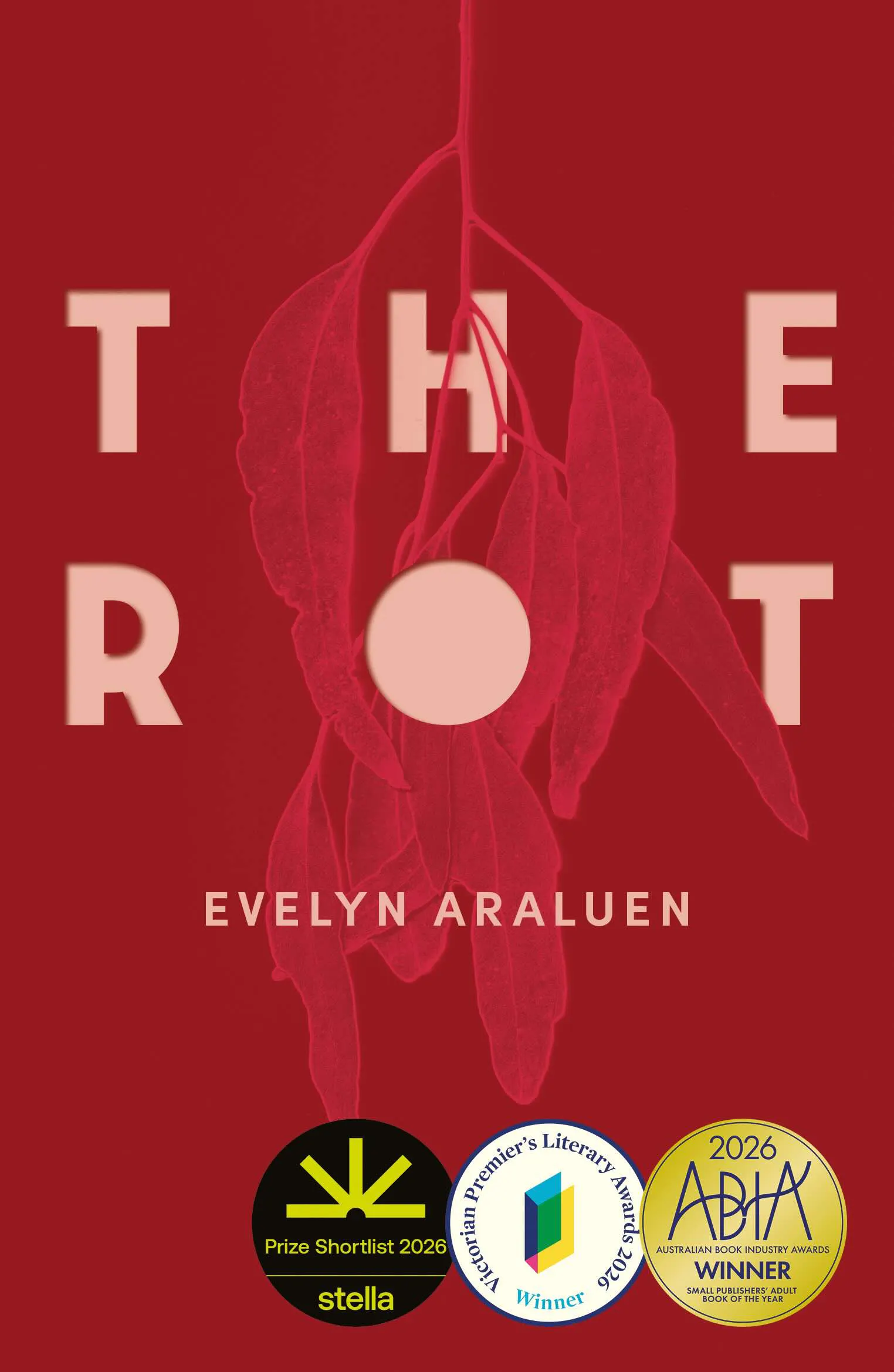
Mykaela Saunders on Evelyn Araluen’s midden poetics
Few words have captured our historical moment’s many malaises as neatly as ‘rot’. Parsing its usages in Evelyn Araluen’s recent book, Mykaela Saunders nevertheless finds incitement towards life and action amid the poems’ catalogue of catastrophes.
The anarchist salutation ‘love and rage’ is an expression of solidarity, marrying two powerful feelings that might be thought of as unrelated. In grassroots politics, rage is a protective energy deployed to keep safe that which we love. Evelyn Araluen’s new poetry book The Rot is a fiercely loving offering to all the poet loves, and is, as a consequence, an antiwar book. It is against the war on girls, the war on Gaza, the war on the working class – all populations loved by the poet. Using the language of the multivalent war effort, Evelyn launches, at the very core of her book, a counter-assault at the level of language, where all consent is manufactured, where all complicity and complacency are coerced.
There are poems that can be read as looking out at the world – or ‘staring back’, as Jeanine Leane wrote in her review of Evelyn’s debut Dropbear. But more than staring, The Rot takes the language of war, economics, marketing, slacktivism, the faux, the twee and the woo, and explodes it, making new weapons from the debris (no matter how ineffective poems may be against actual weapons). In other poems, those looking in, the poet stirs her fingers through her heavy heart to see what surfaces. Indeed, she acknowledges that writing some of the poems ‘emotionally depleted’ her. The work of raging against so many machines is balanced with licking the wounds they have inflicted, tracing the movement of pain through time, through history and family, and across space, in communities and minds, using, as Ursula K. Le Guin once put it, the ‘obsessive technologies’ of our time.
The Rot twists the cadaver of modern English open, spills its entrails onto the earth, and reads new things from its steaming guts. I want to write about the language of The Rot – its fresh shapes and meanings – and think about how the poet, despite handling slippery, imprecise words, is able to get her soul across so cleanly. What are the techniques she employs to convey rage, heartache, or the determination to go on, no matter what?
Each of the book’s three sections mounts in urgency and intensity of feeling. Part 1, HOLDINGS, sets the scene, introducing the book’s rich assortment of recurring subjects: girlhood, grief, horror, online existence, late capitalism’s subjugation of our souls. Every poem here is addressed to ‘you’, holding the reader at a distance while she puts us through her paces, and introducing recurring motifs of hands, blood, screens. The stakes climb higher in Part 2, FRAGMENTS ON ROTTING, as past and future are folded into the now, exposing the brutal machinery of settler-colonial abuse and its wide-reaching effects, and articulating the need to fight against its savagery while acknowledging the crippling grief and terror that comes with such a project. Moving into the first-person, this more intimate section feels the bleakest. Part 3, UNFOLDINGS, is emotionally devastating and urgent in its deep thinking about the future.
Rage is deployed in a few different registers, most straightforwardly in direct and blistering language that names the ‘rot’. Then there is quiet, seething rage, spat out in snatches and small phrases in otherwise contemplative poems. Finally, there is the satirical turning of jargon, and the language of violence and complacency, against itself, disarming it in the very act of approximation.
This third register is put to use in two poems which adapt copy from weapons sales pitches to describe more accurately what the machinery can do. ‘R400’ draws on an EOS blurb that sells vicious weaponry like a hot commodity, focusing on its ‘supple / seraphic’ designs and cutting-edge ‘firepower’. Evelyn sarcastically repurposes the blurb’s cold, attractive descriptors in an angry poem that makes something honest of the original propaganda hiding behind its technical and commercial euphemisms: ‘Sleek stabled axis of perfect mortality your nimble / lethalities outstrip market competition’. ‘Uplock Actuator System’ rejects Penny Wong’s lies on behalf of the Albanese government: ‘We aren’t sending weapons, they said, / just the only lock for the only door that / opens when they are fired from the air’. Where political spin attempts to obscure Australia’s complicity in the Gazan genocide, and weapons advertising copy tries to make it sexy, the poet cracks open this kind of language to expose the rot at the heart of it. She turns the language of war against the warmongers, pushing back against their empty words, filling in the silences (exactly what these pieces are used for, and by whom and against whom), writing the objects back into the real world, locating the flesh and blood impacts of such devastating machinery.
In a similar vein of parodic critique, ‘Billionaire Liturgy’ reckons with our era’s plague of grossly bloated capitalists and the true costs of amassing obscene fortunes, paid for by the working class and the planet. This poem counts all the crimes committed to attain such wealth:
for a billion you’ll need a billion
bones of a billion small birds, a billion
shimmering fish, a billion crimes, a billion
incandescent bribes for the cops, you could
feed a billion to the dopamine machine
and never touch the sides, he’ll spit you
out a deportation compound, the code to
automate the domicide protocol, before
you know it you’ll be communing with
The Market in faster-than-real-time
By repeating the word ‘billion’ Evelyn grounds this extraordinary number in the ordinary, cyclical evils of late-stage capitalism. And by ironising what it takes to make a billion (a wry version of the mantra that you only get out what you put in), she closes the distance billionaires create between their images and their crimes.
In these cases, the rot is the disease of capital, consumerism, war – but it is also the rotting flesh of horror films, the rotten core of the colony and its necrotic logics. The language of rot – of decay, ferment, calcification – is in every poem. But is rot the antithesis of living? The enemy? In recent years internet slang has produced the twin concepts of ‘bed rotting’ and ‘couch rotting’, describing the acts of sitting or lying still at home while scrolling internet feeds, reading books, or watching TV – passively consuming rather than working or writing or otherwise producing anything of value to capitalist sensibilities. It’s grim that the concept of rest, traditionally prescribed by doctors as the cure for burnout, has been denigrated as laziness and conceptualised as a process of decay. Audre Lorde said: ‘Caring for myself is not self-indulgence, it is self-preservation, and that is an act of political warfare.’ Still, I suspect that for many people with good politics, resisting the capitalist grindset and resting without guilt is a struggle.
Rot is also fertile; Evelyn quotes Michael Ondaatje quoting Chaucer, ‘Till we be roten / kan we nat be ripen’ acknowledging that the aging body and mind hold the fullness of experience. In ‘I Will Love (after June Jordan)’, Evelyn vows to ‘grow seed in the ash / from this rot grow love’. Old waste gives new life. In compost heaps, microscopic species thrive and these systems support us in turn. Similarly, Aboriginal midden sites are not just rubbish heaps. They hold important cultural, archaeological, and environmental significance. Ecologically, the unique composition of our middens gives rise to forms of life not found anywhere else; there are species of bacteria that are globally specific to their respective sites. Just as our cultures on our Countries are. Just as this poet working with, and playing around in, and raging and grieving through language is. But even our garbage has been colonised and extracted for colonial wealth. Many Sydney middens, piled over centuries with calcium-rich shellfish shells like cockles and rock oyster, were pillaged to make slurry for limestone to build wealthy Sydney buildings, particularly around Macquarie Street and the foundations of Government House, and the rock wall at Tubowgule, where the Sydney Opera House now stands (Quandamooka artist Megan Cope has drawn on this story for her own work).
Midden-like, the title pages for each of the three sections are parts of a black and white landscape photo of the chaotic contents of Evelyn’s bag. The photo is edited: the white turned up so bright it’s as if sunlight is blinding the eyes after spending so long in the dark. The blacks are grey, and the greys are washed out. Still, we can make out some of the contents: a small woven token and skeins of raffia for weaving; a toy susuwatari (soot sprite or dust bunny) from My Neighbor Totoro; a white keffiyeh with black net embroidery; a squeezed out aluminium tube of Aesop hand cream; a prescription jar of dexies and another white plastic prescription bottle, contents unknown; seashells; a large plastic hair claw; a MAC bullet lipstick; myriad cords and cables of varying colours and textures; an infringement notice; a travel-size squeeze bottle of hand sanitiser; a Marx & Engels paperback; a black Wilin lanyard; a pen or vape with 2000s tribal symbols; a silver blister pack with pills popped out; a white tube of something with government commission-style Aboriginal art printed on it; a tube of lip gloss. Combined, this midden tells of the poet’s preoccupations – tools and tokens signifying diverse cultural, spiritual, and political engagements. This is reflected in this book’s rich assortment of recurring subjects and motifs, affirmed by the list of readings at the back of the book. Of this list, Evelyn writes, ‘The poems and fragments of this collection were composed in response to a critical mass of literary and digital media works I consumed with unhealthy intensity following the publication of my previous collection.’
Many types of rot are uncovered in this book. Digital rot, mental and spiritual disease, physical pain and decay. The term ‘The Machine’ is used often, sometimes to mean the settler-colony, but mostly to refer to the internet or electronic devices; screens are portals to horror as well as connection. The social media algorithm is a living thing that can be fed. It eats and excretes. In the three sections of ‘256GB of salvaged memory’, the digital comes alive: breathing, growing, decaying, heaving, seething. The language of organic life is used to talk about the digital and electronic, entangling meat and machine, soft and hard, and breathing and lifeless forms. In the first of these pieces, a mini essay/prose poem, ‘[t]he pattern announces itself’ through a collection of digital detritus: songs, pictures, poems, quotes, gifs hoarded over years, evoking a sense of getting lost in the poet’s coming-of-age archive. We might think of ourselves as the media we consume. The second poem, a list of often-visited images, sets the scene for a young Tumblr account curator expressing her identity through other people’s images and quotes marked by ache, grief, rot, decay. The online self can be anyone. All this data amounts to nothing, but the poet can’t stop returning to it. The final section is an epic list of horror and despair; yet in juxtaposing the abject and mundane, it remains alive to the beauty of decay, to the breathtaking nature of even the grimmest of apocalypses. In ‘256GB of salvaged memory’, death is a continuation of life, not its opposite. Its poems function as digital midden sites, where new life arises from decay.
The use of lists, fragments and sections in parts that are revisited and reprised throughout the book conveys a sense of making order from chaos. In her ‘Disclaimer’ she notes some of these poems were written ‘on my phone in the bath’. Writing on a small screen shrinks immense, spiralling thoughts to poems the size of the palm. Much of the content of the rot circles around the spectacles of the screen, and in this attention economy, what better tool than the phone, what better scaling than its tiny screen?
The Rot is chock-full of the causes and effects of mental illness and spiritual crises. Insomnia is a recurring theme from the opening poem ‘Sleep Act One’; in hard times sleep is always the first casualty, which creates its own troubles. This poem lists coping mechanisms: ‘wine in / the bath, a cup of sleepy tea, a few licks of / your lover’s seroquel’, and other ways of escaping or abiding the hard things we see online. This is later reprised in ‘Sleep Act Two’, also about coping, or not, with the horror of the world filtered through the screen. Insomnia as both cause and effect of mental illness: paranoia and sleep-dep delusions, the hard work of not letting grief slide, and using hard facts as anchors to reality. The poet knows the urgency of holding the line, of not letting oligarchs control the narrative: ‘When they try to tell you a different / story, tell this one over and over again’. Memory suffers under the torture of sleep deprivation, which is exacerbated by grief, trauma and chemical remedies. The poet offers ways to store truths outside the deteriorating, micro-plastic riddled mind: ‘Keep them / on a hard drive you can hide from / the moon, make copies / in books the cops can’t read. / Store what you can in resin’.
The ideation and prevention of suicide is threaded throughout the book, particularly in ‘I won’t use these drafts for your eulogy’. This gorgeous poem is addressed to her beloved, touching on their shared life, grief and mental illness; its tenderness is made urgent by the title, headlined by the knowledge they are lucky to still be here:
My anxiety, your
rapid-cycling-polar-axis, the years we’ll spend
watching the fires, the children we couldn’t bear
teaching to survive. You keep saying this
is a good run on the life you’d parlayed,
tallying years against headstones, your mangle
of griefs.
Much of the book’s mental and spiritual anguish stems from its grief for Palestine, the past and future. ‘Those who will die after’ is addressed to ghosts of the future – ‘you who surface from rubble of rubble’ – and speaks to welding the self to the world, horror and all, and refusing to leave. More cynical and resigned, ‘One day the books will count the dead’ looks ahead to the future remembering of Gaza, predicting and condemning the intellectually dishonest strategies that will be used to ‘pass over the / weapons, / the death mongers’ to paint the genocide as ‘inevitable, / unstoppable, unfathomable’. Impotent sadness will wash out effective rage, erasing the victims and their fight against Israel. Such strategies enable Zionist settler moves to innocence, manufacturing consent for the next genocide this way. The poem finishes at the natural conclusion: ‘If we let them / they will do it again’.
I say Israel and Gaza, knowing the poet’s politics as I do, but I am putting words in her mouth as neither is mentioned in the poem. By defamiliarising the ‘we’ and ‘they / them’ of the poem, the poet casts her net wider, and back and forth through time, to include contemporary and future witnesses to any genocide. This poem is about the Gazan genocide in the here and now, but doesn’t lock itself to one time or place. The lack of specificity in the poem’s forms of address is crucial to the poem’s rhetorical intentions and its desire to activate the reader. What we as readers say or do now may well determine whether we become one of the ‘we’ or one of the ‘them’ in the future. The poem asks us, What kind of witness will you be?
Among the examples of spiritual and mental rot, the rot of physical pain is not forgotten, however, and Evelyn explores its connection to mental suffering through time. The three poems of ‘hip’ trace the history of an injury across twenty-five years, showing how pain can be a portal to old places and memories accessed by touch. In the second poem, a young girl walks through the wondrous, gothic scenery of Dharug nura, wanting to get lost in her imagination but thwarted by the seedy attention of men. Accompanying this implied menace is electric imagery that reveals a range of nightmares, from the intimate to the historic to the apocalyptic: ‘a figure in a blood-soaked surgeon’s coat performing night-time operations on the hips of young girls’; ‘walking the street with your lover and the piano falls, there is only time for them to beg you to claw their ribs back together but you are stone and still for the rest of your years without them’; ‘all the ancient pollinators of the world are turning to dust’. The third poem, one long run-on sentence in a block – a breathless, claustrophobic stream of consciousness narrated from ‘the latest in an assortment of foreign beds that fuck up my hip’ – moves from racing thoughts of escaping pain and her too many commitments, and returns to Dharug nura, the place where this all began.
In the midst of its exploration of mental and physical pain, The Rot insists on the dignity of girls in a world hellbent on destroying, then forgetting, them. The poet champions girls, defends them, and when that doesn’t work, she avenges and remembers them. Along with the book’s dedication (For my girls, and the world you will make), many of its poems are addressed to girls. In keeping with the language of the war poems, Evelyn cannibalises the jargon and neologisms meant to skewer the life of girls working and existing for the algorithm, which holds them in thrall as consumers, while subjecting them to the spectacle of horror day in, day out: ‘In this shining new era of girlgods / it’s your choice to girlsleep girlwoke girlcope’ (‘Girl Work!’); ‘glory be to girlypops gaslighting / too close to the sun’ (‘Glory Be the Girlypop’). By stringing all these phrases together into a maximalist slang fest, such poems drive home the dishonesty of the empowerment they superficially espouse. Moving beyond simply critiquing this language, she offers girls more, urging them to join the struggle: ‘Instructions on Getting a Gun’ commands ‘Don’t say girl boss say fuck the police’, while ‘Ark’ exhorts ‘Girls, we need you to be useful: there is so much to assemble, so much we must take back’.
A brilliantly elliptical musing on the cultural essence of girl and womanhood, ‘Terms of Reference’ lists the ways in which the poet is proscribed as a woman by the overculture – a proscription inaugurated at the beginning of our people’s apocalypse: ‘(iii) How much of this is to find a way to say that she died the day the boats came? That a body already dead can only ever be a ghost?’ That was the moment when her cultural womanhood was killed – and therefore, she has always lived her life as a ghost. Her cultural self is to be found not in this book, in written English, in the tools of empire, but in the still and silent Country of her ancestors, ‘perhaps still washing in the river in Baryulgil, wandering the hills of Molong, is resting on the banks of the Dyarubbin or waits in the lonely dark at Dennewan’. The ‘you’ and ‘she’ of this poem are doppelgangers, one a pained and writing self, separate to the real, eternal, self elsewhere.
The only time the word ‘man’ appears in the book is in a racialised way, as subject to white state violence: ‘Yesterday the / gunjis shot another black man in the street’. The only times men are concretely specified are when they are ‘tethered by relationality in the mode of address’ (‘Terms of Reference’): as father, as husband. There are a handful of blacked out words throughout the book for which ‘man’ or ‘men’ is my best guess (in all but one example): ‘Cars slow beside you and you have learnt not to turn your head, to avoid the eyes of spirits and ███’ (‘hip’, ii.); ‘While death holds the gaze of the ███, a girl is never presumed to look it in the eye’ (‘on ghosts’, i.). This is a book for, by and about girls, too often abused at the hands of men. By banishing men at the level of language, as an abstract concept and an amorphous group, The Rot allows girls to breathe deep and sleep easy, free of at least one common threat.
Close to my heart is all the playing around with genre in this book. I love to think about the function of genre (particularly speculative fiction subgenres) and how Aboriginal writers express story through their conventions. Horror, and its various subsets and body horror tropes, feature throughout The Rot. ‘Blood Wash’ is a meditation on blood and all its iterations in the life of girls, reflecting the rage of being a girl and all the shit done to them and in their names. Relationships are drawn between menstruation, birth, death, slasher films and hysteria; all along ‘the game was getting you used to blood’. Two true body horror stories come from her ancestors: that of the Baryugil asbestos mine, mentioned in ‘Sleep Act Two’ and ‘Analysis Act Two’, where her old people who worked there were killed by ‘throats of asbestos’; and of the lead in the blood of her mother (‘Sleep Act Two’ and ‘Glory Be The Girlypop’). Refracted through horror conventions, the marks of historical abuse at the hands of colonial capitalism left on her family’s bodies not only highlight the grotesquerie of these histories, but also call into question the categorisation of horror as speculative, not realist. Other poems mention more contemporary afflictions that fixate on embodied aesthetics, such as disordered eating and an obsession with a flat stomach: ‘Approximately three hundred saved videos of lower-belly exercises.’ ‘It’s hard to bathe with a body full / of body horror’, she says in ‘Losing Dogs’, encapsulating the defamiliarisation of the flesh that the genre explores.
Aside from horror, The Rot is also an extremely gothic collection. Western gothic is traditionally concerned with ghosts and hauntings, and it is little wonder our writers relate to the genre: What could be more perfect for us as abused people on stolen land? Some poems exhibit the poet’s deep thinking about the genre and its relation to girlhood, grounding Derrida’s concept of the ‘hauntological’ – the past which persists – in black woman’s thought. Indeed, ‘On Desire’ presents a brilliant thesis on the twinning of death and desire, listing all the ways that ghosts stand for longing, and the act of summoning them a form of desire and the antidote to grief. The first part of ‘On Ghosts’ theorises that ‘Death looms in all versions of female escape we allow ourselves’, and ‘The death of young girls in literature […] is charged with erotic spectre’. Girls are charged with staying young, girlhood dying in some way or other before womanhood is attained; in this sense, they are born as ghosts.
‘Night Cries’, a four-part poem, responds in title and substance to Tracy Moffatt’s seminal short gothic film of the same name. Night Cries (1990) is, as Evelyn puts it in the second section, a ‘speculative re-imagining’ of Charles Chauvel’s Jedda (1955), a film that Marcia Langton calls white assimilationist propaganda. In Moffatt’s story, set in the future of the same universe as Chauvel’s film, the Aboriginal girl Jedda (now played by Langton) doesn’t die but lives to womanhood and is left to look after her elderly white adopted mum. The film is set in a surrealist landscape standing in for Country, the perfect setting for the daughter’s ambivalent feelings which are contextualised by flashbacks to their history. All the wealth from the house and land of the original movie is gone. Although Jedda is no longer a girl, she remains trapped in that role. When her mum dies, Jedda is left alone, crying, as Jimmy Little’s ‘Royal Telephone’, a song about the power of prayer, plays: ‘Built by God the Father for His very own / You may talk to Jesus on this royal telephone.’ Building on the first two parts and drawing out the relationships between assimilationist propaganda, policies and poverty, the third part of ‘Night Cries’ meditates on the entanglements of labour, death and desire through the colony’s archiving of blackfellas through loss – familial loss through child removals and our old people’s loss of time and often of compensation in the documentation of their labour. The sequence ends with a found poem using Rosalie Kunoth Monk’s famous ‘I am not the problem’ speech from Q&A in 2014; Rosalie played the young Jedda in the original film. The four parts of ‘Night Cries’ provide important history and context for both films, including the words of both actors who played Jedda, entangling fact and fiction across time. By tying these different voices together across the history-story boundary, the four parts of ‘Night Cries’ channel the revisionary potential of art like Moffatt’s film, creating a sense of communion and continuity that Chauvel’s original work had attempted to foreclose.
Through generic conventions or otherwise, Indigenous writing that engages with our futurity is powerful conjuring. When centuries of policy and enforcement attempted to wipe us out in every which way you can count, imagining our thriving futures is important resistance, modelling our visions for others while exorcising our fears, so that we may share our hopes and connect with each other through this communing.
At its root, The Rot is a collection concerned with how to live – what methods, what morals – at this fraught and horrific moment, and well into the march of time. Central to the imagining of futurity is the labour, intellectual and manual, needed to get there. The Rot meditates on working and idle hands, crafting, making, weaving. The word ‘folding’ appears throughout the book with different meanings: the physical acts of kneading bread and folding laundry, the psychological process of folding something back into the mind after it’s been aired out. Folding can mean subsuming, assimilating one thing into another thing, or it can be an action that employs the hands to fidget out anxiety, or fight (‘But you are here now / and have hands, fists’, as the poet observes in ‘Sleep Act Two’) or simply because ‘you need / something to do with your hands’ as Evelyn writes in ‘You’, a poem that ends an entire section of ‘you’ poems with a plea to stay, to work through grief, loneliness, and alienation. A loving survival guide, ‘WHAT YOU CAN DO WITH YOUR HANDS’ desires a return to old ways and crafts, as well as providing practical and tender instruction on how to care and love for an injured pigeon, which can be mapped onto any hurt creature. In working and being marked by work, hands provide a kind of ethical litmus test for the poet as J.H. Prynne attests in a quote that opens ‘Analysis Act Three’: ‘no poet has or can have clean hands, because clean hands are themselves a fundamental contradiction. Clean hands do no worthwhile work.’ Indeed, reporting on the arrest of poet Alice Oswald during her support for Palestine Action, Dan Sheehan says, ‘Some poets get rounded up for protesting state violence. Some sip champagne with those who enable it. Same as it ever was.’
But The Rot is alive to the importance of intellectual as much as manual work. In the first two of three poems titled ‘Long Future’, Evelyn describes a galvanising moment in her intellectual, political, and spiritual life – listening to Unangax̂ scholar Eve Tuck’s lecture, ‘Biting the University that Feeds You: Theories of Change in the Settler State and its Universities’ (a moment explained in more detail in Evelyn’s contribution to the Shapeshifting lyric essay collection). This moment marks itself as the axis of the ‘Before, after, within’ of her life. The first section of ‘Long Future’ recalls her youthful awkwardness and struggles of the ‘before’: grief, insomnia, and disillusionment with academic research. On the way to bush care, the poet and her dad have a touching yarn, talking through Tuck’s ideas and others that made sense to them and had real purpose: ‘And he liked it, in most ways he already knew it, so he came back next week with another handful of pages he wrote instead of sleeping.’ It seems cleverness and insomnia go hand in hand in the family, both inheritances from dad. Sleeping well is at the top of the list in the poem’s second part which offers instructions for becoming part of the long future, a way of thinking of survivance into the deep times to come. This is a manual for getting lost in a new way – in the world of academic work, of living in the head, not the whole body, and the pain of learning, unlearning and relearning. There are candid reflections on being young and unready for dealings that wound. In this struggle there is no straight or easy path to enlightenment; the work and the knowledge both hurt. In the poem’s concluding section, the young born-again academic proselytises Tuck’s theory at every chance, selling it to family and students, watching it transform them as it did her. Then, she posts a clip of Tuck talking on social media and is woke-scolded by a white anarchist that Tuck married a cop. The dream is dashed.
I pondered this poem for longer than many others because it brings up interesting questions around politics and purity. I thought of all those who use certain aspects of their identities as shields to hide other privileged aspects, or to deflect from accounting for dishonest or harmful actions. I’ve never been an Eve Tuck superfan, but we can all agree that her co-authored essay, ‘Decolonisation is not a metaphor’, is now a seminal text. But even I felt betrayed. Maybe it is a metaphor, then? What kind of praxis is marrying a cop? An actual cop. They had kids and all. If all cops are bastards, what does that make someone who marries one? It’s meant to be ‘Fuck the police’, not fuck the police. ‘Kill the cop in your head’. What about the cop in your bed? I know there’s no ethical consumption under capitalism. But does that extend to love? To intimate relations? I know there are worse things, but isn’t this an unforgivable sin in our circles? Wouldn’t it be just like a ‘settler move to innocence’ to pretend we aren’t aware, to try to separate the art from the artist? Closer to home, some of our best and brightest have also been entangled with the police in various ways, or have been talking heads for mining companies that annihilate sacred Country and culture, or else make a living off running our people down. Some have atoned for their sins; others are yet to reckon with theirs publicly. Do we discard all their good work? Or do we just factor all the shitty stuff into it? Is it even possible to still enjoy any of their political work, tainted now with the knowledge that the resources that supported its production – the material conditions that made them so comfortable in lecturing to the masses – was wholly or partly financed by a cog in the most brutal machine we know? And that the very fact of their identities served to legitimise these institutions?
But what would I know? I have worked for universities that violently and bureaucratically suppress the rights of Indigenous people and our supporters to free speech and association. But I have bills to pay and mouths to feed. Still, I've never been married to an actual cop. Maybe if I were I'd feel more comfortable being more outspoken in public, knowing the protection I could summon at will. Anyway, I'm glad to know this now – not as ammunition for purity politics, but to remember that all humans are flawed, including our own people who act otherwise. All those high horses wobble on structurally unstable foundations. (In ‘Losing Dogs’, named after the Mitski song, Evelyn reveals that her beloved singer’s dad was a spook, making her a CIA nepo baby. Another strike against purity politics.)
Love is the biggest threat to the current order, this disordered universe that places profit above sacred life. Love reaches across difference, through dispute, protects the vulnerable, avenges the wronged, and gives salve and healing. I’m talking fearless, fighting, transformational love, not the watered-down stuff we are sold and told will save us. Evelyn has poured so much of this love into The Rot: love for girls, so long denigrated, abused and denied; love for blackfellas and all we’ve endured; love for the heating earth and the creatures who love her; love for Gaza, for children, other poets, ghosts, her family, husband, dog, Mitski and Eve Tuck. All this love leads to sorrow, rage, insomnia and obsession, but also to warmth and connection.
The book’s closing poem, ‘I Will Love (after June Jordan)’, references Jordan’s poem ‘Resolution #1003’, which begins, ‘I will love who loves me / I will love as much as I am loved’. Evelyn’s fresh, powerful response is a promise – a vow that whatever horror and heartache we meet as individuals, as a people, she will choose love as a way of moving through life, every time. ‘You will’ is repeated at various junctures in the poem where we might despair, give up or turn away, and this directive is followed by actions that preference protective love over anything less: ‘you will no more endure the well-intentioned / nor wait for tears to dry’ and ‘you will not placate the complacent nor / withhold your stumbled fragile rage’. These affirmations, among others, encourage the reader to show up, show care, work, fight and bear witness, especially over polite things we might be doing uncritically, as part of our conditioning, such as ‘break bread with motherfuckers’ – acts not of love, but of rote manners, and a waste of time we can no longer afford. ‘I Will Love’ is written in defiance of the pressure we feel to be good and work, to give up and die. This is a futurity poem, an instruction for how to endure in the now and any forthcoming apocalypse: ‘when the last flag falls / it will be death / or love’, and ‘until love kills you you will love’. Love is the strategy to abide, and the fuel to go on. Love despite, love in spite: an avowal to win through love.
While this strategy of love at all costs is woven throughout the book, three other poems stand out for their generous instruction for how to live. In ‘Invocations’, a list of things, big and small, to do to survive and feel okay with existing, and underlined with love. In ‘Antidotes for Despair’, each of the four parts references a relationship that is a ballast for her, each detailing a way of relating for feeling better when things are hard: i. a phone call to someone solid and dependable, who holds her grief and leads her forward with gentle prompts of what to do next; ii. sweet and easy friendship; iii. lovely Country known through sense, feeling and images; and iv. romantic love, replete with simple food and days. ‘Ache’ is a poem of grief, of death, addressed to the reader: we are on the same side, she is saying. We are struggling together. We must carry this pain together. And by giving equal weight to all these different kinds of relationships, rather than elevating one or another, she affirms love is a whole way of life, not just one aspect of it.
Something I had to reckon with, while reading this book, is that I often bury my feelings to survive, avoiding the news, keeping busy with work, deleting apps and blocking websites. Not so bad, I used to reason, as I used to do other, much unhealthier things to push away anything too intense. But as I read The Rot I ached. It opened up in me the fissures that I habitually stanch and bandage over to get on with things. Seething, tender, vicious, raw and lucid; written with such force and clarity the reader feels all the writer does; inviting fellow feeling and commiseration over the horror story that is settler-colonialism – on this continent, in Palestine, all over, all through time and beyond it – this is a book to be felt as well as contemplated. A marriage of head and heart, love and rage. A book that opens the reader up to let more in, and in doing so, encourages us to roll up our sleeves and get on with the work of pouring ourselves back into the world.