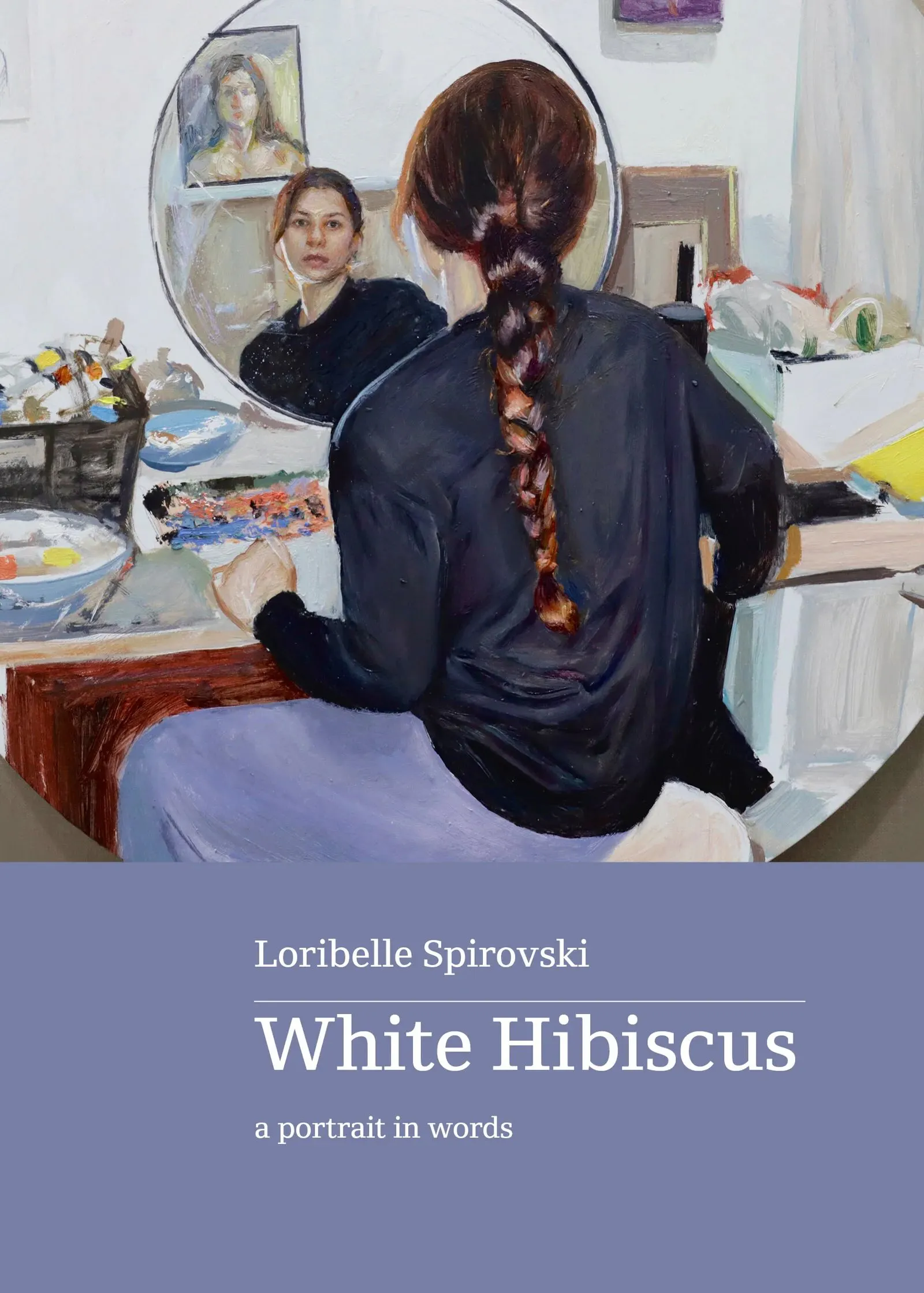
Loribelle Spirovski’s first book, described by the publisher as a poetic memoir, plays out in a boat-bound world that is marketed as a perfectly constructed luxury experience. This is typical of such journeys at sea: ‘The promise of a cruise’, writes Vimala Mangat in a Gazettely review, ‘is a meticulously crafted fantasy of indulgence. It suggests boundless buffets, carefree days by the pool, and an escape from the mundane.’ One scene in White Hibiscus captures an instance in which the messaging around idyllic harmony is deafeningly asserted: ‘While passengers disembarked’, the narrator observes, ‘“What a Wonderful World” / played so loudly / over the speakers / that you could do / nothing but sit / and wait for it to finish.’
But the narrator on this journey, Loribelle, is not having such a carefree time. Within this floating world, her nausea is omnipresent and diffuse. Its steady, staccato recurrence through the story springs up in relation to many different situations and encounters, symbolising the multifaceted ways in which abjection – that uneasy, queasy awareness of ever present but potentially permeable boundaries – inflects her journey. Aboard the ship and beyond it, the demarcations between classes, ethnic identities, and personal and public spaces aren’t as simple or as stable as they seem. Nor is Loribelle’s present life a water-tight state: past memories and trauma seep into it, like a leak in steerage, eventually demanding attention.
The cruise ship is one example of what Michel Foucault refers to as a heterotopia, meaning: a place that is a world unto itself, closed off from the world around it, which contains or reflects elements of the larger, shut-out world, even as it distorts and complicates the relationships between those elements. A cruise ship, for example, contains – in floating suspension – a gamut of spaces: those designed for hidden labour and performative servitude, like galley kitchens and reception desks, and those designed for private pleasure and performative holidaymaking, like luxury cabins and swim-up bars. Cruise ships also carry a full socio-occupational spectrum of people, from toilet cleaners to ultra-wealthy clientele. On the face of it, these delimited spaces and hierarchical strata are distinct and impermeable: they may interface with each other but are not permitted to leak into each other or change positions. ‘Our life is still governed,’ Foucault writes in his essay on heterotopias, ‘by a certain number of oppositions that remain inviolable, that our institutions and practices have not yet dared to break down […] for example between private space and public space, between family space and social space, between cultural space and useful space, between the space of leisure and that of work’.
Certainly, most clientele aboard the ship in White Hibiscus seem invested in defending supposedly inviolable spaces and distinctions. When Covid arrives on board, it functions less as a crisis than as a chance to redouble existing commitments to these boundaries and oppositions. A particular kind of elitist social distancing, for example, is already in place: ‘The passengers’, Loribelle tells us, ‘reluctant to be / in too close a proximity / to others – always kept / a polite distance. / I noticed that if they sensed / a crowd forming / they instinctively stepped back / waiting for numbers to disperse / – That’s how you can tell if the clientele is a luxury one.’ Guests are also already metaphorically masked. The wealthy, for example, costume themselves and signify their status in designer labels. The narrator refers to them at one point using sartorial synecdoche, a single sly instance of repetition hinting at the mundane sameness of this exercise: ‘Prada Bag / Ralph Lauren sweater / Chanel espadrilles / Saint Laurent bag / Gucci shirt / Chanel espadrilles.’ The staff uniforms, on the other hand, mask identity complexity under cover of single nationality. ‘Each crew member’, the narrator tells us, ‘had a name badge / identifying their country of origin / so we were waited on by both / Mark Canada and Mark Philippines.’
Perhaps because of the symbolic masking and default distancing already in place, the introduction of surgical masks on the ship becomes ‘quickly and quietly / ordinary’. Compliance with quarantine protocol now infuses, but does not change, established norms around protected personal space: ‘Whenever there were more / than four in a room’ following the Captain’s pandemic announcement, the narrator tells us, ‘guests / would / fumble inside pockets pull / masks / across mouths / look into laps.’
And yet, in heterotopias like this one, the dividing walls between oppositions and dearly defended distinctions can – at least temporarily – weaken or break down. The abject, as described by Julia Kristeva in her essay on the Powers of Horror, lives in this breach: the blurring, the discomfiting overlap, the disconcerting threat of cross-pollination. That which disturbs the division between self and not self is abject, and results in the uncomfortable sense that our own borders are unstable and permeable. This happens, for example, when we bleed, vomit, or transgress social norms, since blood, vomit, and taboo relationships destabilise our sense of what belongs to or can pass in and out of the body or in and out of established groups. The abject, Kristeva writes, is that which ‘does not respect borders, positions, [or] rules’. In heterotopic narrative settings, such as the cruise ship, gastroenteric events – like nausea, defecation, or emesis – can work to signal the point at which this happens: the moment where rigid categories and identities are breached, blurred, or inverted. And the presence of the abject in heterotopic settings provokes discomfort, not just disgust, because it reminds us how precarious and permeable our own identities, statuses, personal spaces, and physical boundaries really are.
In White Hibiscus, Loribelle has to negotiate a set of uncomfortable borderlands related to socioeconomic strata, ethno-communal identity, and sexual trauma: tilting seasick through hybrid crowds and empty function spaces, she occupies the uneasy overlap between guest and crew, European and Filipina, and the traumatised self / individual purged of trauma. Technically travelling for work, rather than for leisure, she and her husband don’t quite belong to the category of paying guests, whose showy wealth and dismissive, oversimplistic approach to ethnic identity unsettles Loribelle. Socioeconomically, she therefore finds herself in the position of almost belonging to that which both rejects and appalls her. Similarly, she relates to but does not belong to the group of Filipino crew members (Loribelle the narrator, like Spirovski the author, was born to a Filipina mother and then-Yugoslavian father). There is an unspoken connective membrane between her and the crew, and some quantity of mutual recognition leaks across this membrane – but it nonetheless remains in place, an uncomfortable reminder of her ongoing, untranscendable, part-insider, part-outsider status. And she also is marooned in a liminal territory related to the sexual assault that she endured as a child, unable to forget but equally unable to fully remember and deliver herself from what happened.
There is a potent scene – half real, half dream – in which she envisions her trauma made manifest in the form of a ‘large black mass’ that rises from the floor of the ship’s empty ballroom in the middle of the night; but even as she looks upon it, she is aware that it is both inside and outside her, never fully leaving her through expulsion or expression. As she looks at this thing, both horrified and magnetised, ‘the nausea,’ Loribelle says, ‘was a solid thing / in my chest / as though / the onyx child / standing before me / had its twin / inside / my ribcage’.
Other narratives that take place aboard cruise ships – like Ruben Ӧstlund’s 2022 film Triangle of Sadness, say, or Netflix’s 2025 documentary Trainwreck: Poop Cruise – use nausea and gastrotheatrics, but to different, if spectacular, effect. Triangle of Sadness centres its narrative around catastrophic expulsion: following a comprehensive portrayal of violent seasickness on board, surviving guests are spewed onto a beach, where power dynamics are radically, if temporarily, reshuffled. Here, vomiting and diarrhoea are confined to a single part of the narrative, delivering blunt-force symbolism to signal the abject social reordering underway, but they are not further leveraged for meaning. Trainwreck: Poop Cruise, alternatively, is concerned with grotesque containment: following a failure of power and waste disposal mechanisms, the guests and their shit have nowhere to go but closer and closer to each other. Here, the accrual of bodily waste escalates in tandem with an equivalent, opposite disintegration of previous social norms: the story’s deployment of the bodily unpleasant takes the form of a culminating crescendo. But White Hibiscus defies the narrative impulse to fully contain or expel, fully silence or tell, fully commit to insider or outsider status, fully deliver on a fantasy or completely descend into chaos. Instead, it keeps us in the realm of nausea throughout: the spaces in between, the borderland of me and not-me, the imminent feeling of queasiness that never leads to complete relief.