
Would she care as much if the reef were not as aesthetically pleasing as it was? As Culturally Significant? If the national identity were not being threatened. Had she not discovered in herself, that she was – in her attraction to Lexi, Tomas – at the end of the day, a deeply (undeeply?) shallow person, mesmerised, above all, by beauty?
The Human Romance
Ursula Robinson-Shaw on realism and the climate novel
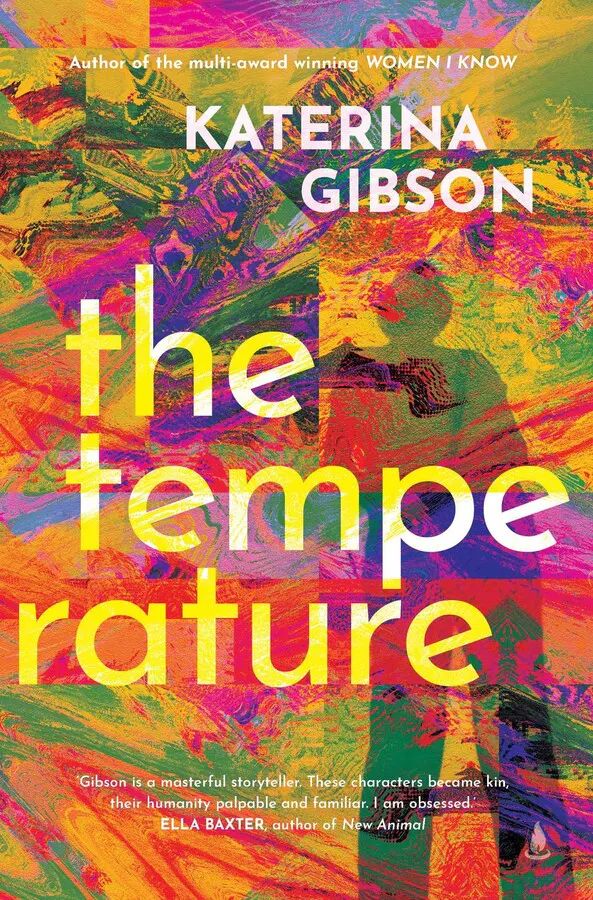
What remains of literary realism in the age of climate change’s great derangements? Reviewing Katerina Gibson’s novel The Temperature, Ursula Robinson-Shaw assays the use of audacious delusions, for life and for fiction, during these end times.
CONTAINMENT
When I was about seven, my father explained that the world was ending. His description of fossil fuels, the greenhouse effect, polar warming, the rising of seas was detailed and technical, with the slightly wall-eyed asides of a chemical engineer; despite this, there was something very practical, very inflexible, about what he was telling me. Soon after, I developed a recurring dream: I picked a blade of grass and fell through the earth, into a labyrinth of mechanical bowels, which roared terrifically, reproduced exponentially, would proliferate until, having excavated the underworld, they ruptured through to the surface. This force – which had something to do with the toxic sludge monster in Ferntree Gully, my mother crying, Mary the farm dog I was not allowed to touch – proceeded, unambiguously, from my own bad behaviour. I was personally responsible for it. A dream is a wish. The apocalypse looked back at me and winked. Special girl.
So I told Robert, vaguely intimating that this early pattern of paranoid dread might in some way account for my creative life. Literature is all repair, recuperation, redemption, telling us that life’s crises are not the cruel vagaries of an indifferent universe, but the unfolding signs of our character. How should a person be? What does it all mean for me? And this is a particularly effective coping strategy when we are anticipating an ending.
He pointed out, politely, that if I had been so trailed all my life by the black dog of environmental collapse, I might have become a climate scientist, rather than a pursuer of significant design in fiction. He did not mean my writing should be more political. ‘Not everything is good material,’ he said, cheerfully. ‘If you think climate change is bad, try reading a novel about it.’
I have. The novel is the cultural form that hinges most explicitly on the question of moral truth; a recursive gut-churn forming ever-tighter whorls of self-reference, self-loathing, self-judgement. We are familiar with the excuse that terminal capitalism renders us incapable of narrativising our own conditions, of imagining and thus actualising other possible futures; that our technologies have siphoned all the blood from our brains; that our blighted fingers can barely flick our screens before lassitude takes us like the spirit of a Black Mass. Under these conditions, are we motivated to tell a compelling story about climate change? No. We’re not motivated at all. This failure is often identified as the root of the problem: if we had better stories, we could remake the world – but we can’t remake the world because we don’t have better stories, perhaps we no longer have stories at all. Stories have been replaced with moods. We have given up teaching the children to read. Long in crisis, we have graduated. We are no longer panicking. We are doomed.
If you like sweeping generalisations, and I do, you could cast contemporary fiction into two camps: the annihilating solipsism of the autofictalisque, contorting her supernumerary vertebrae to face her reader, and the attempted return to the old world, when novels were Novels, characters spoke in quotation marks, and one thing led to another. Amid our hyperreal narcissistic vortexing, the cataclysms and the dissipation, the falling away of the natural world and the unnatural one too, Katerina Gibson flees collapse like a rat from a sinking ship and returns to the realist tradition, the point of which, Leo Bersani says, is to ‘coerce experience into making sense’. A realist novel can metabolise anything into a ‘structure of significance’, which disposes it to a maximalist style of thinking, a tendency towards a collapse of scale. The economics of the Napoleonic wars, English laws of succession, class conflict, sexual difference – all can be reduced to what Austen called the ‘light and bright and sparkling’ object, a composition that is also a self-sufficient whole, a kind of surface, an array of incommensurate particulars comprising a truth universally acknowledged, namely, that what gives the world form is human desire, that ‘apparently random incidents neatly carry messages about personality’. This is why it makes sense to talk about the ‘question’ of a novel; its implicit task is to make sense of experience, that is, to answer it.
Climate change is the impossible theme because, ‘massively distributed’ as it is, it has nothing to do with personal crisis, and because its scale prevents it from being directly represented, to think about it at all requires a metaphoric register incompatible with the merely personal. So it figures in the realist novel either as neurotic fixture or as set dressing. And why not both?
The Temperature opens with a little apocalypse kitsch, a quote from Revelations 12:12 – ‘Woe to the inhabitants of the earth and the sea!’ Though there is much hand-wringing about the death of all known things, The Temperature is about crisis on the human-interest level of breaking up with your boyfriend – substituted for a number of more or less compelling disasters such as: gay daughter, dead daughter, dead mother, deadbeat father, getting fired, getting cancelled (remember?). Gibson’s characters conform to ‘types’, or perhaps better to say ‘demographics’, of concern to the left of the recent past: the poster; the poseur, or aesthete; the downwardly mobile petty-bourgeois liberal arts graduate student; the enlightened proletariat; the upper-class activist; and the bigoted white farmer. Sidney is ‘an insomniac, failed poet’, ‘single, depressed PhD dropout’, and ‘fashionable’ bisexual; we find her, following a bad breakup, at ‘the precipice, but never the tipping point, of some personal disaster’ – luxuriating in a catastrophe that is yet to arrive as a way of avoiding the realities of the present. She works as a barista, spends her nights doomscrolling, haunted by dreams of the dying reef. Govita is a visual artist, ‘admittedly more prone to play than work’, who parties as a tool of elaborate procrastination, and avoids the news because ‘of course it felt like The End Was Nigh if your brain was suffering from overload’. Tomas is a lapsed climate activist and precariously employed single dad who loves movies and, inexplicably, Sidney. Legacy activist and ‘Venus flytrap’ Lexi Bostik is cancelled for fostering a toxic work culture at her environmental startup and being older than all her ex-girlfriends; at a loose end, she makes herself the live-in domestic of a farmer, Henry, who has spent the last twenty-odd years sending her hate mail, with ‘something resembling the passion of [a lover]’. Henry is the father of Ruth, Lexi’s first, lost, love who killed herself on Lexi’s hippie commune in the 1980s. Sadly, the developments between the latter two central characters – incredibly juicy in outline – get short shrift. Fi, with whom the book begins, is a member of the reviled late millennial subset; a taker of excitable selfies, ‘that tweet girl’.
These six are united by their concern; they all seem to have a pretty vague idea of what climate change entails, but they nonetheless fashion the concept into an instrument of penance whenever they look at their wilting vegetable gardens or unwritten PhDs or age-gap girlfriends or gay children. This is part of what makes the novel the same texture all the way through, like a bar of tone. I might say that the characters in The Temperature are an attempt to map the question of culpability in contemporary Australian life: how do settlers address, repress, or occlude the annihilations, past and future, that are the condition and the consequence of their national identity, their ‘being here’? I might also say, the better to make space for the reader’s judgements, that I have been writing this review for well over a year while undergoing an extensive, intractable renovation of my personality – that is, a breakdown. During this time, The Temperature became a part of my psychic infrastructure, the way fibres collect in matted hair. Doris Lessing once said, about The Golden Notebook, that a breakdown is a shedding of illusions. This does not always apply.
THE MORALISING IMAGE
Of all The Temperature’s portraits, Sidney’s is the most enervated. She is adrift in an eternal present-time, ‘living the same hours over and over again’, having failed to complete her thesis, to master her traumatic childhood experiences through a Mummy-baby relationship with an environmental warrior, or to award herself a sense of purpose in a world which seems not to need her at all. Sidney’s post-breakup climate anxieties, which orbit the death of the Great Barrier Reef, are shot through with self-reproach:
Hers is a contemporary psychology: she is a paranoid reader of the self, distrustful of her own apparent feeling, her own fallow, ‘flighty’ character, easily seduced by ready symbols. Her projections of ecological collapse are miasmatic, nonspecific – a crude doom lurking in mundane things, vague tropes of heat, rising seas, dead reefs, a terrible feeling in the gut. Her climate anxiety has not spurred her to action, but it has made her a bummer at parties. She rants to Tomas ‘about her dreams of the reef, her guilt. How writing about the reef was not enough, thinking about it was not enough.’ Enough would be something that exceeds the personal. The really torturous thought is not the death of the earth but the solipsism with which she entertains it, the thought that she might be ‘personally and solely responsible’, as Tomas playfully points out. Her climate anxiety – or the desire to sublimate it into poetry – serves as proof that she is one of the apocalypse’s bad actors, rhapsodising but not doing.
This is an inversion of the Romantic conception of the poet as conveyancer of the Image, as one who, Frank Kermode says, is necessarily ‘cut off from life and action [...] as a preparation for the “vision”’. In place of visions, Sidney’s fixations, her repetitions, her insomnia, cause stutters and lapses in memory, experienced as a crisis of language:
[T]here was only one moment after another. Time skipping. A constant but manageable feeling, the hum of cicadas growing in the distance. No, not cicadas. Or hummingbirds. Or bees, buzzing – like electric scooters. This was the problem with metaphor: it wrapped one experience onto another. And therefore – maybe – prevented her from being able to represent the feeling authentically. A mutinous belief from a poet.
This slippage, ‘wrapp[ing] one experience onto another’, is not a poetic lens so much as a puddle, a fumbling rush of half-chewed lyricisms, as if there were something stressful about the suture of an image and a meaning that must be avoided. Her moments of enchantment are reflexively discredited: ‘Birds, fallen from the sky. What a cliché.’ When she finds a coin, she is ‘communing with something unseen’, ‘the weight scientists couldn’t account for in the universe. Dark matter. Something she could find her way back through.’ There is a lot of this: getting lost, getting distracted, stopping to observe, glimpses of significance (‘something’) preemptively consigned to irrelevance. The seductive pull of the symbolic induces a feeling of helplessness, portrait of the artist as a sightless kitten. Sidney recalls an early oil painting of the bush:
In them the eucalypts had the soft, dense leaves of oaks, the landscapes rolled and blued in the hues of the English fields. Was this why she did not know how to articulate the underlying sensation of helplessness? She, a white settler, whose bloodline had not had to survive an apocalypse […] for whom no amount of blinking could pull history into focus.
Anxious about the colonising gaze – under which all things are referred back to established terms, so that a eucalypt is finally an analogue for an oak – Sidney’s ability to interpret the world metaphorically is undermined by her terror of history, past and future. Abdication of ‘vision’ might be another manifestation of the interpassivity that now structures our social reality – connected to Fi’s concern with being a ‘good person’ by being identified as the kind of person who is good; or to Govita’s desire to do more than ‘simply present as artistic’ while making art about their own self-presentation. But it’s through Sidney that The Temperature is most concerned with the frivolity of its substitutions, the language of personal disaster borrowing from the language of climate catastrophe, revealing that it is really the latter that borrows from the former – that, at least in novel terms, it is only the personal that is thinkable. Years ago, I met my friend Luara for coffee at the academic theme park where we were both then employed. I was in a slump, I said, having just read the latest IPCC report. ‘I don’t have time to worry about that,’ she snapped. ‘I might be breaking up with my boyfriend.’ Existential terror can be a placeholder for personal crisis, or both can be expressions of the same thing. Luara did break up with her boyfriend. It was 27 degrees in May. Which of these things took up the greater estate in my emotional life? Yet we would tend to regard the collapse of one into another with suspicion.
As Sidney’s climate grief is expedited by her breakup, so Tomas’ activism stems from the birth of his daughter. As a young father, his is the urge to do it right this time, even, especially, in the time of too late. For his failure to save the earth, ‘it would not be wrong, Tomas thought, if Minnie never forgave him.’ Minnie’s bedtime stories feature altruistic aliens, horrified by environmental collapse. An essential trope of The Temperature imagines time itself as a figure of witness: an alien, a child, a future anthropologist. Tomas’ concern, like Sidney’s, is with this future vantage, gazing back, as if he were only camped out in his historical moment, experiencing it as a set of contained images for someone else’s use.
Tomas shares with Lexi a connection to a shadowy ecoterrorist organisation which ‘required total devotion from [its] participants’. He is involved – and then, at the last minute, is not – in a dangerous action that leaves another man without an eye. Following this, he limits himself to attending climate protests, something he and Sidney begin to do together. When she leaves, he finds the protests ‘overlaid’ with her memory. Climate change itself becomes a reminder of her: ‘as the heat came earlier and earlier the memories would too’; ‘[as] the temperatures continued to climb his time with her would take over [...] his life’. He resolves to seek Sidney out: ‘If he was going to fight for a liveable future, shouldn’t he also be fighting not to be miserable there?’ Theirs is the couple form around which the novel bends. While the ecoterror subplot is rushed through, the prose stalls in his lovelorn worries, descriptions of the garden, movie summaries. Everything vital and sensuous takes place in the private domain. Individual life and political commitment are impossible to reconcile. Tomas must first secure his domestic happiness, like a life jacket or oxygen mask, before fighting for ‘the future’. Through Tomas, the novel pulls the anxiety dream of planetary annihilation into an intelligible structure of individual desire and possession – to fight for his daughter, he must get the girl.
For Sidney and Tomas both, every banality is soaked in its moral dimension: the food they eat, the transport they use, what they watch and read and talk about, down to the truly pecunious, as when Tomas admonishes himself for wasting ‘four buckets’ of shower-water while thinking of Sidney. By contrast, Govita is, of all the characters, the most efficacious, the least hidebound by grief or paralysed by the disappointment of their own moral codes, partly because of a reluctance to have any. Govita’s question is a variation on a theme: How should the artist live? Their unread books, borrowed from Sidney, ‘explored questions regarding how and if one should live an ethical or aesthetic life’, and their solve is pretty simple: the ethical life is the efficient life. The ‘aesthetic life’ makes it too hard to get anything done. After months stalling on a new series thematising the queer body, described as ‘not a reflection on community, simply a reflection – Narcissus, leaning over the water’, they are shocked to their senses in the black summer bushfires. Instead of making art about body and identity, ‘the ideas behind the art making process itself’, they shift focus to the event.
Visual art can wrestle out of self-reference and become about something; writing, not so much. When, eventually, Sidney returns to poetry, it is with urgency but no ambition. She discovers that the catastrophes she feared were those ‘unseen’, ‘things she couldn’t control’, ‘collapse and calamity’. Her anxieties are revealed to have been essentially aesthetic, and neurotic, after all.
Tomas’ skirt-chasing, despite its irrelevance to the project of Saving the Planet for His Daughter, makes sense if we think of him as a lover by vocation: ‘nature and the female body, were to him entwined, lighting up the same part of the brain in something that resembled worship.’ The object of worship is placed beyond comprehension, so the beauty and wrath of the planet derive from the same mythic source. As he makes a woman come, Tomas’ thoughts drift to Neptune, Roman god of waters:
In the tides of the sea, the bend of rivers, Tomas could concede there was something of the inexplicable, the benevolent and wrathful – and that these things were controlled by something remote, celestial, something so large as to be ungraspable.
His sublime ‘something’ works much the same way as Sidney’s anemic worry-beading about her own aestheticism. ‘Did the people who wreaked havoc on the environment understand the world they were leaving behind for their children – did he understand it himself?’ Because the characters are unable to ‘see’ their moment in historical time, should they judge themselves, even as hell is foreshadowed in every triviality? They know what they do; just not what to do.
This captures the basic interest of The Temperature’s characters: whether or not their commitment to the reproduction of a livable world is genuine. Do they really care about the reef, or the bush, or their children, or are they only seduced by the idea of the thing, the thingliness of things, their beauty? In this sense, The Temperature is a novel, like many Australian novels, about fraudulence, about the guilt that accompanies self-fashioning and its prosthesis, writing. One way to ward off a moral conclusion is to write books about writing, to avoid answering the question – how should I be? – by staging it instead.
But The Temperature’s ambitions exceed this sort of fumblingsroman reflexivity. From time to time, the narrator takes on a schoolmarmish inflection:
Was it possible, could [Fi] concede, she had – maybe – done the wrong thing? Was it an impulsive, thoughtless (drunk) thing to have done? Could she have kept her job if she’d apologised? She didn’t linger on this last thought, did not allow herself to acknowledge it, to hear it properly.
This does not quite chime with her gestural, unfurling elaborations of image (‘The ungodly shrieking, and its echo. Trees that whisper to one another. Canopy shyness: the thin strip of stars blinking through the trees, curling around each leaf, labyrinthine.’), which is, in places, striking. Elsewhere, it coincides with a contrived tautness and comes off like a highly dosed Attenborough, straining at profundity, tapering into self-consciousness, nodding out mid-idea:
An hour of time concentrated: the leaves of a mimosa plant, opening and closing like a butterfly. A day: a patch of sky, heating up, cooling down, flushing into night. The week sees every colour pass through it. [...] The river runs high and still, becomes a perfect reflection of the sky, undisturbed, even more inviting, perhaps, than its blue double.
Natural phenomena are at once abstracted and seen with the fixed bias of the camera. ‘From this perspective, it’s easy to see the grass taking breaths, ants drawing abstracts in the grit, the land, living,’ says the narrator, but what is this perspective? Sometimes the reader is roped in: ‘If we are to look beyond the perimeters of a lifetime’ ... Well, we – ‘those of us who are standing too close to time’ – can’t. Central to The Temperature’s style is this lyrical imprecision, a chronophasic tendency (‘through the trees, sunlight faded into cobalt’), murky compositions in which the exact terms of the metaphor are difficult to discern (‘the fluff of cygnet’s feathers mature and slick themselves down into the majesty of black swans’). In one such spool, human history is compressed into a series of objects; the metaphors for development are consumables, materials, commodities, doubling as a story of the Fall:
[...] as man invented tools, so too the lightbulb, penicillin, the iPhone, greed, forgiveness, the Dewey decimal system. To the earth, all humanity will be seen in a layer of the earth that will settle in a sediment, a slice of cruel history to be looked back on as a dog does a nasty bout of fleas, or as one recalls a tumultuous summer romance.
The rapid flickering of scale disorients: human history is a minor element in the geological record; then it is referred through the perspective of a dog, before it is restored to human particulars in the next clause. This is the ‘zooming’ of a malfunctioning lens, a jerky gurgitation back and forth. Heavy on colours, shapes, light imagined as bars or sheets or glosses – this lyricalese often struck me as The Temperature’s way of avoiding metaphor, as if the novel were determined, on a granular level, to retain an indifference to the transformation that is the key driver of poetic activity. The unthinkable scale of the apocalyptic event denies it a peer in figuration, and the attempts to bring it back down to earth, so to speak, are strangled and confused, imprecise or dysfunctional. This reluctance feels related to The Temperature’s tendency, despite the literary investments of the characters, to replace texts with images: videos, paintings, television, and, in Tomas’ section, multi-page synopses of movie plots, though books do appear as props. People watch nowadays and do not read, so this is ‘mimetic’, but this tendency jostles alongside so much suspicion about a love of beauty – as in the many valences of the old-fashioned ‘glamour’ – consternation about the textualisation of feeling, and evocation of the tropes of popular film, as when Henry’s ‘eyes [were] scanning the property like Schwarzenegger, not that he would make the connection himself’. Part of the work of the lyricalese is to keep the implications of the text perceptual – ‘closely observed’, as they say in creative writing – at the same time as the lyric churn gives the impression of cosmic scope. The many truncated similes, abbreviated scenes, jump cuts, film synopses, stack up to a scopic urge, a desire for transitivity, to cut to the feeling, that is, to the point: an imagistic freefall with no doubled meaning, a pure theme made apprehensible.
All this issues from the seat of social correction: The Temperature’s tut-tutting narrator, the posterior moral consciousness from which its characters are excluded. Hers is a generic narrator’s trait: to serve as a seeing eye – knocking through the walls of perspective, assuming all postures – and, more obliquely, as an interpretive guide, mediating our judgements of the characters, assuring us that we are not colluding with their bad moralities when we award them our sympathy. Tell us what we see, then tell us how to see it, so what remains for the reader is to ascertain the gap between narratorial voice and authorial intention.
Where are we to trust the novel’s discourse, and how much? The irony implicit in this compact is what makes fiction so peculiar as a form: though we might read anything in a state of suspicion, it is fiction that draws on the resource of suspicion for its fundamental operations. This is a delicate balance. We do not like to feel that we are being told, too neatly, not to trust. The Temperature distributes its suspicions liberally: a suspicion of the lyric impulse (Sidney), of the ethical impulse (Fi), of the political impulse (Tomas), of the altruistic impulse (Lexi), of the impulse to self-fashioning or self-expression (Govita) and, finally, of the nationalist impulse that finds its fullest expression, in Australia, through property development (Henry). Gibson’s narrator assumes our complicity in each of these impulses, and attempts to do what Sidney cannot – ‘blink and pull history into focus’ – in a voice laced with a lyricism that is itself impossible to judge, insofar as it transmits no clear message, as if its totalising idea had flickered and extinguished during the flight of thought to speech.
By avoiding the scandal of metaphor, a realist writer ensures they are not accountable for the promotion of a systematic ideology that might obliterate individual human particulars – suggesting, essentially, what could they have done, being what they are? Was there another earth for them to burn? This points to a guilty structure: emphasising our shared agency, the individual can harness their resources and put them to the retention of some element of the good; failure to do so invites judgement from the perspective of eternity; yet individual limitations make such a perspective impossible to attain, so we must accept the inevitability of adverse judgement; and since this judgement can only emanate from ‘outside’ human time, it is prefigured; as such, the ethics of the present are, if not neutralised, pretty much redundant.
What I’ve called the novel’s moralising image may be a reaction to squeamishness about metaphor itself, anxieties about the violence of symbolic reduction, a fundamental ambivalence toward a system of ideas. If this is the case, what is the conclusion, or delusion, to which The Temperature is afraid of succumbing?
My friend Geoff is a scholar of scale, if you can believe such a thing. ‘Scaling always involves the construction of more or less localised domains of sense,’ he wrote. ‘This allows you to avoid the problems of universals, while still retaining the capacity to systematically generalise.’ I trust, implicitly, anyone who relies on italics. The temptation is to think that scales are commensurable – that a big catastrophe, like climate change, belongs to the same order as a small catastrophe, like a breakup; that is, what is true of a small problem is true of a big problem, only more so; that, though the very size of a problem may create a proliferation of problems, and these problems may compound, they can be treated by the same method of abstraction. For this to be possible, you need the ability to group problems into orders, and this requires a ‘suture’, or a foundation, a position of arbitration from which evaluations can be made.
Character is the suture of realist literature: the unit from which all significant order proceeds, and to which all significance points. We take descriptions of feelings and acts to make up a ‘personality’, which the writer deploys as a partial metaphor for the social, which then functions as a partial metaphor for the universal, the human condition. At least, this is the workaday critical position familiar to me from my schooling. Q: Why does the character do this? Q: Why do you think the author wrote it that way? Q: What does this say about society? As Geoff put it, ‘either you have things inside your system that don’t fit together, or you’ve excluded stuff from the internal functions of your system, so your system is, in an important sense, incomplete, or not total.’ This means there are always ‘at least two possible systems’. What is the other suture, or determining system, for our purposes? Q: Are there any symbols? Q: What do they mean?
When I first read this book, I had just undergone a common experience, which is that my beloved partner of many years left me for being too wonderful. Among other complaints, he said he was sick of being the only person in our relationship who took care of me. I took him to mean I was alcoholic, addicted to uppers, addicted to downers, determined to destroy every professional opportunity that came my way, and often rude. I had believed, up until this point, that our union was animated by a profound romantic ideal; that what we were building was nothing less than something to live for in these last days of the world. If that sounds annoying, it was. More than annoying, it was a drag, so much high-minded existential filigree hanging off our necks every time we tried to make dinner. When our relationship ended, brutally, I immediately felt much better. I also thought, thirty or forty times a day, that I was going to die, and it toggled on and off like that; I felt much better, but I could not go on; this was a great improvement, but I could not survive it – like I had been shunted from a slowly boiling pot into the ocean.
Whining about heartbreak is shameless. One of the peak human experiences, it’s pursued by most people with bloodied determination the whole course of their lives. Many of these people go on to write poems; thankfully, in my hot/cold water tank, I stuck to novels, and at some point in my stupor hit upon that histrionic’s classic, After Leaving Mr. Mackenzie. I misremembered a line about audacious delusions and went around decorating things with the phrase for a while. The actual quotation concerns the heroine’s final humiliation at the hands of her wealthy benefactor and his executor: ‘They had destroyed some necessary illusion about herself which had enabled her to live her curious existence with a certain amount of courage and audacity.’ Somehow I scrambled this into an affirmation. Audacious delusions! I screamed, slamming my pint on the table, every time someone asked me how I was going.
Being in some ways practical, I fell upon the next guy who emailed me – too old, I thought, aesthetically incongruous, a bus driver, career bachelor – with whom I could not sustain fantasies about revolutionary couplehood or the fabulous securities of the property ladder or as my mother called them ‘wanted accidents’; with whom I might sequester my heart and other key organs in an indulgent and limited affair while I went about the practical business of rebuilding myself, for the first time in my vain and deluded life honestly appraising what I was and what I wanted, what I could still get from the world, or make do with. Goodie, I thought, time to self-actualise, buttoning myself up, awaiting the next phase in which I would be really fantastic, which looked exactly like the last phase except that everything that had gone wrong would now go right, because of all the lessons learned through suffering, hot on the heels of my own grand consonance.
Or this is what I believed, abandoning my work, barely sleeping, reading The Temperature, sitting in Robert’s garden, watching him swing around in his dressing gown and shout at the blackbirds, and it wasn’t until some time later, close to the present-time of writing, that he told me with kindness and only a little sanctimony that I had sought a first false cure in drugs and a second false cure in my partner, and that, having failed to fix herself by these means, the woman he met was just trying not to die. I took him to mean I was hard to talk to. It’s hard to talk to someone who is waiting for a sign.
The love story, Bersani says, is the greatest ordering fiction of modernity, because – much more than the individual moral adventure – it is the story of personality. This is so much the case, he says, that love is a dramatic metaphor for literature, not the other way around. When we want someone, we don’t just want them close; we think about what we are in terms of closeness or distance, and this delusion – in another person, more real than us, whose proximity will make us real too – is the force that makes each day hang on the last. This has a deranging effect. Among other things, a symbol is a failure of perspective. Denied love, we go crazy: the world has no hierarchy, loses the only system of scale – are we closer or further away from the loved one? – that can ‘hold the whole imagined universe’. Without it, there is no thoroughgoing way to account for experience, the objects of which become a dead currency, the coins in your hand turning to Prussian francs.
It’s a lie to say you ‘realise’ anything. Nobody can know what they haven’t first made room for. Nonetheless, I became aware that I was undergoing another common experience: falling in love with an unexpected person at a weird time. Automatically, my circumstances transformed from Russian soldier lies down in snow to comic miracle, like two tragic clowns tripping over each other in a darkened wood.
‘I actually like you,’ I said.
Robert blinked carefully. ‘Why is that a surprise?’ he replied. He drove his bus off into the desert, and I sat on the floor of my new living room, annotating The Temperature, feeling featherlight, enlightened, carried away by the incredible power of a new fiction. Bovarysme never strikes once. We are none of us safe from our repetitions. Again the world was new.
THE SIGN OF CHARACTER
It’s out of fashion again to abolish the family – all those primetime drag queens got married, binary gender is back, reproductive rights are out, rents are skyrocketing. The Temperature is concerned to queer those old solves of partnership, family, garden plot, security in domesticity, but everyone’s attempts to shirk or subvert the couple form fail. Sidney ends up pairing with Tomas, her age-appropriate father-surrogate, after repairing her relationship with her actual father. Govita goes home to the family farm in New Zealand. Fi, who relates to everyone in her life with sneering defensiveness or possessive self-interest, may finally answer a call from her mother. Most intriguingly, it is through the partial restoration of the family that Lexi finds her redemption-in-compromise: bunkering down in Covid with Henry, recuperating the deviant homosexual doubling with his daughter that has caused so much strife, while quite literally rewilding his parched farm, the brutal settler-colonial heritage of which is only patchily traced.
Henry’s plotline offers the most trenchant example of the violence of the family structure; used openly as a tool of frontier genocide, it cannot be justified in the narrative by the possibility of personal love it might occasion. Henry is a mean old bastard, abandoned by his wife and children; in his loneliness, he fixates on Lexi as the culture warrior devil incarnate. However, his is a cursed legacy – the third generation of men to participate in overseas wars, he returns from Vietnam pocked by post-traumatic stress. So humanised, he can be saved by the flawed and fallen Lexi. Unlike her, he lacks the power to interpret the political and environmental forces that blight his life, just as his father is described as ‘blissfully unaware’ of the massacres and the destruction of the bush required to clear their farmland, filled with the ‘sense of calm that an ahistorical understanding of the land had bestowed’. This logic of ignorance has the same structure as Sidney’s, Tomas’, even Govita’s: knowledge induces a guilty paralysis; lack of knowledge induces impotence and frustration, which are themselves paralysing. This softens their contribution to apocalypse, whether from colonisation or climate change, whichever way ‘accountability’ cuts.
That we should demand from a novel an ethics adequate to the present is, obviously, stupid – but this is precisely what the realist novel of climate declares as its subject. Then it talks about something else. More than the climate anxiety, the real volition of The Temperature is to do with coupling. The underside of its ethical-aesthetic consternation is the happy-unhappy family; the obverse of its social conscience is that most topical concern – should we, from our doomed vantage, be permitted to covet the most rapidly-diminishing of all commodities: the potential captured in the sexualised, lyricised image of the youthful body? The perverse ambition of this narrative element is undersold by its insincere reaching for a glittering humanist sincerity, embedded in much more cautious narratives about white saviourism, bourgeois hypocrisy, and settler-colonial inheritance. But the lyricalese reveals its wish. Lexi, upon meeting Ruth, whose youthful doubles she continues to date into her sixties:
She understood […] that the forming of continents, the earth moving for billions of years, volcanic ash spewing, cavities of soft coal collapsing to let in lakes and seas, the slow ambling of a planet – all of it had really been the earth rushing her forward to this point, and felt as if her feet had melted into the ground.
The whole of geological history becomes a backdrop for the human romance. Yet the actual details of courtships, the magnetic power two people exert upon each other, are scant, gestured to in retrospect, almost with embarrassment (‘The way they looked at each other across the room when they had a party, the bickering while they prepared a meal.’) Throughout, the fretful inner monologuing is reserved for concern, anxiety, frustration. Strong passions in action are not themselves depicted. But the romance remains at the heart of things, and the symbolic textures of the novel betray an erotomaniacal fixation on collapse: the sucking, crushing, burning, crashing, the great excess that threatens to annihilate. It matters that the surfaces in The Temperature are sensual, stimulating, affectively intense but conceptually insubstantial; images of the sea, of fire, of mountains and valleys, of flowers opening and closing, so many snowglobe aestheticisations of disaster. Like a man describing the details of Emma Bovary’s dress, the alien arbiter who narrates The Temperature wants to fuck our apocalypse. This is not just a great derangement but a great enchantment, a reification of the eschaton.
The ostensible question of The Temperature is the question of all realist fiction – in a world that is hostile to anarchic, disruptive desire, which of the available compromises will mutilate us the least? How can we refigure this compromise as goodness, or what avenues for goodness does climate change afford us? The Temperature is taking up the cancelled project of realism in an attempt to – what? Extend a self-justifying structure of protagonicity that fails and fails and fails, as the novel itself has it, to move us one inch beyond the fantasy enclosure, the summoning circle, of our own individual redemption? In the end, everyone settles. Lyricalese streams across the screen. The book is startled into silence by its own inquiry. The final chapter provides a hasty post-Covid survey of its cast: running into Tomas and Sidney, Fi felt ‘all at once [...] the guilt of every crime she’d committed against her friends and family’. Sidney forgives her before she can finish her apology, and this humiliation gives way to a new futurity, ‘if she could let her body carry her down the street, one foot after the other’.
Forgiveness is the final virtue of The Temperature. With ‘one foot after the other’, each character plods their way to redemption, never mind the horror, to kingdom come, to this oddly jaunty summary of the human adventure:
A story of extinction, of folly and largesse, read in carbon and excess, rendered into beauty, some wonderful curiosity. This knowledge uncovered, pieced together in things misplaced, a species of upset and destruction and waste emerging as a warning, a sign, acknowledged or unheeded. Or maybe, maybe in the evidence of absence, they’ll find the wisdom to let it all alone. For now, things continue to shuffle and race, we excavate and examine the path of our destruction, map it onto the future, and try to imagine ourselves there. For now, the wind blows through the trees, the moon pulls the tide.
The book delivers us to a final, cosmic compromise, the ideology of return – ‘reefs will leave, as they have left before, and, perhaps, return again, some new thing, plants that bloom and move and stick, crashing into another shape. Another predator, mammalian, reptilian, vermin or avian, will forge another path, forward’. Something will ‘forge another path’; there will be some renewal. Never mind that the frame of renewal dies with us. A realist novel about climate change can only be a controlled expression of fear, a form of containment sewing the world up into the subject. It is no more than another therapeutic technology – an antiquated one – for an age lousy with them.
Yet The Temperature resists its own condition, urging itself away from its foregone conclusion – that it is finally about ‘folly’, that a character is something to be barbarously maintained by the terror-fantasy of judgement, by the lyric blur of its superlunary gavel. The Temperature’s treatment of the family may plod awkwardly alongside its more serious concerns – but the characters, unable to focus on the end of the world, are led inexorably back to the question of romance.
Real life follows literature. The Bovarysmatic attack that is falling in love is expressed in narrative symptoms: a failure to distinguish between a pattern and a plot, between the first lover and the last, between a change and a crisis, between a dream and the evidence of the senses. This derangement of perspective is what makes sense of the human adventure: it draws experience as an arrow draws a bow. The secret ambition of The Temperature is to collapse its realism under the sign of an older law. It wants to be a better novel; a more deluded one.
Robert and I were having the kind of argument that had become familiar: no hostility, wounded confusion, as if we couldn’t remember how we got there, like two drunks facing off on opposing mechanical bulls. ‘Why do the bulls have to be mechanical?’ Robert said. ‘Why can’t they be regular bulls?’
‘I think if you love someone enough, everything gets better.’
He looked at me sadly. ‘That’s what children think.’
We took ourselves to Abbotsford Convent, to dignify the dissolution with a dramatic setting. Admiring the sheep, I explained the theoretical sweep of this essay, each convoluted intellectualism met with mounting enthusiasm, and I thought, aha! I have him!, like a perfect psychopath. ‘Then there are the parts with you in them,’ I said.
He shifted, broke his gaze with the charming lambs. ‘Maybe you’ll find you only needed those parts to write it,’ he said, hopefully. ‘And at the end you can take them all out.’ He began to lope away on his great long legs.
I squinted ahead, into the sunset, at whatever had captured his attention: a small, fat pony, galloping in circles; an attractive groundskeeper giving frantic chase. I knew I had only seconds before he began loudly and performatively flirting with them both.
‘I don’t think I will take them all out,’ I said, but it was too late.
ALLEGORICAL CRITICISM
Criticism, my editor reminds me, must concern itself with the individual qualities of an artwork; yet there is little worth saying that is only applicable in the particular. Conventional wisdom is that the critic and the artist each attend to two levels of abstraction, closer or further away from the original sublimation, but this forgets that criticism is only another unconscious drama. The critic, like the artist, is a weaver of red strings, a watcher of consonance.
Some time ago, a duchess of millennial Ozlit was holding court in the sweaty corner of a magazine party. It was forty degrees at the top of the Nicholas Building; the windows had been artfully covered with tinfoil, and the room was dark like the inside of a playfort. Sweating at her elbow, I expressed excitement for her forthcoming novel. Her face darkened. ‘But you’re not going to review it,’ she said. I like a lot of books, I replied. ‘Really?’ she said. ‘Which ones?’ She plucked a stray eyelash from my cheek.
Having developed a reputation for cruelty, I feel the need to justify my motives. What could compel repeated, forensic demonstrations of disappointment for little-read local novels? Why am I approaching Readings Carlton staff recommendations like the collected works of George Eliot? Why pretend to review books people are pretending to write and pretending to read? Part of the answer is that if you can string three sentences together in this country, even two, they lie down flat at Simon and Schuster, provided you’re not asking for a copyeditor or a reasonable advance or any form of marketing or promotion. Get too high on your own supply and you might trick yourself into thinking your novel is finished, or even good – nobody will stop you – and it could be that the only way to avoid this is to generate so much negative will towards your future efforts that you can’t afford to risk mediocrity. This is the opposite of backscratching, a sort of affirmative approach to making one’s bed and lying in it.
The other part, nastier, is that so much contemporary writing is hollow, sad, grasping, that in everything we feel the strain to mean something, or to sound like something that means. Robert and I spent a happy afternoon picking up the recent novels strewn about my house and reading sentences aloud, in a silly, affected tone. Anything sounds bad, I said, when you read it in that voice. Middlemarch would sound bad. But much Australian literature is read in this register. It is a voice with the wisdom of a symptom. It is the voice of someone who hasn’t read your book reading your book, someone whose final judgement has always already arrived, and many of us are writing to this voice, or, worse, writing with it. The best we might hope for are attempts to transcend this self-consciousness, rather than merely to stylise it. Yes – woe to the inhabiters of the earth and sea. The next line from Revelations, not included in Gibson’s epigraph: For the devil is come down to you, having great wrath, because he knows that he has a short time.
The question of whether the novel will save us is moot. Many of ‘us’ are dead already. Maybe the degree of human suffering is constant, and only our perception of scale has changed, as Govita suggests. It makes no difference to the novel’s moral satisfactions, an economy in which redemption is a circle, in which damaged experience belongs to a structure of significance, as the marriage plot justifies the sins of modernity. This is wrong. The horrors of history are successive, irreversible; they cannot be rescued. It is hot now; it will get hotter. Individual priorities, on any grand scale, make less and less sense. Maybe there is no novel in this. But in the world we inhabit, there is no romance without the delusions provided by the intelligible clichés of literature: the novel is a field for wanting with and through others. The only answer to its question, how should I be? is in love. This, too, is wrong, but wrong in the way it is wrong to say that we deserve a better world. The function of romance is to hold the imaginary space of that ‘better’ we don’t deserve. It is to keep us, passionately, in debt.
Technically, this is a book review. Here are my opinions about The Temperature: Gibson has ambition, and this was demonstrated by her first collection, which, though it read very much as what it was, everything stuffed in the drawer pulled out at the premature prompting of a publishing house ill-equipped to develop her promise, had flair and vision and moments of elegance. Based on the number of copy errors, the resounding unevenness of its sections, the clipped disposal of its many aspirations to subplot, The Temperature strikes me as so obviously rushed that, initially, I felt it might be unfair to write about it, until I reconciled myself to the fact that this is what Australian literature looks like now and that, bleat as I might that I like books, mine is not a bleeding heart.
My instinct is that this novel, given three or four or even five years, could have realised itself, and it seems unfair to say this since, as we all know, three or four or even five years must be purchased somehow, usually by processes attritional to good writing. But I want to suggest, considering the theme of the text, another possible motivation for the rush: that three or four or five years might be more than we can reliably count on for luxury activities such as novel-writing; that in three or four or five years things may have taken more than a literary-formal turn for the worse. ‘Slow publishing’, in this climate, sounds from the toneless field between the last bohemian and the last aristocrat: a plea for dysfunction, false starts, inefficiency, for a pace of life that is no longer anyone’s liberty. I understand the desire to do things soon, while the rapidly upscaling horrors can still be styled as warning shots, while the full form of future evil is yet to be revealed. Hurry, publish your novel, and take me in your arms! Life may not be long!
And why not rush, when we can have so little expectation of sense-making, transformation, resolution? Rapid movement staves off the dread – that none of it matters, that change cannot be willed, that not only can you not make anything work but you can’t make anything work. But the loss of this fiction is a loss of power, even if it is only the power of children, the audacious delusion that allows you to live a curious existence, which in adults finds attenuated expression almost exclusively in love. To romanticise is to decorate life’s harsh problems with complicated answers – that is, to transcend one’s material. Yet the realism of its opposite brokers no satisfaction. Loving something does not make it better. Everything is just as bad as it looks. It doesn’t matter, as in, it makes no difference. My injunction for literature, in desperate times, is the same as my injunction for everything: put your whole pussy into it. The word I know for this is devotion.