
As a rule, he didn’t ask people for unpleasant details [...] There was something avoidant about George’s character. He’d rather not enquire why he didn’t get a job he interviewed for, or why he and a friend drifted apart, or why his sister called him once a year, or why a girlfriend broke up with him, or why certain teachers at high school did what they did to him. George saw the world as fundamentally inscrutable and malignant, and he had reason for this prejudice. There were infinite painful explanations that he could live without, or at least defer.
The Measured Art of Love
Shannon Burns on Andrew Pippos’ gentle metamorphoses
Tuning in to the Ovidian echoes of Andrew Pippos’ second novel, Shannon Burns juxtaposes the violence of Olympian passions with The Transformations’ subtler drama of love set in a world of media disruption, institutional abuse, and non-monogamy.
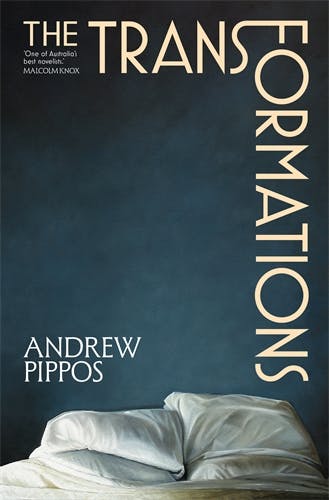
Andrew Pippos’ exquisite second novel opens with an epigraph from Ovid’s Metamorphoses, with which it, subtly, shares a title: ‘What we were once, and we are today, we shall not be tomorrow.’ Ovid gives the line to Pythagoras in the final book of his poem. The statement is at once trite and profound. Depending on our mood, the particular circumstances of our lives, our nearness to loss, our investment in or indifference to a given narrative, we can read or utter the line, or some variation of its theme, and conjure dozens of different meanings and feelings. Metamorphic itself, the statement can reassure us one day and terrify us the next.
Unlike Lucky’s, Pippos’ more exuberant, multi-generational first novel, The Transformations focusses on a limited period and setting. The year is 2014, and Pippos captures one of the later phases of print media’s transformation from a thriving and vital institution governed by implied professional ideals, into an insecure and depopulated one struggling to survive and maintain a recognisable form. It’s a familiar situation to anyone who has worked in industries that have lost funding streams and social status. The Transformations grapples with notions of obsolescence, redundancy and inadequacy. These related anxieties (or realities) are all linked to transformation, if only negatively: they precede and induce it. Old media gives way to new media not because it is a natural development, but because the old ways have ceased to function adequately.
Pippos foregrounds the disappearance of institutions once considered central to society and people’s lives, and the resulting changes in how we understand the world and comport ourselves within it. While tonally and structurally different from Lucky’s, The Transformations shares aspects of its universe: both feature characters with family connections to Greek cafés and Ithaka (and casual references to Odysseus and Penelope); both involve protagonists who are copyeditors; both are set in Sydney; and both circle around the memory of traumatic events.
The Transformations joins a recent splurge of books exploring non-monogamous relationships, chiefly memoir, but including fiction. It’s unsurprising that a (modestly) growing social trend should make its way into contemporary novels with some frequency, especially since the more familiar territory of extramarital affairs is so well-trodden. Non-monogamous relationships provide rich possibilities for exploring human feeling and behaviour shorn of reassuring, and guiding, social conventions. And characterisation is indeed one of the novel’s strengths. The Transformations is written in a different register than Miranda July’s On All Fours, trading July’s wry humour for sincerity. Sally Rooney’s Intermezzo is closer to Pippos’ offering, in style and ambition; both are character-driven and deal with human messiness, and both are emotionally compelling.
It’s hard to discuss ‘character’ in fiction without sliding into dullness, but my admiration for The Transformations owes so much to Pippos’ acuity in this area that I’m willing to embrace the risk. In most respects, the novel is conventional, though skilful. Take the opening chapter of The Transformations which, in customary fashion, sets the stage, giving us image, history, smell, touch, character and social context. Pippos never neglects the essentials as a storyteller, but this novelistic world-building doesn’t feel tedious or prescriptive. Pippos evokes an immediate sense of how a newspaper runs, its smells and rhythms, rituals, personalities and interpersonal dramas, as well as the crisis the industry is experiencing. From here, our protagonist George Desoulis, reserved but well-liked, alone yet social, slowly comes into focus, as one of the people who will be missed by the retiring/redundant Ivan Rakic. George holds onto and relishes an idea of print media that belongs to a different time. He takes his job as a subeditor at a major national newspaper seriously, despite the stagnating pay and decreasing prospects of advancement. He feels that he is participating in a wondrous and herculean endeavour: ‘everyone in the newsroom was engaged in the incredible task of describing the world each day’. According to him, ‘the paper could not exist without the idea of unlegislated obligation [...] and the sense among readers that such a duty was real’.
Pippos’ characters – even at the margins – are afforded an unusual roundness; they are carefully individuated instead of being ‘types’. One gets the impression that the author is unwilling to let a character merely serve the plot or furnish a theme, and Rakic, only a marginal character in The Transformations, carries a substantial narrative load. His relationship with his wife, Maria, is an example of the complex and ‘messy’ relations that will be explored throughout. Theirs is a story of enduring and transforming love, featuring periods of connection and alienation, separation and reconcilement.
While the minor characters are life-like, the central characters are keenly defined, possessing psychological depth and a coherent, if sometimes conflicted, sense of self. Pippos’ omniscient narrator signals that a dark past, some traumatic experience, has conditioned George to regard the world with wariness and insulate himself against unpleasantness:
If George has been conditioned to be wary and pessimistic, it hasn’t made him unpleasant or miserable. He loves his job and is unusually optimistic about the newspaper industry, whereas his fellow copyeditors (rightly) foresee a bleak future. George is capable of naïve optimism in one important area of life, and deep pessimism in others. This kind of complexity and fullness is The Transformations’ subject and ethos.
In Ovid’s Metamorphoses, there is no firm boundary between seduction and pursuit, desire and violation, love and forced possession. The gods – male and female, but mostly male – resort to rape as a natural extension of their desire, their status and their power. They seize whoever resists them. Here, the actions of love coincide with that of predation. Offended by Apollo’s condescending attitude, Cupid shoots him with an arrow of love, then shoots Daphne with an arrow of repulsion. Gods may have extraordinary powers, but all are subject – and subservient – to the forces that Cupid wields. When Apollo is struck by Cupid’s arrow, he becomes both victim and hunter.
The ancients had conflicting attitudes to love. It immiserates and enlivens. Love is a catastrophe and a salvation. But it is always transformative, always disruptive: to be struck by love is to lose control over your life, to be pushed in a new direction. To fall in love is, apparently, a rare experience. Some never have it. Others experience it just once, twice, thrice. Some of us long to fall in love again. Others hope to avoid it forever. But none can control it.
We know the story: penetrated by irresistible passion, Apollo pursues Daphne. Repulsed by his attentions, she runs for her life, terrified and doomed. Daphne stands no hope of obstructing the more powerful god’s will. So in desperation, she prays to her father, the river god Peneus, and he turns her into a tree. Still, Apollo loves Daphne (his love is so severe, so demented, that it can tolerate this radical transformation of the beloved’s form), and he takes possession of her: twining her foliage into his hair, his lyre and his quiver of arrows.
Ovid repeats the story of predatory pursuit and transformation throughout his cycle: Pan pursues Syrinx, who changes into reeds; Jupiter pursues Io, who becomes a cow. Neptune chases Caenis, Alpheus pursues Arethusa. Their transformations generally freeze the action in some way. Metamorphosis is substituted for rape.
Daphne is trapped. What is left of her is transformed into objects that Apollo can use, but the nymph is not recognisably present. She has withdrawn inside a different form, her tree-ness, and is protected within that withdrawal (as much as can be hoped under the circumstances). In the same way, a child abused by a more powerful person – a parent, a teacher – might find themselves transformed into an unresponsive object that conceals, deep within, an untouched and unbroken remnant, thereby preserving the essential self.
In The Transformations, we find out that George has recently published an essay in The National about a Christian brother, named Constantine, who taught at his Catholic high school. The essay details Constantine’s abuse of numerous children over many years, including the period that George attended the school. One is reminded of a 2017 Sydney Review of Books essay Pippos wrote on the same subject, which fused personal experience with testimony given to the Royal Commission into Institutional Responses to Child Sexual Abuse.
George does not reveal, in his essay, that he was one of the victims; nor, in the intervening decades, has he told anyone else, aside from a therapist:
It was far easier, he found, not to tell anyone [...] and instead speak as though it never happened. In doing so, George protected his own equilibrium. He’d settled the matter in therapy, or so he thought: he’d discussed Constantine quite enough.
In both his essay and the novel, Pippos describes a school environment that instils confused and fearful submission in its young victims: authoritarian rule, corporal punishment and public humiliation, friendly dogs used as lures, and bizarrely skewed institutional priorities that shield perpetrators from punishment and give them access to new victims. We learn that George harboured murderous thoughts while Constantine was alive, but a decade after his abuser’s death, he is no longer overtaken by rage.
Other effects are harder to discard, though George recognises their impoverishing qualities: ‘The brothers made him assume the worst of people, particularly those in authority, but these were defence mechanisms, and not particularly interesting or idiosyncratic habits of mind either.’ On top of this, George’s father died of a stroke when he was fifteen, soon after the abuse ended; the family café subsequently shut, and his mother died of cancer when he was twenty-two. These major ruptures, closely following each other, all combined to unsettle George’s formative years. He has been left unsure of himself and exposed, ‘hyperaware of danger, even where no threats existed’, and passive in the face of life’s impositions.
This is serious, sensitive territory, and because Pippos renders characters delicately and with care, he makes something improbably beautiful out of it. Notably, George is not abusive in any way himself, nor are there any signs of troubling sexual urges. He is not especially sexual (certainly not hypersexual or promiscuous), yet he is also perfectly capable of enjoying sex with a chosen partner. The aftereffects of abuse and tragedy are subtler: as with Ovid’s Daphne, a protective shield has formed around him, which he struggles to relinquish, and he is prone to passivity. In this withdrawal and preference for solitude, George consumes books and films in order to ‘carve new channels into his life’ (a compensatory function of art that may be uncomfortably familiar to some readers). George feels that he is too tied to the past, that he inhabits it too intensely, but we don’t see him enduring sudden flashbacks, or living inside it as though it were the present. He is not prey to variable moods or extreme emotional responses. Pippos discards usual methods of representing a traumatised protagonist in favour of particularity. George deals with the past in his own way.
The Transformations finds George locked in his protective bubble, the tree he has become. His character development is a reversal of the earlier metamorphosis. He yearns to break through that protective barrier and become human again, but to do that he must expose himself to the possibility of injury and the chaos of the world. Above all, he needs to risk the difficult experiences of love.
If The Transformations is, broadly, a novel about unremitting change, it is also a story about tricky romantic and familial relationships. Two people penetrate George’s bubble: George’s teenage daughter, Elektra, who has recently moved back to Sydney from Melbourne; and a married colleague, Cassandra, who is in an open relationship with her husband, Nico. A reporter for The National, Cassandra is adaptable and open, her temperament and outlook providing a sharp contrast to George’s. While George is convinced he could never manage an open marriage, Cassandra seems comfortable fulfilling numerous roles and portioning her time and attention in multiple directions. She does not let maternal duties interfere with professional ambitions, or marriage with her desire for romantic and sexual adventure. Nor does she let her desire for George interfere with her other responsibilities. Of all the characters, she is the most adept at the kind of continual transformation required of someone who embraces many roles. She is the sort of woman who believes she can have it all, that the pursuit of personal happiness is entirely legitimate, and she reorients herself accordingly. Problems arise only when the relationships become too complex or burdensome for George and Nico. Nico struggles with alcoholism, and both men are both vulnerable, though in different ways, yearning for stability and the reassurance of her love.
Pippos examines the stages of an open relationship with a sharp eye, and it furnishes him with a means of nuancing his characters and their relationships with each other, rendering them dynamic. But non-monogamous romance conflicts with George’s habits and impulses. Interested in dating, but not enough to go through with its contemporary rituals (i.e. swiping and matching), he resents questions about his love life and guards his privacy carefully. We discover that, for George, love manifests as a desire to share himself with Cassandra as he has never shared himself before: ‘From the start of their relationship he wanted to tell her everything.’ Cassandra agrees that ‘their conversation was more intimate than anything else they did with their bodies’. This is true partly because George values privacy to an anachronistic degree. Their intimacy is a product of his reserve. But the discombobulating irony is that it is equally a product of Cassandra’s desire to share herself with multiple partners, to distribute the self more broadly.
The connection between privacy – preserving large portions of the self for limited consumption – and the expression of love is strikingly rendered by Pippos. And to my mind, this raises a broader question about the nature and formation of romantic love in an age of social media and over-sharing. Does it still seem ‘special’ when someone tells us intimate (or even mundane) details about their life, or are we numbed to the significance of personal revelation? Is love now formed, and expressed, by other means? Is it harder to generate a shared sense of intimacy? If so, how do we compensate?
Who can say what the world is? The world
is in flux, therefore
unreadable, the winds shifting,
the great plates invisibly shifting and changing –
– Louise Glück, ‘Prism’
Circe turns Odysseus’ men into swine. The gods disguise themselves as bulls, dolphins, eagles. The world transitions through its ages: golden, silver, bronze, iron. Then the world is reborn again (and again). George Desoulis loses his father, the family café, his innocence, his mother, his daughter, his open-heartedness. His daughter returns, he loses his job, he falls in love, he lets love go. He shields himself from pain, he opens himself up to pain. He reads Louise Glück. He is a subeditor, then goes back into hospitality. He is an absent father, then an involved father, passive and distant, then active and intimate. He starts working with words again. Cassandra is desperate to avoid an unhappy marriage, she reacts against her parents, she finds herself in an unhappy marriage nonetheless and sympathises with her parents. The world is in flux, but it isn’t unreadable: each reading produces a different meaning, a different reader. The map keeps changing, but in time, we orient ourselves. Life is full of impossible situations, conflicting needs, competing responsibilities. In conventional, realist fiction, those needs and responsibilities run into each other, narrowing the options, forming obstacles, forcing the protagonists to choose, as they do here. George and Cassandra live with those losses. But in a world of constant – and sudden – change, losses might also be redeemed, and barriers can dissolve. This is where realism and myth coincide.
There are a few sound critical approaches one might apply to a book like The Transformations. For example: a focus on child sexual abuse and its aftermath, contextualised through cases documented in the Royal Commission into Institutional Responses to Child Sexual Abuse and other relevant historical material or case studies, alongside fiction dealing with similar themes. Pippos’ novel might be shown to follow or depart from well-trodden representations of abuse and its aftermath. Or one could analyse the novel in the context of social, institutional or political upheavals, taking the lead from George’s interest in Byzantium and Balkan history, and his enthusiasm for documentaries like The Death of Yugoslavia. (Byzantium was transformed into an imperial residence by the Roman Emperor Constantine, who shares his name with George’s abuser, so the analogy between personal and world-historical ruptures and transformations appears ready-made.)
Both approaches would be worthy and revealing, but an in-depth study of child abuse and its representations would eviscerate this critic’s emotional resilience, and The Death of Yugoslavia – brilliant though it may be – left me miserable for days, while The Transformations had the reverse effect. The fact that Pippos shapes difficult material into a source of readerly pleasure – and his employment of understated methods to do so – strikes me as the more animating concern.
The Transformations is highly accomplished, character-driven realist fiction. Its qualities are obvious: depth and verisimilitude, bracing social and personal contexts, contemporary relevance, a faultless narrative structure, precise but unassuming prose, and a fine balance of tragedy, ugliness and beauty. The centrality of love, and a gently mythological frame, tempers the novel’s staid, causal logic and bend the confines of its genre. Its realism is never stale.
The question I’m left with is: how can a novel featuring two people who are reasonable and competent – people who balance their desires against their responsibilities and make sober decisions, after lengthy deliberation, despite the intensity of their feeling for each other – how can such a duo work as the central figures of a love story?
George is no Heathcliff or Maurice Bendrix: impeded love does not induce raging jealousy or hatred. He is not a storm continually threatening to break. And Cassandra is no Anna Karenina or Emma Bovary: she keeps her head throughout. George is passive by nature, but his manner of rationalising his situation is pointedly undramatic: when they break off the relationship, he accepts that there will be a lengthy period of heartache, which he will simply have to manage while he attends to his growing paternal obligations. Cassandra, too, exercises restraint and does her best to move on. Romantic love and its consequences don’t overwhelm these characters or irrevocably shatter their worlds; instead, each maintains a level of control. Only Nico is vulnerable to irrational and destructive behaviour, due to his alcoholism, but even he makes the requisite effort to put his life in order.
On the face of it, reasonableness and sober decision-making are not satisfying dramatic material. The conventions of love stories, going back to Cupid and his arrows, involve drastic and sudden transformation: a character is struck by love and placed under its control, losing autonomy and the capacity for moderation. Love, typically, involves extremes: Catullus loves and he hates, intensely (he doesn’t equivocate); and Dido burns her entire world down.
In Pippos’ hands, love’s influence is slower and subtler, without losing narrative power. This is a considerable achievement. The Transformations describes a gradual, inching, tentative metamorphosis, initiated by love but obscured until its final transition, which arrives like a flash of light.