The Sun and the Truth
Naish Gawen on climate politics

What accounts for the proliferation of new climate technologies in an era of unprecedented temperature rises? Reviewing Wim Carton and Andreas Malm’s recent book, Naish Gawen provides a political-economic reading of the turn away from mitigation.
In 2025, for the first time, the world’s three-year temperature average was more than 1.5ºC above preindustrial levels, exceeding the collectively agreed-upon limit codified in the Paris Agreement. While three years is not long enough to declare the Agreement, which observes long-term averages, officially breached, the writing is on the wall. The UN Secretary-General António Guterres has acknowledged that it is now ‘inevitable’ that long-term average temperatures will rise more than 1.5ºC and that it is ‘indispensable to change course in order to make sure that the overshoot is as short as possible’. As short as possible? In this ‘overshoot’ conjuncture, movement across temperature thresholds is not unidirectional. Warming and the catastrophic effects brought about by an increased concentration of greenhouse gases in the atmosphere can be reversed at some point in the coming decades.
This reversal is to be achieved by a range of technologies, each with varying levels of proven efficacity. Some of these technologies are already at work, albeit at miniscule scales compared to their projected futures. These include carbon capture and storage (CCS) and direct air capture (DAC). Others are more experimental. Earnest proposals, either to draw down carbon dioxide or halt temperature rises directly, have included: building sea walls around the North and South Poles, hanging lamps over the Amazon rainforest, painting every single rooftop white, erecting designer umbrellas over the Arctic, brightening all clouds by shooting salt crystals into the atmosphere, and wrapping the Sahara in a bright plastic sheet.
Despite the farfetchedness of such proposals, the notion of a reversible overshoot has been baked into climate projections all along. Since the very start, some kind of atmospheric panacea has been factored into economic models, underwritten negotiations, reassured decision makers, and inflated companies’ stock prices. According to one kind of climate economist – think William Nordhaus, winner of the 2018 Nobel Prize for Economics – removing carbon from the air could be cheaper than preventing its combustion. The failure to limit temperature rise to 1.5ºC cannot, then, be simply understood as a failure to achieve what the signatories of the Paris Agreement set out to do. For certain sections of the ruling class, breaching this limit was always part of the plan. If catastrophic warming can be wound back, why expend all that effort trying to prevent it to begin with?
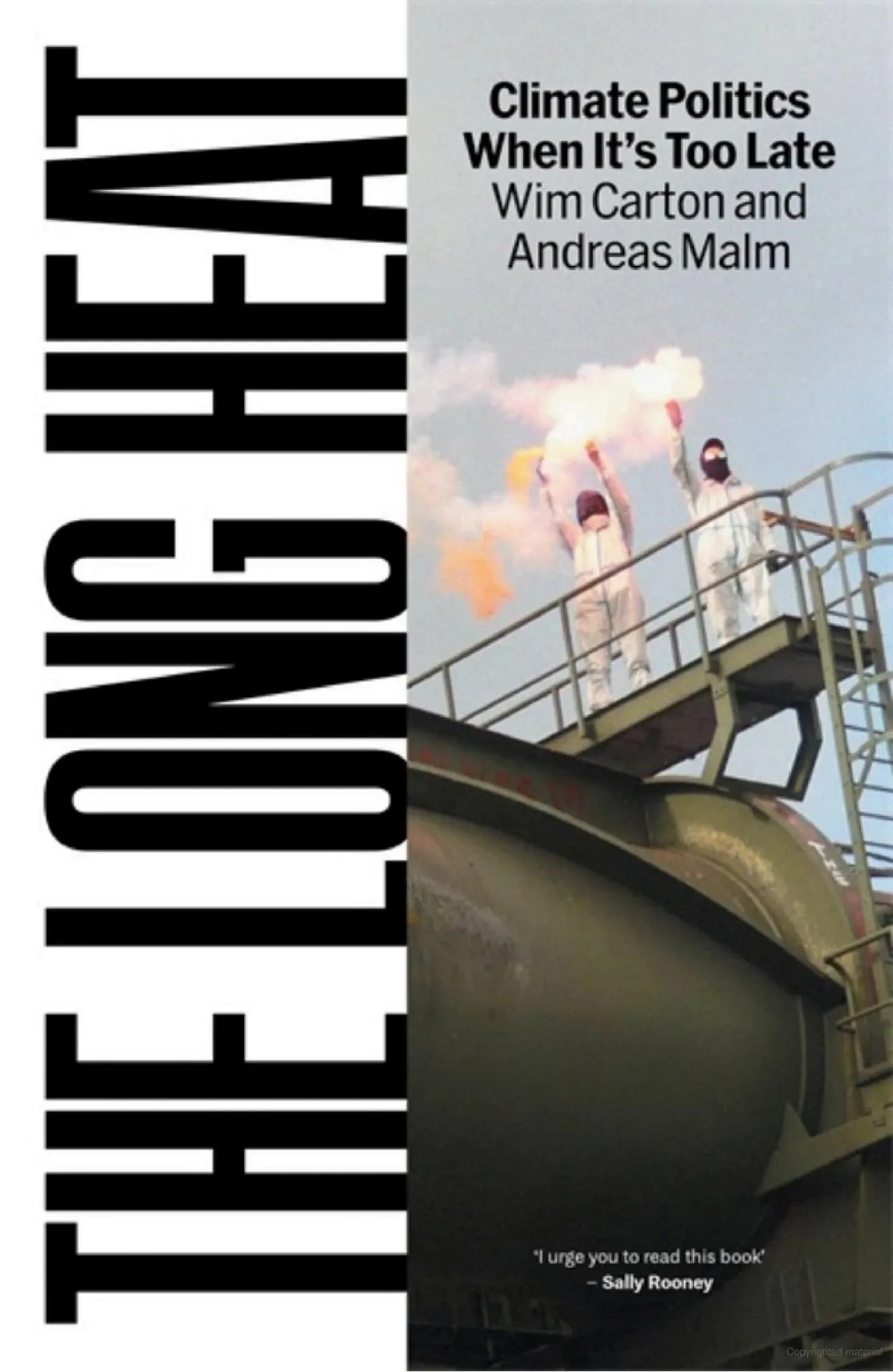
Wim Carton and Andreas Malm’s The Long Heat: Climate Politics When It’s Too Late locates itself within this present conjuncture when atmospheric limits have been breached and climate catastrophe is not only a future certainty, but in many places around the world, already occurring. For Carton and Malm, we are living through a period in which ‘the dominant classes demonstrate their constitutional inability to shut down the drivers of global warming in the face of fast-approaching limits’. Against this backdrop of ‘too-lateness’, The Long Heat is a triptych structured around three verbs: to adapt, to remove, and to engineer. Each of these verbs has a relationship to what could be considered the ur-verb of contemporary climate politics: to mitigate. Mitigation means ending the extraction and burning of fossil fuels – the single most important thing required to bring down greenhouse gas concentrations in the atmosphere. Due to the failure of society to mitigate sufficiently, climate adaptation (management of the symptoms of warming), carbon dioxide removal (taking carbon from the air and storing it in some natural or commodified form), and geo-engineering (intercepting solar radiation) have come to prominence. Instead of trying to prevent the catastrophe outright, then, the terrain of climate politics in a warming world has seen the ‘multiplication of secondary fronts beyond that of mitigation’.
The political shift in focus from mitigation to these subsequent fronts is sharply criticised by Carton and Malm as a manoeuvre that enacts climate defeat as much as it responds to it: ‘those technologies peddled as instruments for dealing with the climate crisis when it is too late instead contributed to making it too late’. Rather than innocent techno-fixes arriving to save the day, these examples of ersatz climate action are outgrowths of the dominance of an ideology known as fossil capital, which Malm explored in his 2016 book Fossil Capital: The Rise of Steam Power and the Roots of Global Warming. In this Marxist account of the rise of a fossil fuel economy, Malm argues for an understanding of fossil fuels as a ‘material substratum for the production of surplus-value’. Fossil capital is inherently expansionary. To be sure, this is a feature of capitalism itself, but as Malm points out, since the industrial revolution, ‘self-sustaining growth in general is welded to the combustion of fossil fuels, and therefore generating a sustained growth in emissions of carbon dioxide’.
To illustrate the expansionary thrust of fossil capital, let us visit the multi-billion-dollar fixed capital investment known as the Darwin liquified natural gas (LNG) export terminal, located on Larrakia Country in the Northern Territory. Darwin LNG has been operating since 2006, fed by gas plundered from an offshore basin of the then recently independent nation of Timor Leste in infamously unfair negotiations. The last shipment of LNG made from Timor Leste’s gas occurred in 2023. But the two decades’ worth of profit needed to be reinvested somewhere, so the Barossa gas field — vociferously opposed by many Tiwi Islanders whose Sea Country the pipeline would traverse – was opened up to backfill the Darwin facility and ensure that the asset stays profitable for decades to come. This new gas field has a higher CO2 content, and will keep the plant polluting until around 2050, the year that everything is meant to be at ‘net zero’. There are a thousand other examples. Investment in fossil capital begets more of the same.
This self-perpetuating tendency of fossil fuel investment is not incidental, nor is it a result of particularly nefarious individual CEOs. The thrust to expand inheres in capitalist property relations. If burned, the proven reserves currently sitting on oil and gas companies’ balance sheets would catapult the earth’s temperature as much as 4ºC. This dormant profit must not be realised. Assets need to be stranded – and they aren’t going to strand themselves. The implication for the problem of mitigating climate change is clear: there is, as described in The Long Heat, a ‘material contradiction between fossil capital and the climate system’.
The Long Heat is a follow-up to Carton and Malm’s previous book Overshoot: How the World Surrendered to Climate Breakdown (2024), which argued at length for the necessity of destroying the fixed capital congealed in the form of fossil fuel infrastructure if mitigation were to have any meaning. Indeed, all of Malm’s work since Fossil Capital could be considered a coherent oeuvre, approaching the question of capitalism and the climate from a range of angles over the course of a decade. His influential and contentious output over this time includes White Skin, Black Fuel: On the Danger of Fossil Fascism (2021), an anatomy of the far-right and its relationship to fossil fuels; How to Blow Up a Pipeline: Learning to Fight in a World on Fire (2020), a defence of sabotage as a strategy of the climate movement; and The Destruction of Palestine is the Destruction of the Earth (2025), an analysis of the imbrications between the genocide in Gaza and the fossil economy. From the Nakba to the contemporary rise of fascism, Malm is aware that the experience of catastrophe is neither singular nor limited to the climate front.
The Long Heat sets out to show that, instead of meeting their demise, the forces of unbridled capitalism that brought us to this position of climate catastrophe are having a field day in the present-day overshoot conjuncture. Fossil fuel companies have posted record profits in recent years: in 2022, oil giant Saudi Aramco recorded the highest annual profit ever seen in the history of the capitalist mode of production. Not only are there still profits to be made from the planet’s destruction, there are also opportunities to commodify the attempted reversal of this destruction, too. Carton and Malm record the CEO of one start-up, the developer of a direct air capture plant, pronouncing, ‘I will complete the job of reversing climate change, turn [the startup] into a $1 billion company, and revolutionize quantum theory using topology for the benefit of understanding what is time and who we really are.’ There is no shortage of hubris in the business of saving the biosphere. Having immersed themselves in ‘a peculiarly Californian business ethos, in which unhinged entrepreneurialism and rebellion against rules and expertise was elevated to a cultural form’, Carton and Malm have ended up traversing ‘a graveyard of startups’ in researching their book. (When the aforementioned company was sold off in 2024, it was for a price less than a tenth of its lofty projection.)
But what if the ever-elusive spectre of a quick fix was in fact a programmatic feature of fossil capital itself? Even if the proposed technologies – such as frying the diurnal rhythms of the flora of the Amazon in order to double the rate of photosynthesis – are not really feasible, we should not be foolish enough to ignore the ‘ideological services’ that the spectre of these new technologies nevertheless provides to owners of fossil fuel infrastructure. These services can be summarised as a form of life extension for the fossil fuel era; if emissions will seamlessly be brought down by a new technology that is just around the corner, the impetus for intervening in fossil capital’s circuit of accumulation is tempered. As Carton and Malm observe, ‘the essential attraction of all this tech is the semblance of a consonance between fossil fuels and climate stability, when none can exist’.
No doubt, defenders of less experimental negative carbon technologies – technologies like CCS that in policy circles have acquired a sheen of respectability – will protest that mitigation and CO2 drawdown need not be mutually exclusive. But Carton and Malm painstakingly and convincingly demonstrate that this is precisely the political economic origin, and actual function, of these technologies: they are tools pioneered to extend business-as-usual. When the backfilling of Darwin LNG was proposed by Santos, it was concomitantly suggested that the old, expired gas field could be used as a storage facility for the carbon emissions from the to-be-developed Barossa field. Plans for CCS progressed alongside plans for opening the new gas field, the former shepherding the latter, not just rhetorically but also in obtaining finance and approvals. Which of those projects is operating right now? Not the carbon storage one.
In a departure from Malm’s previous work, the thinker (other than Marx, of course) who looms largest over The Long Heat is Sigmund Freud. As Malm states in an interview with his publisher Verso, he first read Marx at fourteen and Freud at forty. The belatedness of Malm’s encounter with psychoanalysis is unsurprising given the intellectual milieux in which he grew up. A member of the Swedish Communist Party’s youth wing, Malm then joined the Swedish anarcho-syndicalists during the mid-1990s. His anarchist intermission ended in 1997 when, attending a Fourth International summer camp, he was brought back into the fold of communist politics, this time as a Trotskyite. None of these political homes would have been particularly propitious for an encounter with Freud. Nor can we assume that the psychoanalytic influence on Malm’s later work is a result of his intellectual collaboration with co-author Wim Carton, an academic geographer whose PhD thesis critiqued the use of market-based mechanisms in energy policy.
Rather, it was the experience of watching the crisis unfold against a backdrop of ever-expanding fossil fuel production that led Malm to conclude that the explanatory tools of Marxist political economy, while fundamental, are ‘not enough’. As Malm ominously wrote in own PhD thesis back in 2014: ‘the more we know about the catastrophic implications of climate change, the more fossil fuels are burnt in the world’. One needs to look into the unconscious of this system to understand its irrational persistence. The Long Heat is thus deeply interested in matters psychic. Its authors declare that ‘psychic causation should be given primacy in the study of climate’; that the climate crisis is thoroughly determined by irrational forces; that the intensities of the current crisis – notably the range of defence mechanisms thrown up by fossil capital to ensure its survival – cannot be properly understood without recourse to concepts provided by psychoanalysis. To this end, not just Freud, but German analyst Edith Jacobson, as well as the burgeoning field of psychoanalytic climate studies, are regularly cited throughout the work. One of the book’s longest chapters is dedicated to proposing a Freudo-Marxist theory of geoengineering.
There is a moment in the intellectual history of twentieth-century socialism that proves especially instructive for reading Malm’s psychoanalytic turn. The familiar story of a tradition known as Western Marxism, canonised by works such as Perry Anderson’s Considerations on Western Marxism, tells us that this intellectual formation was a ‘product of defeat’. In the early twentieth century, socialist revolutions failed to spread outside of Russia, and a triumphant fascism quashed working class movements across Europe; the tradition’s authors wrote their works mostly in despair and exile. This experience of defeat catalysed a ‘mutation’, to use Anderson’s phrase, of Marxist thought, entailing a changed intellectual orientation: less economistic, more philosophical, and more finely attuned to the superstructural – that is ideological, social, and cultural – dimensions of capitalism. The texts – from authors such as Walter Benjamin, Herbert Marcuse, and especially Theodor Adorno – of this moment are consulted throughout The Long Heat.
According to Carton and Malm, in today’s era, capital is once again ‘crushingly victorious’ over labour. Working-class politics are presently ‘enfeebled beyond historical recognition’. These lines come almost as an aside, towards the end of the book. But they provide crucial context for the authors’ psychoanalytic turn, if we accept that this turn is born out of the soul-searching that accompanies political defeat. Despite the ‘graveyard of startups’, the ideology that gave birth to them lives on. If anything lies buried, it is the body of working-class politics in the Global North. While the parallel between the birth of Western Marxism and the increasingly psychoanalytic bent to Malm’s militant thinking is imperfect, it captures one version of a left-wing response to confounding despair: the dissolution of certainties and a search through unorthodox intellectual resources to explain why no revolutionary historical agent seems able to rise to its occasion and arrest the crisis.
If this is almost unbearably depressing, Carton and Malm insist that engaging with despair is not the same thing as giving up. While there is still a degree of uncertainty about how things will go, the struggle is worth continuing. But the authors spurn reflexive optimism, instead holding their gaze on capitalism’s horrors, contemplating such possibilities as a scorched Amazon rainforest, a melted Arctic. The human suffering entailed by climate change is periodically returned to the reader’s attention. How many of us recall the almost 6,000 people who died in a single night in September 2023 as a dam in Libya burst asunder due to Storm Daniel, a statistical unlikelihood made possible by climate change? A system that produces these catastrophes and then doubles down on the very activity that led to them is in the grips of a kind of irrationality that has sent Carton and Malm to the therapist’s couch.
Carton and Malm draw on the Freudian concepts of denial and repression to understand the displacement of mitigation by a fixation on technologies like geoengineering. The authors discuss a particular variant of this technology known as stratospheric aerosol injection, which proposes to cool the earth through the injection of sulphur dioxide into the atmosphere, where it would form a reflective, cooling barrier not dissimilar to that caused by volcanic eruptions. In theory, this barrier keeps temperature rise at bay for as long as the technology is deployed, but does nothing to address the cause of the temperature increase, merely locking it away. Drawing on Freud’s reading of Macbeth, the authors describe the overinvestment in geoengineering as a classic example of symptom formation – equivalent in Carton and Malm’s account to Lady Macbeth’s compulsive hand-washing – where the psychic contradiction of reversing the irreversible is ‘converted into corporeal acts’ that in their obsessiveness perform a ‘refusal of the external world’.
But such a comparison, with its connotations of guilt or at least conscience on behalf of the symptomatic subject, is slightly at odds with how, elsewhere in the book, Carton and Malm understand the accumulative drive (the German Trieb is used by both Marx and Freud) of capitalism: all id, no superego. Perhaps a more apposite reference from Macbeth would be Macbeth’s ‘I am in blood / Stepped in so far that, should I wade no more, / Returning were as tedious as go o’er.’ (III, iv) The extraction and burning of fossil fuels has brought us waist-deep into this crisis; the emissions from these activities have led to an inadvertent tampering with the globe’s thermostat. Instead of seeking the tedious route of return that is emissions reduction, the impulse to geoengineer is the impulse to cross to the other side: to double down and seize control of the thermostat itself. Get out by going deeper. Pour blood into the river, (literal) fuel onto the fire; take your pick of metaphor.
The authors’ criticism of geoengineering, and its potential to unleash unforeseen and devastating environmental consequences, harks back to the bread-and-butter critiques of planetary meddling by earlier pioneers of green thought. Rachel Carson wrote in the 1960s that to ‘have risked so much in our efforts to mold nature to our satisfaction and yet to have failed in achieving our goal would indeed be the final irony’. And both the risks and ironies of geoengineering are extreme. One such example is termination shock. When the stratospheric sulphur injection stops, the heat previously kept at bay by the aerosol barrier will return with full force: a literal return of the repressed, scorching the landscape. The more the atmosphere has warmed in the period between deploying the technology and retiring it, the worse this termination shock will be. As pop icon Cher once tweeted, ‘there are 2 things that cant be hidden 4ever...the sun & the truth.’
The temporality of overshoot is one that assumes linearity and, hence, reversibility. To dispel this notion, Carton and Malm take a long and fascinating detour into the history of the philosophy of science – via (Charles) Darwin, Hegel, and Lenin – counterposing the school of gradualism to that of punctuated equilibrium. According to the latter school, change in both social and natural systems does not happen in a mechanistic and calculable fashion. It can move both glacially and then by leaps and bounds. One of the conclusions arrived at through this detour is that you can’t unmelt an ice sheet. (Nature’s non-linear temporality is dissimilar in a different way to the temporality of poetry, in which, Anne Carson observes, ‘a piece of ice melts forever there’). Overshoot ideology is prima facie reckless and irrational in that it is blind to tipping points, to cascading processes and unforeseen consequences.
So no matter how much mitigation happens from now on, we are still going to need to live with a certain amount of catastrophe. For this reason, the verb ‘to adapt’ gets off the lightest in Carton and Malm’s critical survey. While it has been deployed as an alternative to mitigation by governments uninterested in challenging the ‘unassailable background condition’ of fossil capital, the authors also recognise that progressives do not have the luxury of ignoring adaptation as a political front – it may soon be the only front left. Yet, the book is unequivocal in its exhortation of a relentless focus on mitigation, on preventing the crisis from getting worse. For the authors, this is the very same thing as embarking on a ‘return to the unaccomplished mission of attacking investment in fossil fuels’. This exhortation beams forth as an urgent reminder of the unfinished business of the climate movement, one that has been lost in a thickening molasses of targets, acronyms, conferences, and a deluge of climate writing that seems utterly, wilfully ignorant of both the stakes and sober realities of the present moment.
But we should be wary of hypostasising a hard distinction between adaptation and mitigation, a distinction that is itself a product of the eco-technocratic discourse so disdained by the authors. The discreteness of the categories belongs to a world in which the solution to the climate crisis lies in the minds of ‘policymakers’ (the authors cannot write the word without scare quotes) rather than in politics. Transformative, indeed revolutionary, political action wouldn’t observe the categories. An illustrative example is the demand, salient in the Australian context among others, for land back: the assertion of First Nations sovereignty, as articulated forcefully and over time by generations of First Nations activists in this country. My own perspective on this has been shaped by Larrakia leadership in Darwin, thinkers and writers such as Danggalaba Kulumbirgin Tiwi woman Mililma May. Land rights, including the ability for Traditional Owners to meaningfully decide what happens on their Country, would present a potent threat to fossil capital’s logic of endless accumulation. It could actually entail a hard limit. It would also allow for autonomy and resilience in the face of changing climatic conditions that are already being disproportionately experienced by First Nations people.
Or take the Green State Vision proposed for Indonesian-occupied West Papua, a place dubbed by Douglas Gerrard as ‘climate change’s forgotten frontline’. Within a context of settler colonialism experienced by Indigenous Papuans, the region faces an onslaught of Indonesian and foreign companies attempting to extract more petroleum and pursue deforestation for monoculture plantations. In response, the government in exile, representing the independence movement, has released an ecological vision for statehood, one that brings together environmental and social protection, customary Indigenous guardianship, and democratic governance. Whether this counts as mitigation or adaptation is trivial. Rather, the risk is that everything, including any genuine political victories, is threatened in the meantime by the unfolding disaster. As Carton and Malm point out, ‘even a communism of sand would be drowned by a sea that keeps on rising’.