
Gouts of blood erupted in long and snakelike ribbons and the eyes were wide in disbelief and he just shuddered and mouthed soundlessly: no, no, please stop it, it hurts, oh God save me, and Jimmy stood and spat and with labouring breath yanked down the man’s buckskin britches and there in that grove with the man’s own knife he gelded him with cold steel and the blood flowed out from ruptured arteries, the gash wet and trembling, and Jimmy kicked it once, twice, and then threw aside his instrument of agony, that brutalist, and collapsed back against treeroots. It did not take long for the ranger to die in that redblack and alchemical mirror wherein he lay sprawled and writhing like a sacrificial bull, the fingers curling like the legs of an enormous spider busy at dying.
‘This was to be his garden’
Angus McGrath on what a historical novel set in the U.S. reveals about Australia’s myths
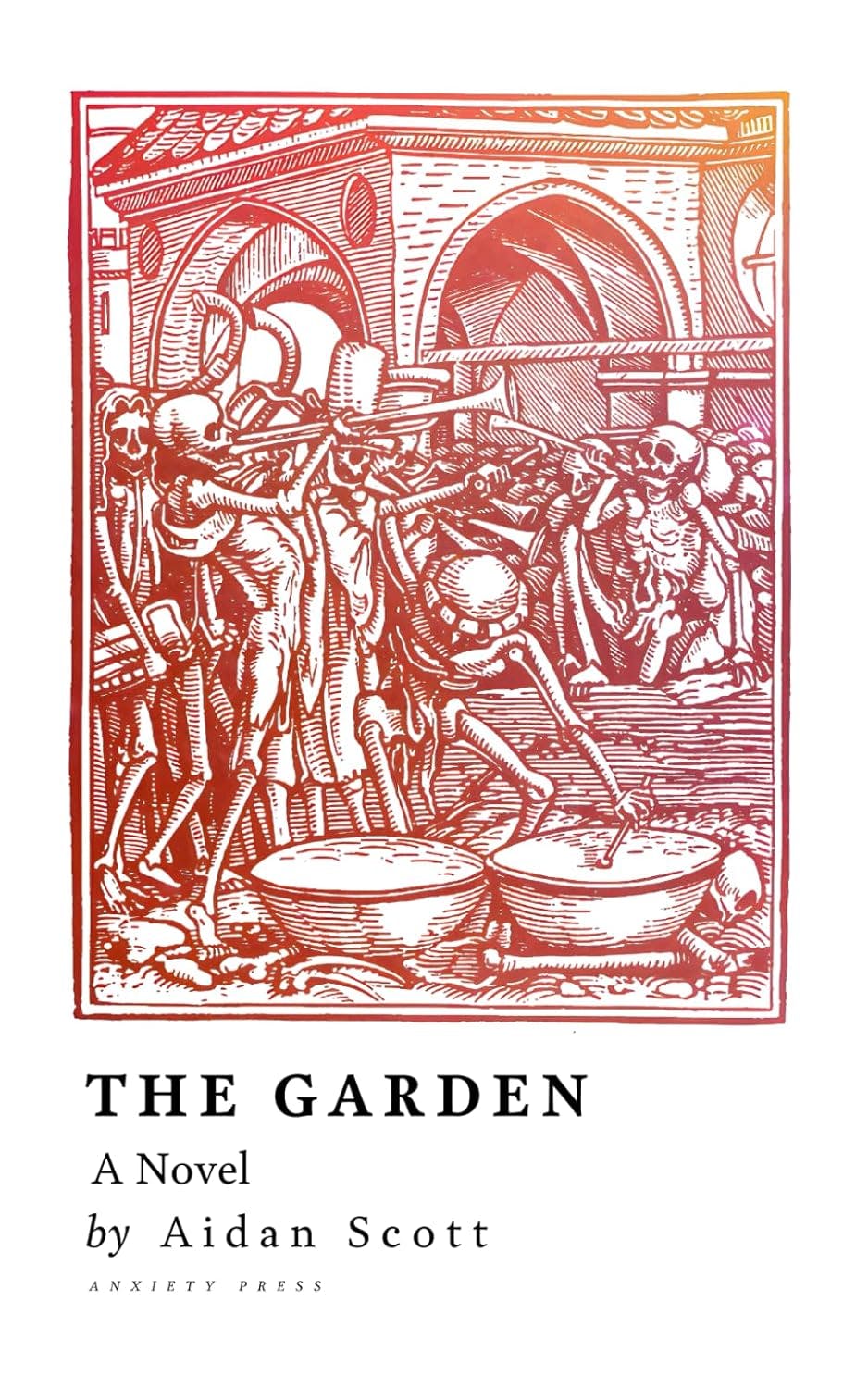
Aidan Scott’s The Garden takes place in the U.S. during the Mexican-American War – far away from his hometown of Canberra. Yet its account of violence and racism abroad speaks volumes about white Australia’s desire to cover up its own crimes.
Growing up in Canberra, I would always describe the McDonald’s at the edge of Braddon, just off the city’s central road, Northbourne Avenue, as being like an old-style saloon. Its patrons were either keeled over by drink, or yelling and foolish with it. All the while, unhoused people were trying to sleep, as it seemed to be one of the only night spaces that did not kick them out. This was also one of very few eateries open late, and was appropriately close to the nightclubs and pubs. There was a punch-on at least once an hour. Mud was run all over the white tiles. I could imagine someone kicking open the swinging glass doors, proclaiming, ‘This town ain’t big enough for the both of us.’
This stylised image of the McDonald’s from my youth immediately came to mind when I began Aidan Scott’s 2024 debut novel The Garden, which takes place in a likewise archetypal cowboy setting. This tale follows a gruff drifter with a shadowy past, who we first meet perched up in a similarly grimy cantina for grimy types. This is Jimmy, a twenty-three-year-old outlaw who roams the wild American Southwest with his mentor, William, though the older man is quickly killed in a robbery gone wrong. Without a guide and wallowing in profound existential angst, Jimmy begins a picaresque journey of revenge and gore across the unwelcoming plains, all the while haunted by an evil, elusive, and magical man named Augur. Little information is given to contextualise Jimmy outside of his age, brown mop hair, and worn-out clothes, casting him as a surly loner with a mysterious backstory: an anti-hero straight out of a Western.
Our protagonist at first seems amoral, quick to extreme violence and holding no opinion on the war which rages around him. Following the loss of William and a near-death beating, Jimmy falls into a job as an overseer of slaves on a cotton plantation. While he does quietly question the ethics of slave ownership, Jimmy only takes any kind of action after Luam – a slave with whom he strikes up a friendship of sorts – kills a white man to protect him. This unearths a tension within Jimmy. He is torn between his identities as an ice-cold drifter, a hot-blooded killer, and a penitent plagued by grief and wide-reaching guilt. In his emotional uncertainty, Jimmy becomes determined to help Beth, a nineteen-year-old who murdered her abusive husband and is now travelling to Texas in the hopes of connecting with her estranged mother.
The novel takes place in 1847 against the bloody backdrop of the Mexican-American War, which saw the U.S. and Mexico fighting over territory, while both sides continued to battle the many distinct Indigenous groups whose land they wanted to possess. The war concluded in 1848 with The Treaty of Guadalupe Hidalgo, resulting in Mexico ceding 55 percent of its territory to the U.S. and establishing the borders of both countries as we know them today. America’s involvement in the war was directly driven by a sense of Manifest Destiny: the idea that America’s expansion, physically and ideologically, was a divine, necessary, and unavoidable project. The term was first coined to justify the 1845 annexation of Texas, and from then on, Manifest Destiny continued to be invoked, not only in regard to the war, but as a further rationalisation for keeping slaves, displacing and destroying Indigenous culture and people, and engaging in additional extra-continental colonial ventures. After being more or less retired for a century, the concept has reappeared, with current U.S. President Donald Trump’s various calls for America’s expansion everywhere from Canada to Palestine to outer space. ‘We will pursue our Manifest Destiny into the stars,’ proclaimed Trump in his 2025 inaugural address, ‘launching American astronauts to plant the stars and stripes on the planet Mars.’ His dedication to this vision of expansion has been aggressively displayed since, in America’s interference in Venezuela and an insistence on acquiring Greenland.
In Scott’s novel, it is the mysterious, imposing, and occult antagonist Augur who personifies this myth-fuelled dream of domination. A facially scarred, middle-aged hotel-and-bordello owner, Augur commands authority over outlaws and rangers alike, and evokes great fear from all who cross his path. He spends his time contemplating ancient mystical texts, using his convoluted philosophies to extol the virtues of America’s violent activities, which infuses The Garden with arcane magical thought. Augur even monologues to Jimmy about the Mexican-American War: ‘A righteous war […] In short, it is an inescapable and not inglorious step in the historical process by which these states united will be brought to its future place in the world.’ In an endnote for The Garden, Scott describes how Augur’s words here are ‘an almost direct quote from The Story of the Mexican War by Robert Selph Henry, which, while an impressive piece of scholarship, I thought often spent a little too long trying to justify the war rather than report on it.’
All signs point to Scott’s novel being unmistakably and squarely about America. Even the book’s clear parallels to Blood Meridian by quintessentially American author Cormac McCarthy (an avowed major influence for Scott) are in line with this undeniable fact. And yet, I find myself interested in contextualising Scott as a young writer from Canberra. Although there is a vast geographical and contextual difference between the present day of Australia’s capital city and the establishment of the United States’ borders 178 years ago, I cannot help but try and draw threads between the two. Perhaps this is my inner Canberran persisting, attempting to acknowledge cultural production from the boring, quiet city I grew up in, while also trying to make sense of the peculiarities of my hometown through the lens of stylised genre forms, as with the McDonalds-saloon in Braddon. Notably, Scott himself has never made a connection between his home and the subject matter of his debut novel, and in fact, appears to be keeping firmly away from writing about Canberra. Despite teasing a novel set in Canberra during an interview with CityNews in 2024, he has set his second book in nineteenth-century northern England. Canberra is ‘a place he never thought he would write about’ and hasn’t yet.
I feel that The Garden’s various allegories, parallels, and shortcomings can be used to look deeper into the left-identified, white perspective which tries, and struggles, to face up to Australia’s true history. While Scott is focused specifically on the Manifest Destiny of America, his book still offers insight into Australian identity and the creation of its own lore. It is worth noting here that the cowboy-influenced, settler-outlaw anti-heroes central to Australian myth closely resemble those of the American Western: of course, Ned Kelly, but also the brumby. Horses were just one of the species Britain introduced upon their arrival which resulted in feral populations, and though these brumbies are pests, they have come to symbolise Aussie ideals. Take Banjo Patterson’s poem ‘The Man From Snowy River’. Or our $5 note. Or even the 1993 film my sister adored throughout our childhood – The Silver Brumby – the poster of which depicts Russell Crowe’s head in the sky, softly smiling down over a large white horse, the whole image emblazoned with the tagline HIS SPIRIT CANNOT BE TAMED.
The Western, though, is undeniably considered the quintessential American story, and its gunslingers are figured as the first American heroes. The typical Western takes place in the aftermath of the American Civil War (1861-1865), restaging a real era and fictionalising the perceived beginnings of the America we know today. In their most Hollywood-ised form, these are stories where ‘Indians’ are baddies and fast-shooting cowboys are goodies, yet their skewed historicisation still contributes to the conception of actual American identity. While The Garden’s Mexican-American War setting is less common for the genre, it has been consciously selected by Scott as a major moment in America’s development, capable of foregrounding the violent realities of the country’s forging – this tale, as the book’s blurb states, tells of ‘the eerie birth of an unsettling future’. Perhaps it is possible to geographically transpose this intention, as well as its unintended effects, onto our own national context. While the U.S. has placed their many battles at the centre of their story (the Revolutionary War, the American Indian Wars, the Civil War, and of course, the Mexican-American War), Australia continues to bury our own, though they are there nonetheless. Australia’s history is rife with instances of British occupiers clashing with and plainly massacring First Nations peoples, yet these Frontier Wars are not and have never been officially recognised or commemorated by the Australian War Memorial in Canberra, or by the Australian government at large.
The desire to ignore the violence by which Australia was settled can be seen at work in the written, institutional account of Canberra’s establishment on Ngunnawal and Ngambri Land – first as a sheep station on the Limestone Plains in 1823 through to the 1913 ceremony where the wife of Australian Governor-General Thomas Denman announced the name of this new city – ‘Canberra’. There were no British soldiers going to battle, and according to historian Ann Jackson-Nakano in her book The Kamberri: A History of Aboriginal Families in the ACT and Surrounds, no open protest by the First Nations people in the area when the first Parliament session was held there in 1927. But this isn’t to say that Canberra was established peacefully. See a case like explorer Charles Throsby, who brought influenza to what became Canberra in 1820, resulting in the deaths of many Indigenous people. Even without specific battles to point to, it is hard to argue that Canberra’s settlement was not one involving military might when one looks at footage from the city’s 1913 naming ceremony. This was a monarchist parade where swathes of soldiers with sabres by their sides rode in tandem on horseback. Watching this military spectacle while believing that this area did not require colonial violence to be settled is a kind of doublethink. This version of history is closely related to the widely held egregious belief that all of ‘the original Aboriginal People [from the Canberra region] had “died out” in 1897’ which was not officially disproven until the early 2000s.1
Such ripples of erasure, or ‘The Great Australian Silence’, as named by anthropologist W.E.H. Stanner, carry through to today, and work in tandem with stories we (as settlers) tell ourselves about being this land’s rightful inhabitants. The persistence of this narrative has been laid bare recently by the ‘March For Australia’ rallies protesting ‘mass migration’ and, in one specific instance, by Bob Katter’s furious response to a reporter bringing up his Lebanese heritage during a press conference about his endorsement of the rally. ‘I’ve punched blokes in the mouth for saying that,’ exclaimed Katter, labelling the journalist as ‘racist’ and eventually going on to declare, ‘I’m an Australian, my family has been here since the dawn of time’. This bizarre statement makes apparent the Manifest Destiny-like credo bubbling beneath the surface of the white Australian consciousness: that this land was fated to become the home of European settlers because some divine order designated it to be so. Katter’s senseless outburst typifies the belief that this was land with no history, or history that mattered, until Europeans took it over. Here, the brutal facts of how the land was acquired have been adequately softened or sped over, making the pill easier to swallow.
Aidan Scott and I have never met, but we have the shared experience of being white men who spent our youth in Canberra. Our settler perspective is often what is assumed to be (both in the sense of ‘supposing to be the case’ as well as ‘taken up as’) ‘Australian,’ and Katter’s outburst is simply the exaggerated version of this commonplace conception. While preparing this essay, I was pointed towards Harry Reynolds’ book Why Weren’t We Told?: A Personal Search for the Truth about Our History, where the historian ponders the lack of knowledge that non-Indigenous Australians have about the unrelentingly brutal treatment of Indigenous people in this country. It is obvious that ‘we weren’t told’ because the telling does not benefit the continuation of white dominance of this country. Furthermore, were ‘we’ ever actually willing to engage sincerely with this country’s violent past? Of course, this raises a follow-up question: what does sincere engagement look like?
While Scott is focused specifically on the Manifest Destiny of America, his book can still reflect much through its genre and approach about Australian identity and our own, unnamed, sense of Manifest Destiny. The style of The Garden is florid; everything is in flowery prose brimming over with simile. Each character seemingly has the inner workings of a Romantic poet, their thoughts narrated in long, cascading paragraphs. Scott even describes the mutilation of bodies with the same elegiac detail he uses to depict the natural wealth of the landscape and the loneliness of those who wander it. This stylish aestheticisation of violence draws the reader into the brutal specifics of the action while imparting a mythic quality, echoing the phrasing with which Augur justifies his viciousness throughout the novel.
A prime example of the book’s lyrical gore occurs in the scene where Jimmy attacks a belligerent ranger. ‘In a bloodred rage he straddled the ranger and began choking him until he could see veins pop in his eyes like miniature fireworks against a bonewhite sky.’ Though a brief interlude of plainer language follows – ‘Jimmy let go and took out his own bowieknife, one now in each hand, and with his right fist slammed his blade down through the ranger’s throat, pinning him to the dirt’ – Scott’s gilded prose, like blood from a severed artery, cannot help but continue to flow:
The Garden’s commitment to historical detail and accuracy is likewise an attempt to not overlook the violence and racism experienced, most intensely by slaves and Indigenous people, in this period. At the novel’s end is a hefty list of sources detailing the scope of Scott’s research, covering everything from the lives of slaves, soldiers, and sex workers at the time through to plant life, alcohol and opium consumption, and Gnosticism. This is prefaced by a note where Scott lays out the purpose of his wide-ranging research: ‘to compose a world based as accurately as possible on history, and to be as respectful as I could to those that lived, and suffered, during the period’. Similarly, the novel’s dedication reads ‘to all who have suffered, and suffer still, beneath the boot of colonialism and fascism’.
Yet, Scott hits a wall trying to at once represent the atrocities of this period while striving to write from an ethical place in the present. An instance of this can be seen in a moment where Luam, the slave with whom Jimmy has a personal connection, is whipped thirty times for crafting the injured Jimmy a crutch. Scott adds in a footnote that this is ‘horrifically, a lower number [of whips] than was usual’. The only reason I can conceive for pulling this punch, to have the repugnant and unapologetic driver inexplicably tone down his punishment, is because Scott does not want to describe the actual number a slave would have received. This approach ultimately begs the question: why this reality if we cannot face it to its full extent? Is Scott doing us a favour by not detailing the severity of this torture, or is he avoiding its facticity? Can there be genuine criticism of such brutality if its portrayal is softened? The Garden is hyper-violent, but, notably, this violence is almost never taken out on the people who experienced it most forcefully: people who are not white, the same people who continue to experience it most forcefully in the U.S. and Australia today. Although The Garden’s primary depictions of violence are ones undertaken against white people (which is not to deny that many settlers suffered gruesome deaths in this period too), it is not a story of non-white revenge against white occupiers, the kind that takes delight in watching oppressors get a taste of their own medicine. In the novel, these acts are mostly enacted by other white people.
Luam, notably the book’s only named non-white character, bears all the hallmarks typical of the ‘Magical Negro’ – a Black character who exists for the purpose of advancing the stories of white protagonists and aiding in their character development, often by dispensing folksy wisdom and profound insight, and periodically protecting them from physical danger. Often, these Black characters will help the white characters without any consideration or concern for their own life and wellbeing. Luam does all of the above: whittling a crutch for the severely injured Jimmy, even though they have yet to meet and it leads to him being whipped; elaborating on his personal theology with Jimmy (at this point an overseer of the slaves) even though it carries the risk of more beatings; and inexplicably saving Jimmy’s life when another overseer wants to kill him, even though it would mean Luam’s death if he were caught. Only after this does Jimmy assist the slaves in escaping the plantation. Much later in the novel when Jimmy is thrown into lockup overnight for drunkenly beating a man nearly to death, he regains consciousness to find Luam in the cell beside him. The latter is to be hanged in the morning but spends his night listening to the former sob and recount his own story: ‘everything, starting from right after Luam left the plantation to finding himself fettered by irons. [Jimmy] told it steadily and without pause. It took hours and hours.’
Though Jimmy does exhibit some racial awareness and guilt while he is working as a slave overseer, Luam, as a character, ultimately serves to assuage Jimmy’s guilt. After Jimmy effortlessly rescues Luam from his fate at the gallows, the pair have the following ludicrously Jimmy-affirming interaction as they ride off on their different ways, even as it is revealed that Jimmy hasn’t bothered to learn Luam’s name:
In the morning they both stood on separate paths, Luam’s facing southeast and Jimmy’s wherever the wind blew and the wind blew west. It was like the parting of some brotherhood.
- Jimmy?
- Yes?
- You’re a good man. Don’t you ever forget it.
As Luam turned to leave, Jimmy stopped him.
- You know, he said, it occurs to me that I never asked your name.
- No you didn’t, Luam said.
The man smiled and mounted his horse and in a span of mere moments it was as if he’d never been at all.
With The Garden refusing either to stare into the detestable barbarism rife in its period setting or to turn this persecution into a revenge fantasy for those beneath colonialism and fascism’s boot, the novel struggles to find a place for its non-white characters. Apart from Luam, there are only fleeting characters who are Indigenous people or slaves. As the novel struggles to come to terms with genuine, racialised suffering, it ends up instead framing oppression in darkly magical and nonspecific metaphor, transmuting the historical reality it portrays of the nation’s birth as an incoming apocalypse. Scott states multiple times in his author’s note his unwillingness to clearly explain this esoterica – ‘Its meaning I will leave to the reader’s interpretation.’ At the same time though, he reveals via the endnotes that the novel’s five chapters draw inspiration from an arcane 1658 text by the Englishman Sir Thomas Browne titled The Garden of Cyrus, a fact that imbues the novel’s narrative structure with an occult air. Arguably more apparent and illuminating, however, is another mystical influence on The Garden’s structure: the circular Ouroboros, the ancient image of the dragon eating its own tail. The Ouroboros symbolises the recurring essence of everything, and Renaissance-era prints of the creature adorn The Garden’s title page as well as its closing one, implying that the abuses and terrors Scott details are stuck in a groove. And again, though Scott’s subject is America, I can’t help but see Canberra, and Australia, reflected in the novel’s architecture: the ongoing omission and sidelining of non-white people and the fact of their dispossession in official accounts of the nation’s founding, which are held in the city where Parliament is based, where the laws governing the people are passed into being, and where the national archives and historic collections are housed. Or to put it another way, where our idea of this country is officially maintained and upheld. The present structure of Australian life isn’t divorced from the past, but forever reliving its history, eating its own tail.
Dare I point out that the mystical architecture of The Garden is evocative of something else: the geometric planning of Canberra, which has long inspired conspiracy theories about those in power having dark and magical designs on the common people of this country? The paranoid mind is virtuosic at finding patterns and signs anywhere, and while any capital city is liable to invite speculation about an occult cabal operating at the site of a nation’s power, Canberra’s purposefully symmetrical layout, rife with triangles and circles, makes this thinking especially easy to fall into for anxious truth-seekers searching for sacred geometry. While The Garden does not feature an organised secret society, the character Augur seems to fulfil a similar role. He is a personification of the holy white entitlement of Manifest Destiny and the occult depravity that drives it. When Jimmy first meets Augur, he notices an underlined phrase in Augur’s notebook, directly tying Biblical purpose to colonial expansion: ‘that this was to be his garden…’ It is fitting that an alchemistic vein runs through Augur’s arcane beliefs, for the workings of the American and Australian national myths are themselves attempts at alchemy, taking a base material – ‘terra nullius’ – and transmuting it into a golden new home. The people in power wield and adhere to these myths, tending to their gardens in the hope of having their flowers and fruits grow. They believe this is worth the cost of watering these garden beds with blood. What the doctrine of Manifest Destiny and the conspiratorial belief that the Illuminati is pulling all the strings have in common is that they aren’t purely fantastical; they simply exaggerate existing realities. The people bent on occupying already-occupied land really do believe themselves to be more important than the inhabitants, and there actually is a group of powerful people in charge who hide many of their real motives. A recent example of this later point is the current Labour Government’s public ‘recognition’ of Palestine in September 2025, while, a day later, quietly paying $9.7 million to Elbit Systems UK who manufacture weapons used by the IDF.
The Garden is not about Canberra or Australia though, yet I maintain that Canberra feels specifically relevant here in ways I find difficult to completely pin down or justify. Perhaps it is because Canberra is not only where the self-image of Australia is most significantly upkept, it is also the place where Australia’s real past is best hidden, and with this comes an easy expungement of historic truth – out of sight, out of mind. It makes sense that the legislative heart of this colony should be where it is hardest to see beyond the illusions. At the centre of the city is a gigantic pyramid-like structure that stretches up to the heavens brandishing the largest Australian flag. This monument marks Parliament House, a building buried in the earth under a million cubic meters of dirt and rock, which have been excavated and placed back on top of the building in a recreation of its original form. It is a simulacrum of a natural landscape, a performance where those in power hide, claiming the ground as their own while insisting it has always been as it appears.
Maybe I am turning to Canberra to try make sense of the gaps, of all these stories where our history is glossed over. I was speaking about The Garden with an anthropologist when she asked, ‘Why did this young writer turn away from the systemic violence of his home to imagine the systemic violence of another land?’ Any answer I had to give would be speculation, my own made-up story, even if it were based in fact. I would argue that people still turn away from so much of the gory and upsetting truth of Australia’s creation because they believe that there is no story that can be told, whether such a belief stems from the ignorance of kooks like Katter, or a self-censorship which blends an acknowledgement of the complexity and sensitivity of this history with white guilt. There are already examples of First Nations artists engaging with tropes common to the Western to analyse Australia’s racist past – Warwick Thornton’s film Sweet Country and Leah Purcell’s film The Drover’s Wife both come to mind. But it seems like white artists are still being caught up in ‘Why weren’t we told?’ We have been, ‘we’ just do not know what to do with it. Until ‘we’ do, we’ll keep turning to the same fables.