
Adam . scryveyne / if euer it þee byfalle
Boece or Troylus / for to wryten nuwe /
... affter my makyng / þowe wryt more truwe
[Adam scrivener, if ever it thee befall
Boece or Troylus to write anew,
... after my making thou write more true]
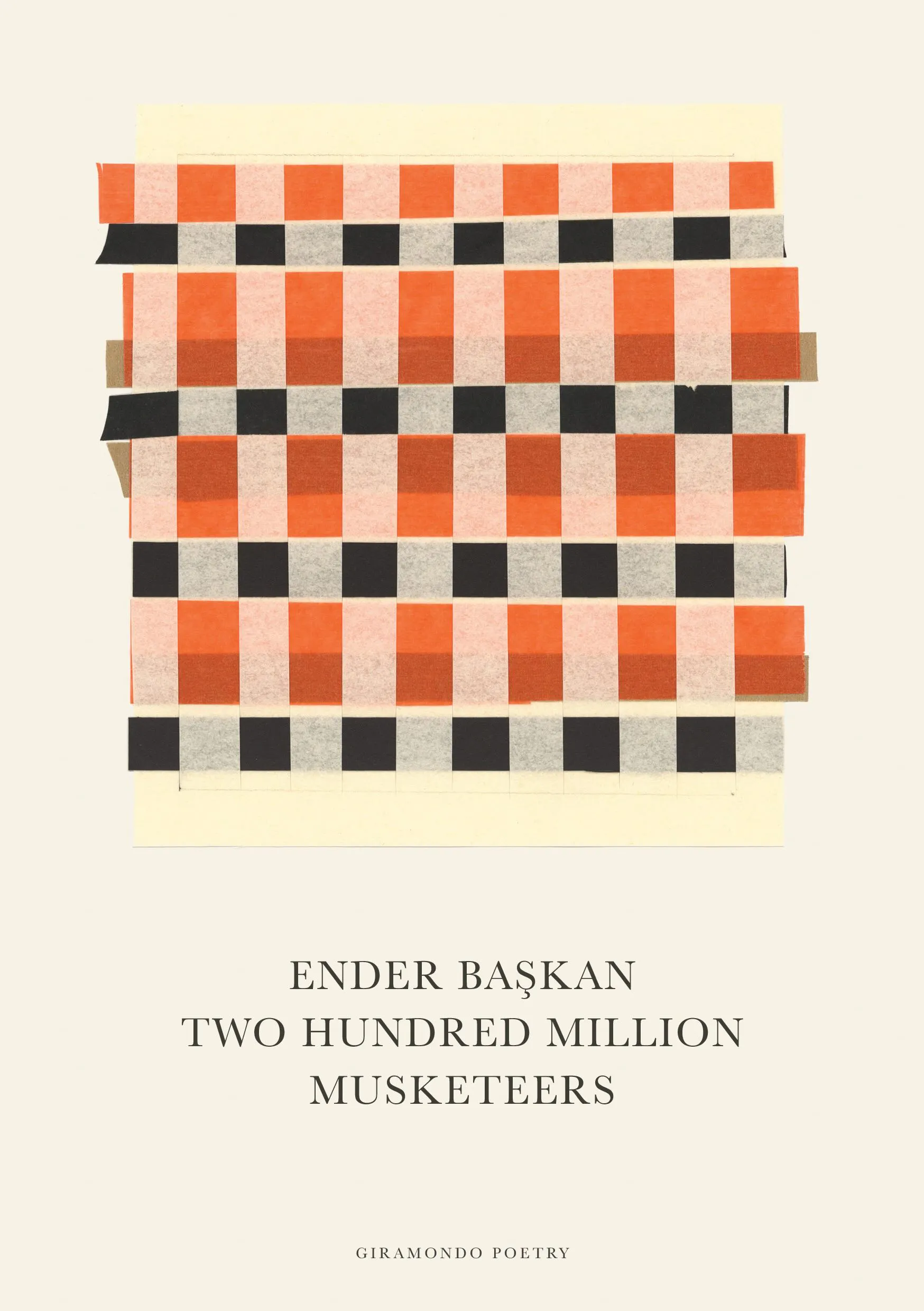
Brendan Casey on Ender Başkan’s virgules
In scoring space and time, punctuation often reflects how we arrange our lives. Through the virgules in Ender Başkan’s new book, Brendan Casey notes the impress of work and fatherhood on poems tuned into the avant-garde improvisations of children.
The virgule (‘/’) plays a significant role in Ender Başkan’s new collection, Two Hundred Million Musketeers, but not for the same reasons it has become a popular signifier in a lot of contemporary poetry. An ancestor to the comma, the virgule, as Margaret Connolly has noted, was used in medieval poetry to indicate where a reciter paused or took a breath. It was a useful tool before the advent of mechanical reproduction, when poetic talent and literacy did not always align, and composer and scribe were two distinct roles. A sarcastic poem by Geoffrey Chaucer, rebuking his scribe Adam Pinkhurst, appears in manuscript like this:
Adam . scryveyne / if euer it þee byfalle
Boece or Troylus / for to wryten nuwe /
... affter my makyng / þowe wryt more truwe
[Adam scrivener, if ever it thee befall
Boece or Troylus to write anew,
... after my making thou write more true]
Like half-beat rests on a musical stave, virgules were a guide to oral performance. After the sixteenth century, when commas became standard grammar, the now defunct virgule was adopted by literary critics to facilitate poetry’s entry into prose. The virgule took on the role we recognise today, where a verse line or stanza break appears in quotation: ‘No that is not it / nothing that I have done / nothing / I have done // is made up of / nothing’ (William Carlos Williams, ‘To Have Done Nothing’).
When quoting poetry, a virgule may still reproduce a pause, but it isn’t directly tied to performance or spoken rhythm. Rather, the virgule belongs to a textual world where the written grapheme has taken primacy over the oral phoneme. In modernity, the poem – in its truest, most authentic form – belongs to the printed page, rather than to spoken performance, so that its typographic design or layout matters above all.
The virgule is then a nomad, migrating from breath to beat to quoted line. The modernists noted this and turned the virgule on itself as a citational knife that cuts through authorship. How far the virgule had travelled by the twentieth century can be sensed in the opening lines of Charles Olson’s ‘The Kingfishers’ (1950):
What does not change / is the will to change
And later, in section three of the same poem:
When the attentions change / the jungle
leaps in
even the stones are split
they rive
Although Olson is elsewhere a sensitive theorist of poetic breath, the virgules in ‘The Kingfishers’ do not mark a vocal caesura (for this, commas would have sufficed). Instead, as Daniel Swift observes, Olson uses virgules to give his text the feeling that ‘all he writes is [already] a quotation’. In Olson’s poetry, virgules signal scholastic rigour, his gathering of literary, journalistic, historical and philosophical source materials in poetry, and a self-conscious announcement of the textuality of ‘The Kingfishers’, its existence as words arranged on a page.
All of which is to say that this isn’t how Başkan employs the virgule. His virgules are far more particular; indeed, their idiosyncrasy perhaps goes to the heart of what interests him as a poet. Virgules litter the pages of Two Hundred Million Musketeers (I lost count at page 30, by which point Başkan had already used 260, averaging eleven per page). Sometimes, admittedly, Başkan employs virgules as a fairly conventional slash, to indicate a conjunctive and/or, such as:
if you have small children I recommend you carry tissues
bandaids / pencils / paper / pawpaw cream / liquid paracetamol
More often, however, they serve a special poetic function, as in ‘A Workers Paradise’, which begins:
i go to work / i go to work / i go to work/ i go to work / i go to work
/ dilân says – i love you dad / dilân says – but i love mum more / i
go to work / four days in a row / 5,6,7,8 / im tired / when i go home
i also go to work but i dont say that / centrelink says sophie doesnt
work / its a lot of work being a parent, people say / it must be a lot
of work / how do you do it? they say, i cant imagine / but i go to
work and i work / i come home and i work and i work / on fridays i
dont go to work but when my dad asks i say – im at work – because i
am, im writing, im working / ...
What to make of this conspicuous cluster of virgules? Are these the first nine lines of a prose poem? Or nineteen lines of verse, rendered in prose? While these are tricky questions, the virgules do not themselves make ‘A Workers Paradise’ a difficult poem to read: they add to the poem’s natural enjambment, each run-on line – or run-on line within a line – contributing to the portrait of a father run off his feet, or stuck, as Başkan puts it, in ‘a work death balance’. A thematic interpretation like this, I think, is key to unlocking Başkan’s use of the virgule.
‘A Workers Paradise’, like numerous other poems in Two Hundred Million Musketeers, is about how difficult it is to write poetry today, not because of lack of talent, ambition or gumption, but because of competing demands. Before Giramondo published this, his third book – coming after the 2019 novel A Portrait of Alice as a Young Man, and the 2024 chapbook Danger Baby – Başkan self-published through Vre Books, a press he co-founded with his friend Gabriel Curtin. In other words, Başkan was not only a poet, a father and a worker, but an editor and a publisher, a book designer, a printer and a distributor. Our contemporary slang for juggling multiple hats like this is a ‘slash career’ or a ‘slashie’. This is what virgules in ‘A Workers Paradise’ seem to mean: they visually and rhythmically enact the accelerated precarity of a life lived across multiple slashes – poet/dad/worker/editor/publisher/designer/distributor.
Of course, poetry has never sat comfortably with economic reality. ‘Poetry is not a very negotiable skill’, John Forbes warned in 1990, addressing would-be poets about their financial prospects. ‘Apart from a brief period beginning in the nineteenth century and ending just before you were born (the “Golden Age” myth), it never was’. Nonetheless, today feels like a particularly anaemic time for Australian poetry, in terms of institutional support and opportunity at least. Commercial Australian publishers hardly publish poetry anymore. Advances for poetry books, however meagre and rare in the past, have almost entirely evaporated. Forget the price of eggs: a night at the pub, which could once be budgeted for on the dole, now spells bankruptcy for many poetry workers. As Başkan writes in ‘Are You Ready Poem’: ‘No more sole trading freelancing grants prizes tenders agents gallerists commercial jobs casual jobs side jobs shit jobs steve jobs’. Perhaps in coming years, as work becomes an increasingly uncertain scramble, we might predict virgules to appear with greater frequency in Australian poetry. They might come to function a bit like the exposed steel beams, air-conditioning ducts, and plumbing you see in newly built public architecture. The ‘industrial aesthetic’ – which all too neatly coincided with the rise of workplace precarity and the gig economy – gives the sense that every building is only ever half-built and temporary. Perhaps haphazard virgules could do the same for poetry.
In his 2011 novel Leaving Atocha Station, Ben Lerner, the preeminent contemporary proponent of the virgule, writes: ‘I tended to find lines of poetry beautiful only when I encountered them quoted in prose, in the essays my professors had assigned in college, where the line breaks were replaced with slashes, so that what was communicated was less a particular poem than the echo of poetic possibility.’ This is the fictional protagonist Adam Gordon speaking, rather than the author, but in the 2016 book-length essay The Hatred of Poetry, Lerner more or less concedes that these are his feelings, too: ‘I have come to believe [...] lines of poetry quoted in prose preserve the glimmer of the unreal’, thus avoiding the ‘fatal problem with poetry: [actual] poems’.
Lerner’s novel suggests that the author likes virgules in poems because they announce the context of literary criticism. When a poem is excerpted, when it comes furnished with virgules, it has arrived predigested, canonised, already equipped with an interpretation and an imprimatur of value. In this sense, they are not really provisional at all, but codified markers of authority, signalling to learned readers.
The fact that beauty is tied to virtuality for Lerner – ‘poetic possibility’, for him, beats the disappointing reality of actual poems – has always struck me as a product of his long education. Lerner completed an MFA at Brown in 2003, where he studied under C.D. Wright, before becoming a professor in his own right at Brooklyn College. His interest in what he calls ‘Defenses of Poetry’ – a genre which A Hatred of Poetry at once emulates and parodies – reminds me of the exegesis or explanation that is required to accompany a creative writing assignment at university. By including virgules in a poem, Lerner seems to say, a poet can allude to this academic apparatus: poetry becomes both set reading and student interpretation or written report with efficient, seamless simultaneity.
Like Lerner, Başkan has postgraduate qualifications in creative writing. Yet, despite his education, Başkan has remained remarkably immune to the cool, knowing, metapoetic tone of the international MFA School of Poetry. If anything, his poetry has a tendency to veer towards an intoxicating, utopian slurry –
even angels are working in call centres...
imagine!
200 million musketeers
200 million pamphleteers
200 million volunteers
200 million chocolatiers...
200 million billy shakespeares
so
each according to their ability
to each according to their need
– which then requires tempering with passages of more immediate or direct reality (in ‘Old Friends’, heaven is more plausibly represented as singing along to the Bad Boys soundtrack in a car late at night). It would be tempting to suggest that this is because Başkan returns the virgule to its earlier function as an indication of the body and poetic breath. At the Melbourne launch of Two Hundred Million Musketeers, Başkan recalled how, when travelling in Istanbul, he momentarily lost interest in poetry, attracted instead to local music and the figure of the Ashik bard, who sang stories, brought the news, as oral archives and conduits to history – ‘a bit like the modern radio’. But I suspect there is a more direct and relevant contemporary precursor to Başkan’s virgule, and that is fellow Melbourne poet π.o., whom Başkan fondly refers to as a ‘hero’, and who provides a blurb for Two Hundred-Million Musketeers.
π.o.’s poetry also features a lot of virgules. In ‘Saul Same’, they stand in for meteorology:
In 1946 there was a fire in the factory, and
he had to start all over again. (No body knows
from which cloud ///// rain will fall).
In ‘Zorba’s’, a poem about a Fitzroy coffeeshop-cum-gambling den, π.o. starts out using virgules as comic book speech bubbles, but then transfigures them into broken bones:
“Ha””
/
Ha
\
Ha
/
Ha
\
Ha
started
cracking skulls; arms / hands / legs / shoulders
In his verse-biography of plein-air painter and cartoonist Harold Herbert, virgules are the strokes of a paintbrush or the inky lines of a pen:
As a kid, all Harold wanted
Wanted to do was paint ///// — watercolours;
Never had a lesson in his life, held his first
Solo exhibition in 1917; 114 works //// in pen & ink.
This last example most clearly demonstrates what π.o. does with virgules. As a concrete poet, π.o. has become adept at making ‘pictures out of words and nothing else’ (to quote his late great friend Jas H. Duke), as, for instance, in this 1973 poem:
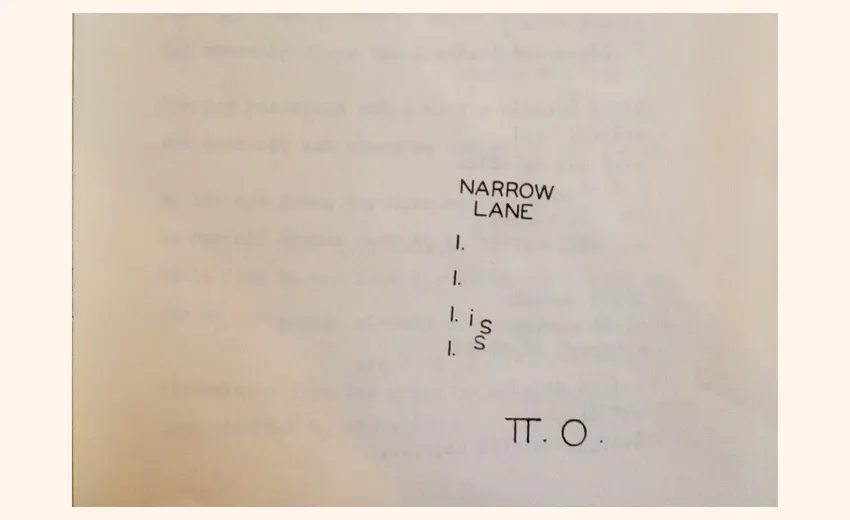
It’s possible to attempt a semantic reading of this poem: ‘i’ (the self) becomes an ‘is’ (a thing-in-the-world) when brought in close proximity to the other. But π.o.’s letters no longer really function as units of linguistic meaning. Instead, they are tools for making images: a skinny person (‘i’) squeezes past two more shapely figures (‘s’ and ‘s’) in a narrow laneway. In π.o.’s lineated verse, virgules serve a similar effect: estranged from its conventional grammatical function, the virgule becomes what it is – a line that can point, can draw, can be used to make a picture of the world. In this manner, π.o.’s virgules are mini-illustrations (and this senior figure can add ‘illustrator’ to his own long list of slashes).
Başkan’s repertoire is not quite so varied as π.o.’s. His virgules never escape the lexical code and become graphic. Nonetheless, even if he does not follow π.o.’s lead into concrete poetry, he does seem to accept π.o.’s definition of ‘realism’, that is, that poetry is obliged to represent reality in all its complexity, materiality and confusion. (This, π.o. insists, goes for modernism and experimental poetry, too: the French realism of Gustave Courbet, he likes to remind, was the first avant-garde, and set the aesthetic and political aspirations of future movements).
Of all the younger poets writing today, Başkan could slip most seamlessly into the pages of 925, the little magazine π.o. co-edited between 1978 and 1983, whose mission it was to publish ‘poetry for the workers, by the workers, about the workers’ work’. Take, for instance, ‘Good Mood/Bad Mood’ by another 925 co-editor, Jeltje Fanoy:
Now he’s in a good mood—
we can be in a good mood!
(chorus) we can be in a good mood!
we can be in a good mood!
Now we’re in a good mood—
he’s in a bad mood...
(ch.) he’s in a bad mood...
he's in a bad mood...
Now he’s in a bad mood
we are in a bad mood...
(all together):
Now he’s in a good mood—
we can be in a good mood!
It’s a magnificent record of workplace hell that ought to be framed in every office cubicle and lunchroom in the country. If The Boss presides over Fanoy’s Tartarus, then Başkan – who works in retail – writes of an equally diabolical tormenter: The Customer. His poem ‘Erotics Of Bookselling’ reads in part:
i dont mind
its no big deal
dont worry
dont mention it
look im sorry
my bad
its a shame
it is what it is
its been ages hasnt it?
its been a while
its been too long
its been a pleasure
yeah yeah yeah yeah yeah yeah yeah yeah yeah yeah yeah yeah
yes yes yes
yes we can
the customer is always / the customer
Everyone working in retail and hospitality knows that some of the worst customers, the truly difficult ones that make forcing a smile feel like cowardice and quietism, have come care of their own toxic workplace, where some version of Fanoy’s Boss made them feel small. Instead of taking revenge against The Boss, they get their own back by play-acting that they have servants – you, the retail employee. Now you’re in a bad mood, they can be in a good mood.
Despite the satiric daggers Başkan has for working life, his realism isn’t all kvetch and moan. In making a record of life, of the world not just as economic but as social, he finds many moments of beauty, both minor and sublime, and, more often, some complex mix of the two. Two starring cast members of Two Hundred Million Musketeers are Başkan’s daughters, Dilân and Ezgi. They animate the collection, not simply as characters, but as speakers. Indeed, the poem ‘Phar Lap’, which is written in Dilân’s voice, seems to have been delivered to Başkan more or less complete:
how old was phar lap when he died dad?
like me im almost 5 and a half
he was just a kid he was just little
is that old for a horse dad?...
how do you know so much about phar lap dad?
whats wikipedia?
What counts in this poem, Başkan suggests, is less the poet as writer than the poet as listener, attuned to the variability of speech as it is socially practiced. Williams famously traced his own poetics to hearing ‘the speech of Polish mothers’; on the Passaic bus or at the medical clinic where he worked, he sometimes acted like a tape recorder:
Doc, I bin lookin’ for you
I owe you two bucks.
How you doin’?
Fine. When I get it
I’ll bring it up to you.
In the easy chattering of his daughters, Başkan finds similar inspiration: the premise that the poet’s first task is simply to listen well.
One Polish ‘mother’ did, however, leave an indelible mark on Başkan’s poetry: the poet and creative writing lecturer Ania Walwicz, who migrated from Świdnica to Melbourne in 1963, and whom Başkan met at RMIT in 2013-14. My favourite poem by Walwicz, ‘Big Time’, reads in part:
I had no choice but to go looking for some good times. And something stronger than lemonade. And brighter than cream. And louder than a whisper. And warmer than lukewarm. And bigger than my room that was too small. And better. I knew I could get better. For sure. You just know these things. Deep down. There was this pearl for the diver. Gold for the finder. Silver for the girls. Sparklets for the mister. Red for the bull. Big time moments for me. Fireworks for this girl. That lived at night. Ate chocolate.
I can’t help but read ‘Big Time’ as a self-portrait, as a kind of cranked up, ‘neon electric’ confessional, and (although surely too convenient) I’ve found this biographical reading more and more compelling since Walwicz’s death in 2020, which left a big time hole in Melbourne poetry, especially for people who, like Başkan, had the benefit of having her as a teacher. She was a tiny woman, about 4’8” or 9”, but her writing was characterised by compulsion, magnification and inexhaustible appetite. To achieve poetry at this scale, Walwicz honed one of the most distinctive and immediately recognisable voices in Australian letters. Her highly experimental writing, which constantly breaks rules of grammar, diction and polite speech, isn’t difficult per se, but can be off putting in its all-embracing excess, terrifying for being too much. ‘Yes! Yes, I want the reader to love me,’ Walwicz explained in a 2018 interview with fellow poet Andrew Pascoe, ‘I want to love the reader!’
Yet what distinguished Walwicz’s experimentalism was that it never felt scholastic. She embraced the avant-garde with a child’s wonder, curiosity and delight. ‘I like unusual texts’, she explained. ‘But, you know, it’s interesting how people view unusual texts. Some people are frightened by it, other people get into it – when I worked with children, they were open to get into most unusual texts. Interesting.’ My son was enamoured with Walwicz when, at the age of seven, he came with me to the launch of her last book, horse (2018). Poetry readings can be dull occasions for children, but Walwicz put on a performance: in a fake beard and reversed suit jacket, she embodied a Punch and Judy rendition of Sigmund Freud. That night, my son believed that he had met the famous author Gertrude Stein. (Stein is another boogeyman for university students – difficult, unapproachable, just plain weird – but who gets big time laughs from children when she is read as a bedtime story).
Başkan’s daughters remind him of Walwicz. ‘I’m a thrilled witness to [their] entry into language’, he wrote recently for HEAT magazine, ‘as they get on a roll and talk like Ania’. In the opening poem of Two Hundred Million Musketeers, ‘Here Is The Shirt, (Get) Off My Back / Swimming In The Afternoon’, we encounter a Walwiczian language game between father and daughter:
dilân is learning italian at school and now she can say things like
prego bella ciao and mettiti il cappello...
well i know three languages already dilân flexes
i know english turkish and another language that is very old!
we found it tucked under the world
and not very many people speak it but me n my friend
... my dad speaks a bit too
its called shuey-ma-shuey
and its tucked under the world!
Prior to any formal induction into language, ‘before self-consciousness and repression sets in’ (as Başkan puts it), children are capable of remarkable linguistic invention, an array of sounds, rhythms, and coinages that would inspire envy from the most adventurous avant-garde poet: ‘tinchi linchi kla haji anji inji ya / inji anji injia ya / klip klop / dip dop / dudu dudu dudu’, say Dilân and her sister Ezgi (her scribe/father faithfully listening, taking notes).
The linguist and literary critic Roman Jakobson observed that children are at the height of their linguistic powers before the age of one, that is, before cooing and prattling are supplanted by ‘mama’, ‘dada’, ‘more’, ‘stuck’ – their first solid words. During this prelinguistic phase, which Jakobson terms ‘die Blüte des Lallens’ (‘the Apex of Babble’), a child ‘accumulates articulations which are never found within a single language or even a group of languages: consonants with the most varied points of articulation, palatalized and rounded consonants, sibilants, affricates, clicks, complex vowels, diphthongs, and so forth.’ However, as if falling under some lapsarian curse intended to teach humility, children invariably lose this capacity. Quite suddenly, in immediate anticipation of their first word, their linguistic powers seem to atrophy. Captivated by the rules of one language, the child exits the boundless – yet ultimately uncommunicative – realm of phonic pluripotentiality. The price of admission for speech, it seems, is forgetting the unbridled joys of babble.
Jakobson’s theory, with its emphasis on the tyrannical mother tongue that jealously kills off infant babble, is an awkward fit for a multilingual family like Başkan’s. Yet in making a record of his daughters’ speech – which he describes as a ‘child’s free jazz’, which ‘might not appear / to have words like other languages but has worlds’ – he seems to want to extend this period of phonic play for as long as possible. ‘im not a dictator’, he writes, in a line that starts as a remark about parenting, but slips into an ars poetica: ‘im a guide a comrade / i have authority but im not authoritarian / im a writer’. In the fabulously titled essay, ‘Look at Me, Ma – I’m Going to Be a Marginal Writer’, Walwicz observes: ‘The study of literature could also be a study of potential literature, of varied literatures, of works which have not yet been written, of hidden literature.’ Perhaps shuey-ma-shuey, a ‘very old’ language ‘tucked under the world’, is one such potential literature. To be a marginal writer is often equated with failure; since at least the fall of Babel, being misunderstood or misinterpreted has been treated as divine punishment. Yet Başkan, alongside his teacher Walwicz, suggests the obvious alternative: that linguistic diversity is not a limitation, but a precious gift.
Alongside breath, quotation and line break, what the virgule chiefly signifies is the need for more within a line: more time, more space, more stretch in the sentence. It is a particularly greedy punctuation mark, that we allow only the poets to have, perhaps because we give them so little else to live on. In a poem-essay published in Meanjin, Başkan links parenting to the tempo indicated by the virgule in his poetry:
What I’m Reading?
not much!
two little kids and working in a bookshop
an abundance of books
to read
not much clear air tho
not many stretches at the desk
fall asleep the minute i get into bed
just pockets of time to think
in the shower, bike to work and back
on the toilet
washing nappies
hanging clothes
walking with a baby strapped to my chest
While it would be wrong to say that Başkan is endorsing Cyril Connolly’s mordant adage that there is ‘no more somber enemy of good art than the pram in the hall’, he is nonetheless admitting that a life event as big as having a child necessarily impacts art. For five years after the birth of his own daughter, the Melbourne painter John Nixon decided to paint only in orange. Choosing orange streamlined his decision-making process and gave him some ‘clear air’ in the studio: orange and the baby were enough work for him. Two Hundred Million Musketeers is part of Başkan’s orange period: ‘not only do i write and work in fragments now / but i read in fragments / seek poetry and dense prose / to grab what i need’. Take in a virgule or two like the satisfying crack of a sore neck. Take a virgule like a smoko or – better yet – a sickie. This is another function of Başkan’s signature slash: they make space for jotted notes, pocketed between the demands of daily life.