
I was suitably impressed by this amazing fact and do not hesitate to disseminate the happy event, the first of its kind, as widely as possible – to you, for instance, who until now have probably remained unaware that you have been exchanging letters with a German stylist. And now I advise you as a friend, not as an interested party, to preserve them – have them bound – take good care of them – one never knows.
Where Have All the Pithiatics Gone?
Robert Boncardo and Christian R. Gelder on Lacan and French psychiatry
Reviewing Jacques Lacan’s early writings, Robert Boncardo and Christian R. Gelder pull back the curtain on French psychiatry in the early twentieth century – a medical milieu that would prove pivotal for Lacan’s understanding of psychosis.
Sometime in the mid to late 1920s, a woman arrived at St. Anne’s Hospital in Paris. This was not her first hospital visit; in fact, she was widely considered ‘a picturesque feature of the Paris hospital landscape’, as historian Élisabeth Roudinesco puts it. The woman had been traumatised by the War. On 22 June 1915, in the northern French town of Saint-Pol-sur-Mer, her house was destroyed by an artillery shell. She was discovered alive under the wreckage, her body in a ‘contorted position’ and her left leg trapped in the ‘collapsed floor’. She was taken to Saint-Paul de Béthune Hospital, where a medical officer issued her the following command: ‘Stand up straight, you will stand up straight, you are straight, stay straight’. She emphasised these words to every doctor she subsequently saw, as if they had pierced her skin like bullets, marking her body.
From that point on, the woman could not walk straight, despite eventually recovering from the physical injuries she suffered in the blast. Her diagnosis: abasia, a term first used by nineteenth-century pathologists who worked alongside the influential neurologist Jean-Martin Charcot at la Salpêtrière in Paris (Charcot’s work would be important for Freud’s theories on hysteria). Formalised by one of Charcot’s students, Paul Oscar Blocq, the symptoms of abasia included the inability to stand upright and walk straight. It would sometimes result in paralysis, jumping fits, tremors, and disturbances in movement. In this woman’s case, she was convinced that if she walked as she had before the explosion, she would immediately collapse, just as her house had collapsed around her. When she moved to Paris in August 1915, new abasiac symptoms emerged: she could, for example, walk forward only on tiptoes. In the following years, and following many hospital visits, her walk changed several times, becoming increasingly elaborate. Curiously, these changes seemed to occur because of, and not despite, the many attempts to treat her.
After being discharged involuntarily from a facility in January 1923, the woman began walking in her most baffling way yet: backwards, on tiptoes, making 360-degree turns at regular intervals. She was given electric shock treatment, but to no avail. When the woman arrived at St. Anne’s, she was seen by Maurice Trénel, the one-time head of department of the now-abandoned Maison Blanche Psychiatric Hospital, and his junior colleague: a young psychiatrist named Jacques Lacan, who would later reflect that he left Trénel’s influence ‘too soon, in order to seek a position in the consecrated spheres of professional ignorance’. Together, they published this woman’s case in the 1928 edition of the Revue Neurologique de Paris, a small journal associated with the Paris Neurological Society. Incidentally, this was the same year that Marie Bonaparte and Rudolph Loewenstein, who would go on to become Lacan’s analyst, translated Freud’s landmark case of the young hysteric Dora into French.
What explained this woman’s strange symptoms, the ‘singularity of [her] motor disturbance’, as Trénel and Lacan put it? Their answer referred to another arcane category lost to the history of psychiatry: Joseph Babinski’s controversial pithiatism. Despite being Charcot’s loyal student in the 1880s and, as Mark S. Micale writes, the ‘natural heir to the Salpêtrian tradition’ of neurological research, Babinski went on to distance himself from his one-time teacher, as many of Charcot’s students did after their teacher’s unexpected death in 1893. In 1901 – the year Freud published the Dora case – Babinski proposed replacing ‘hysteria’ with a more limited term that supposedly got to the essence of somatic disorders. The term he suggested was pithiatism, a portmanteau of the ancient Greek words for ‘persuasion’ and ‘curable’.
Pithiatism brought to the fore the sense that hysterical symptoms were the result of suggestion. Just as the military officer’s commands to the abasiac woman led to pithiatic symptoms, so could they be cured by an especially persuasive doctor. This was a psychologically attuned notion of hysteria, but one that radically diverged from Freud’s own. Where Freud saw hysteria as a process of ‘somatic conversion’ – an unbearable unconscious thought, expressed through the body, that would find its resolution in the talking cure – Babinski thought that hysterical suggestibility could be cured by a doctor deploying all of the theatrical power of medical treatment. ‘A subject’, he wrote, ‘afflicted with an hysterical paralysis, for example, upset and disoriented by successive questions, by the multiple orders that are thrown at him, by the tests we subject him to, by all of the medical rituals shrouded in their mystery, will forget for a moment his paralytic role and execute a few movements’. If the traumatised woman was pithiatic, it was because she had convinced herself she couldn’t walk normally. A doctor was required to convince her otherwise.
While hotly debated in Paris, pithiatism didn’t have legs anywhere else. A small taskforce from the Paris Neurological Society deliberated for six and a half years on the condition, reporting its findings in 1908. The results of the meetings were published in the same journal in which Trénel and Lacan’s case would later appear. Although pithiatism looked as though it was on the outs by the early 1910s, the outbreak of the First World War unexpectedly changed its fortunes. The War prompted debates about the state’s obligation to provide welfare to victims, as well as about how soldiers may have been feigning injury to escape military service. For some psychiatrists, pithiatism helped respond to these questions: in flattening the distinction between ‘genuine’ hysteria and advantageous fakery, both could be subjected to the same theatrical treatment.
Yet if pithiatism could be cured by persuasion, then the abasiac woman’s repeated hospitalisations showed her doctors’ lack of persuasiveness. Despite their efforts, her symptoms not only persisted, they intensified – almost as if she were attempting to convince them of something, and not the other way around. Trénel and Lacan noted that she also suffered from auditory hallucinations of persecutory voices and the conviction that she had been covertly impregnated – symptoms perhaps more indicative of paranoia than hysteria or pithiatism. Indeed, her behaviour could be seen to match descriptions Lacan would give throughout the 1930s of ‘litigious’ paranoiacs: patients who, following an emotional trauma, are hell-bent on having the authorities recognise their suffering, even if recognition never comes in the desired form. The abasiac woman would eventually threaten to burn down the house of an eminent medical authority – reproducing the event that initially triggered her symptoms – perhaps as a message designed to induce recognition and understanding. But what is there to understand here?
Almost a century on, and with pithiatism relegated to the nosological archive, the case of Trénel and Lacan’s ‘strange patient’ remains interesting for several reasons. Firstly, their diagnosis is very much situated in a peculiar French psychiatric milieu, where broader questions about the nature of hysteria converge less on sexual repression and free association, and more on the French state and institutionalised psychiatry. (If Lacan would later become famous for his theatricality, it might in fact be traceable to this psychiatric milieu rather than psychoanalysis.) Secondly, the abasiac woman’s status as a fixture of the Parisian psychiatric scene – her constant appeals to doctors and the medical gaze’s equally intense fixation on her – could be seen to express the rhythms of her symptoms. Her relationship to the medical establishment takes the form of a game of proximity, repeated approaches and pullings away. In consulting numerous doctors, she would, as Lacan and Trénel aptly put it, attach the ‘utmost importance to every step she took’. Thirdly, there is a social and historical poignancy to the case. In Lacan’s early work as a psychiatrist, he wondered if symptoms were not themselves expressions of, or responses to, particular historical moments and contradictions. The final form her gait took – walking backwards on tiptoes while rotating regularly – could be read as a silent assessment of the impact the War had had not just on her, but on everyone: it was no longer possible to walk straight-forwardly into the future, now that it was wholly uncertain. One could only fix one’s eyes on the past, advance away from it carefully so as not to disturb it, and introduce one’s own regularities into a landscape bereft of clear, collective markers. While her doctors were marching ahead under the banner of science, the very same science that had facilitated the War’s industrial-scale devastation, this women’s walk seemed to attest to what the War actually laid bare: that history, both lived and political, never simply walks forwards.
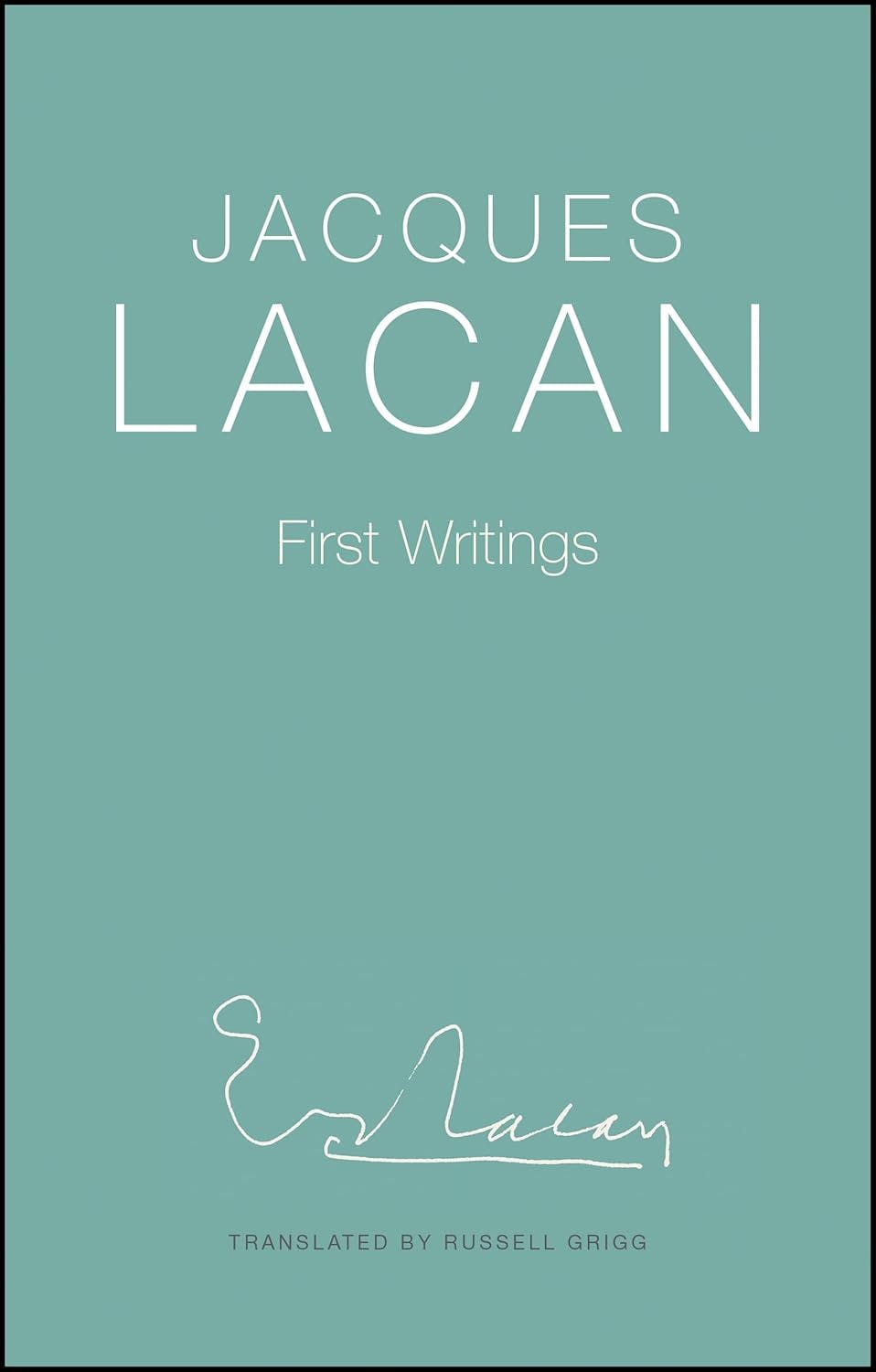
‘Abasia in a Woman Traumatised by War’ is the first article in a recently published collection of essays by Lacan entitled First Writings, translated from French into English by the noted Australian philosopher and psychoanalyst Russell Grigg. First Writings is a slender volume consisting of just eight essays, which were written, sometimes with others, by Lacan from 1928 to 1934, when he was still an ambitious young psychiatrist working at St. Anne’s Hospital and not yet a psychoanalyst. The essays deliver a fascinating snapshot of Lacan’s work before he had encountered all the sources usually claimed as determining influences on him, such as Saussure’s linguistics and French Hegelianism. Some of these articles were written before Lacan had even spent any time on the couch (he entered into analysis with Lowenstein in 1932). Indeed, part of their interest is that they supposedly map Lacan’s burgeoning interest in analysis: the very earliest pieces from the late 1920s hardly engage with psychoanalysis at all, though this rapidly changes as Lacan begins to grapple with Freudian notions of the unconscious and identification by the early 1930s. Yet does Lacan’s career simply march forwards towards psychoanalysis in the way this collection implies, or does his walk eerily mimic that of the abasiac woman’s, sometimes going forwards, sometimes backwards and at others times in no particular direction at all?
Unlike Lacan’s infamous collection Écrits (1966), First Writings (Premiers écrits in French) was never conceived, edited, or put forward by him for later publication. If the essays in the Écrits are infamously florid in style and literary in ambition, showing the Parisian psychoanalyst at the height of his theoretical sophistication, the essays collected in the First Writings are medical and circumspect. They are also generically diverse, featuring a selection of case studies, book reviews, a longer technical essay published in a little-known medical journal, commentary on the literary production of a paranoiac woman, and Lacan’s first pieces for the Surrealist journal Minotaure. However, not all of the essays that Lacan wrote in the years before he became a psychoanalyst are included in this collection – and the method behind what is included is curious.
The published essays were chosen by Lacan’s son-in-law, Jacques-Alain Miller, who has exerted an astonishing amount of editorial influence over Lacan’s published writing. In his ‘Foreword’ to the collection, Miller is anxious to claim Lacan as the sole author of three out of the eight pieces that are listed as being co-written, something disclosed to him via ‘personal communication’. But even insisting on the singularity of authorship is strange, as these essays typically follow the conventions of the early twentieth-century medical case presentation. They record observations that are intended to be made from a neutral, purely medical gaze; they also show the psychiatrists performing tests whose results are meant to be replicable by any medical practitioner. Unlike the Écrits, which in fact opens with an assertion of individual style, these essays have a medical quality that resists being assigned the stylistic authority a title like First Writings implies. They include large volumes of recorded or unattributed speech, literature reviews, and lengthy quotations from patient and medical writings. The Lacan of First Writings is developing his own unique theories, certainly, but he is also participating in the conventions of early twentieth-century psychiatry.
The organisation of First Writings suggests an important set of interpretative editorial practices, which have been designed to chart a neat path from Lacan’s start as a precocious psychiatrist to world-famous psychoanalyst, heir to Freud himself. One of his biographers, Élisabeth Roudinesco, notes that the case of the abasiac woman constitutes an important moment in Lacan’s early career, but the article couldn’t exactly be said to constitute his first baby steps as a psychiatric researcher. The 1926 paper, ‘Fixity of the Gaze due to Hypertonia’, is absent from First Writings, even though it was Lacan’s very first presentation to the Paris Neurological Society. This paper details a sixty-five-year-old who fell off his bicycle and was hospitalised at la Salpêtrière, presenting with a fixed gaze and a tic. Lacan’s report is largely neurological, and so its exclusion could be attributed to the difficulty of drawing a straight line from what Lacan would become to what this article suggests he may once have been. Conversely, it is odd to see the absence of ‘Detective Novel: From the Chronic Hallucinatory Type of Delusion to the Delusion of the Imagination’ (1928) – a presentation co-authored with Joseph Lévy-Valensi, a psychiatrist who would die in Auschwitz, and Paul Meignant, and which was published in the psychiatric journal L’Encéphale. In this brief publication, the authors document a forty-year-old patient who thought himself in the middle of a detective novel thanks to a delusion according to which he telepathically communicated with the police in order to track down several thieves. Couldn’t we trace a path between this case, which shows the importance of literary genre to psychopathology, and Lacan’s later and well-documented interest in the detective fiction of Edgar Allan Poe?
The essays in First Writings invite us to inhabit the remarkable world of early twentieth-century European psychiatry that Lacan was immersed in – a world that was distinct from yet helped to shape his later psychoanalytic theory. Nowhere is this clearer than in one of Lacan’s most absorbing and meticulous preoccupations: the psychoses. In 1955, when he was rapidly ascending in the psychoanalytic world, Lacan devoted the academic year to developing a unique linguistic account of psychosis, arguing that it is produced by a ‘foreclosure’ of what he calls the ‘name-of-the-father’, a process whereby the symbolic law has not been fully registered by the subject and where delusional content is liable to take its place. Lacan’s work here, like that of many contemporaneous American psychoanalytic psychiatrists, stood out in the psychoanalytic world because it pushed back against the common Freudian orthodoxy that psychoanalysis offered little in the treatment of psychotics. And yet Lacan’s ability to work with psychotic patients is sometimes thought to have originated with his earlier psychiatric training, where he spent a significant amount of time treating patients whose extraordinary symptoms pushed the human experience to its very limits. Lacan’s readers often take his doctoral thesis from 1932, published under the title Paranoiac Psychosis in its Relations with Personality, as the origin of this interest. His thesis documents a young patient called Aimée (‘loved one’, after a character from a novel she had written) who was institutionalised in 1931 for attacking the famous French actress Huguette Duflos. The case clearly had a profound impact on Lacan. In 1970, almost forty years later, he would remark: ‘My patient, I called her Aimée, she truly was very touching’.
While Lacan’s thesis is often taken as his ‘first writing’, the ‘Structure of the Paranoiac Psychoses’, the longest essay in First Writings, was published in La Semaine des Hôpitaux de Paris a year earlier, in 1931. Here, Lacan attempts to distinguish psychosis from more transitory mental phenomena or physiological conditions like dementia. He polemicises against the prevalence of biological psychiatry more broadly, criticising the idea that psychosis is the product of an organic lesion or deficit. Against this tendency, Lacan attempts to outline a psychiatric method, one favouring a careful descriptive approach, which he sometimes described as ‘phenomenological’, that requires the psychiatrist to see the patient as a unique whole. It also requires recognising that symptoms only take on a meaning in relation to this broader whole: they cannot be isolated, as they so often are in today’s psychiatric landscape, from a subject’s ‘personality’. However, Lacan’s psychiatry was not diagnostically relativist. In fact, in a review of the French phenomenological psychiatrist Eugène Minkowski’s Le temps vécu (1936), reprinted in First Writings, he criticises Minkowski for abandoning the ideal of phenomenological precision, and for using this descriptive science instead as a vehicle to advance Minkowski’s own personal reflections. On the contrary, Lacan believed that careful description revealed formal essences – typical structural arrangements that give shape to the proliferating details. Symptoms should not be confused with their underlying productive structure.
‘Structure of the Paranoiac Psychoses’ goes on to delineate several distinct clinical forms of paranoia. Those with a ‘paranoiac constitution’ are paranoiacs for whom delusional constructions are so deep-seated that they shape the paranoiac’s world with a consistency that is not obviously incompatible with ostensible periods of good mental health. Paranoiacs of this nature are mistrustful of the world, but they have also a developed system of delusional judgement built on a kind of logical construction, making them ‘reasoning madmen’. ‘Should fortune place him in line with events’, Lacan writes, ‘he may become a reformer of society or sensibilities, or a “great intellectual” [...] who on rare occasions may manage to occupy the place of leader, [yet] is almost always an outlaw: despised and punished as a schoolboy, a poor soldier, rejected at every turn’. At the other end of the spectrum are the psychotics Lacan thinks have a ‘delusion of passion’. These are paranoiacs whose driving force is emotional, rather than intellectual, whose world is mapped according to the passions, rather than sophisticated theorisation. At the extremes of this structure, Lacan notes, ‘one finds political assassins and magnicides who struggle for years with their murderous project before resolving to carry it out’. Passionate psychotics can also be hypochondriacs who assault their doctors, jealous partners, or what Lacan’s one-time mentor Gaëtan Gatian de Clérambault called ‘erotomaniacs’, patients who believe that someone they have never met is in love with them.
What Lacan’s early article ultimately suggests is that while he maintains a difference between sanity and madness, he also believes that there is no single objective world that supposedly ‘sane’ people happen to know. Psychiatric reason consists in being able to grasp the reason of others, not in subjecting the so-called mad person to a universal model of sanity. And yet there is a tension in First Writings between Lacan’s humane approach to treating psychotics and a very developed sense of social conservatism. Lacan’s interest in the paranoiac is counterbalanced by a concern for protecting the social order. However much the paranoiac’s world is self-sufficient for Lacan, he still judges it legitimate and necessary to prevent paranoiac content from spilling over into the ‘real’ social order, with all of its laws preventing harm to others and sanctioning confinement and punishment – including, at this time in France, the death penalty. Lacan’s commitment to this ‘real’ world is quite extensive: at one point he even goes so far as to offer advice to military recruiters who seek to weed out deserters and provocateurs. As in the case of the paranoiac psychotic with the potential to become a great reformer or revolutionary leader, Lacan worries about the uptake of paranoiacs’ ideas by ordinary neurotics, those who are supposedly not mad. The early Lacan is a kind of ‘humanist’ or ‘reformist’ conservative, interested in giving dignity to psychotics but also anxious about how they might lead people astray, fraying the social order.
First Writings not only shows how Lacan’s early questions about the nature of reason, madness, ideology and cure find differently configured answers later in his career, it also presents the dynamic and often-forgotten psychiatric milieu where these questions were able to be asked in the first place. A striking example of this is another of Lacan’s famous early essays reprinted in First Writings: ‘Motives of Paranoiac Crime: The Papin Sisters’ Crime’, which was published in Minotaure in 1933 (if there were any doubt about Lacan’s reading of the legal nature of the case, then the repetition of ‘crime’ in the title should settle the question). Christine and Léa Papin were maids working for a bourgeois family in Le Mans. They were considered model housekeepers, though they barely spoke with their employers. On 2 February 1933, an electrical failure in the house triggered an event that would come to shock the French public. When the mother and daughter returned home, the two sisters attacked them in a manner that was ‘sudden, simultaneous and from the outset carried to a paroxysm of fury’. The sisters ripped the mother and daughter’s eyes from their sockets, knocking them unconscious, then smashed their faces and mutilated their bodies with various household instruments. After soberly cleaning the instruments and themselves, they lay down together in the same bed.
What was most disturbing about this crime, and perhaps most morbidly fascinating to the public, was that it seemed to come from nowhere. The two sisters were more-or-less ordinary, though unusually close, eccentric but without any history of violence. They were also initially unrepentant, at least until a period of separation in prison, after which Christine began to experience horrific hallucinations, eventually attempting to tear out her own eyes. The two were found guilty. Léa, the younger, meeker sibling, was sentenced to ten years; Christine was given the death penalty, later revised down to a life sentence. Léa went on to serve only eight years, relocating to Nantes under a new name and working again as a hotel maid. For Christine, however, her separation from Léa proved too much. She starved herself to death in 1937.
The case attracted an extraordinary amount of commentary from the French psychiatric and philosophical intelligentsia, though explanations diverged. Some thought the Papin sisters were too mad to stand trial; others that their crime was the inevitable expression of a violent class antagonism. Lacan’s explanation mobilised the newfound psychoanalytic theory of paranoia he developed in his doctoral thesis, one which began to shift away from the classificatory approach found in ‘Structures of the Paranoiac Psychoses’ and towards a reliance on the unconscious and notions of identification. The theory was based in part on Freud’s 1922 paper ‘Some Neurotic Mechanisms in Jealousy, Paranoia and Homosexuality’, which Lacan had translated into French in 1932. According to Freud’s explanation of paranoia, the ‘enmity which the persecuted paranoiac sees in others is the reflection of his own hostile impulses against them’. Lacan drew out the developmental aspect of Freud’s theory, noting the centrality of what he calls the ‘sibling complex’ in the constitution of a paranoiac. In undergoing the very first stages of infantile sexuality, a sibling must quell the feelings of hostility they have towards their other sibling. One option available to them is inversion (a characteristic move in Freudian analyses), where that hostility is transformed into desire or, to put it more subtly, an affective ambivalence of love and hate towards the other is generated. In the paranoiac, this ambivalence transfers onto subsequent people who embody that original relation in new iterations of the same foundational image. In striking the mother and the daughter, the sisters were thus striking the part of their sibling they hated.
Lacan’s humanist conservatism is perhaps more understandable in an extreme case like this, where his theory aimed to account for why the Papin sisters could not accede to what he soberly calls ‘socially effective morality’. Roudinesco puts it nicely in her summary of the case: the Papin sisters may have ‘seemed to reflect the social reality of class hatred, but in fact it reflected another reality: that of paranoid alienation’. The paranoiac’s failure to move beyond their initial affective ambivalence impedes their ability to internalise properly the norms and practices of social life. But despite the violence of the case, Lacan’s essay also hints at why he was so touched by paranoiacs and why his writings on the psychoses continue to have widespread influence. Like everyone who finds themselves on the analyst’s couch, the paranoiac displays an enduring and deeply human preoccupation with what it means to be a part of a family. Working with psychotics involves being sensitive to the ways that their symptoms might actually be attempts at answering very fundamental questions about familial life, questions raised by the fact that we just so happen to wake up in a world where we are dependent on other people. Lacan’s interest lies in what he calls ‘the human enigma of sex’: the way in which so much of one’s life revolves around the mystery of what it means to be a child for a parent (and vice versa), a brother or sister for another, or indeed a partner for a lover. Whereas a neurotic might work their hardest to defend against confronting or even articulating these questions, a paranoiac’s delusion seems to earnestly place them on the surface.
While these might be universal questions, there’s also a peculiar uniformity to all the paranoiac patients Lacan examines: they are women who lived in what would then have been considered ‘non-standard’ familial or intimate relations. The abasiac woman is apparently unmarried and without any close family or friends: her main social relations are with her many doctors. Another case that appears in First Writings concerns a set of socially isolated mother-daughter couples where the daughters are all said to be ‘unacknowledged illegitimate child[ren]’. The Papin sisters are also unmarried and socially isolated, having formed a kind of incestuous couple with one another. Even Aimée has a tenuous relation to her husband and her role as a mother: she desperately seeks some kind of social ascension as a writer in Paris at a time before the scope of women’s independence was enlarged in the following decades. If Lacan’s theory of paranoiac psychosis is supposedly developmental, could it also be informed by sociological factors? For example, do the reported delusions respond to something particular about the experience of these women and their unique familial arrangements? And how do they differ from the possibly more ‘masculine’ delusional models of the ‘great intellectual’ or the ‘outlaw’ that Lacan mentions in ‘Structures of the Paranoiac Psychoses’?
We can leave these questions hanging to examine another thread that runs through First Writings: the relationship between psychosis and writing. Lacan’s 1933 article ‘The Problem of Style and the Psychiatric Conception of Paranoiac Forms of Experience’, published in the very first edition of Minotaure, attests to his increasing interest in modernism and the avant-garde, foreshadowing the very stylistic creativity for which he would later become known. Here, he insists that the writings of the so-called ‘mad’ present a naked truth that is eschewed in the writings of the sane, despite culture’s common-sense that it is the sane who are supposedly in touch with ‘reality’. Lacan introduces a newfound and short-lived quasi-Marxist language to suggest that contemporary scientific psychiatry is a kind of bourgeois ideology, a position that seems at odds with his previous social conservatism (it is likely that he was attempting to play up to the counter-cultural tendencies of the Surrealists, most of whom were nominally Marxist and invested in valorising madness, rather than curtailing it). As he argues, psychiatry has produced a view of the mind as a machine whose value – or degree of rationality even – is measured by its relative efficiency in producing profit. Ideology is thus mistaken for science; a political image of the human subject for psychiatric knowledge. Along similar lines, Lacan notes that psychiatry has produced a model of the mind as metaphysically individualist based on the bourgeoisie’s new-found self-conception as ‘free’. This second conception of mind may seem to contradict the mechanistic determinism of the first, but it is perfectly consistent with a historical materialist account of capitalist ideology, which Lacan adopts here: the ideology of freedom works to obscure the mechanical compulsion of the capitalist economy.
Predictably Lacan suggests that his own phenomenological psychiatry bypasses the ideology that underpins the work of his contemporaries, as his vision of psychiatry is sensitive to the fact that a paranoiac does not merely misrecognise, or fail to adapt to, the one and only ‘real’ world. Rather, the paranoiac has their own world with all the hallmarks of objectivity – a world briefly glimpsed in their writing. But ‘The Problem of Style and the Psychiatric Conception of Paranoiac Forms of Experience’ spends more time examining the ideology of the sane than the writings of the mad. The closest First Writings comes to showing how Lacan interacts with the writings of a psychotic is in an earlier piece, ‘“Inspired” Writings: Schizography’ (1931), co-written with Lévy-Valensi (again) and Pierre Migault. When she encounters Lacan, ‘Marcelle C.’ is thirty-four and works as a primary school teacher, though she has changed jobs twelve times in the past four years. Although she appears relatively well-adjusted, she feels persecuted by her colleagues, displaying a deep distrust of men in particular (‘I do not wish to submit to anyone. I have never wanted to let myself be dominated by a man’, she tells her psychiatrists). At the time of her interviews with Lacan and his colleagues, Marcelle C. believes she has been unjustly failed in an important examination and that another woman, whom she hates with a passion, has been given the place that should rightfully be hers. This persecutory delusion is supplemented by erotomania of an unusual kind: its object – an education inspector who used to be one of her superiors – is dead. She also has a sense of her own election and is on a mission to enlighten and reform mankind, one important enough to concern not only the government but also the military.
Although Marcelle C. says she does not hear voices, she does feel that certain words are imposed on her, words that possess a great, albeit mysterious, value. The article is largely made up of quotations and readings of her letters, which record these verbal impressions. While Lacan’s 1933 article in Minotaure romanticises psychotic writing by positioning it as revealing a truth that eludes rational society, here he and his colleagues seem, well, unimpressed by Marcelle C.’s work. They are dismissive of the idea that her writings are at all ‘inspired […] in the spiritual sense’, noting that there is practically nothing in their content that would recommend them to a wider audience, let alone suggest a transcendent source. Marcelle C.’s letters do not hint at a kind of profound truth; rather, being devoid of content, they function more like an artificial language, whose principle of generation is above all language’s own materiality. As words are strung to more words, sentences to more sentences, what creates and then connects them are the productive powers of assonance, homophony, rhythm, and rhyme, as well as the syntactic and grammatical patterns of poetry and proverbs. With no content to transmit, Marcelle C.’s writing relies on language’s infinite capacity to create more language, including language without meaning. While Marcelle C. is convinced of the importance of her writing, Lacan and his colleagues remain skeptical: her writings ‘are no more important than the interchangeable lyrics of a song in couplets’. For them, she has nothing to say, for nothing grounds her delusions.
The gap here between Lacan’s 1933 theory and his 1931 practice is curious, but it also invites us to position ourselves in relation to his own writings, his own first attempts to enlighten and reform psychiatric science. In thinking about this collection, we might draw a parallel between Lacan’s youthful ambition and that of the ‘first’ psychoanalyst: Freud himself. One of his professors had commented on Freud’s remarkable handwriting at the age of seventeen. Young and obviously eager to please, Freud wrote to his friend Emil Fluss:
Are the essays collected in First Writings a bit like this letter, juvenilia that become important after the fact, essays that we preserve because their author would go on to become France’s most famous psychoanalyst? From one perspective, they are; we encounter in these articles a genuine work in progress from one of the most remarkable figures in the history of psychoanalysis. But this is not the only way to read First Writings. The essays allow us to access a psychiatric milieu that we no longer inhabit; a milieu full of rigour and debate, competing theories, distinctions, and inventions – where nothing seems settled or taken for granted. It is a milieu where the very definitions of reason, madness, ideology, care, and cure were still up for grabs. But even more so, the essays from First Writings also allow us to hear, often in their own words, about the lives of some of the strangest, most extraordinary patients – the many psychotics whose singular forms of reason lead them to walk down so many unexpected paths. Where did they all go?