
At the end of the week comes New Years. We pretend on that night that we have swept all the debris of 1954 out of our lives and that 1955 is clean, young and virginal. Then on Jan. 2, we discover that 1955 has the same diseases that her mother had and is just as much of a slut, that no trick of the calendar can help us escape the web of years that we have woven for ourselves. The holiday season is over. We go back to living our dry, desperate lives.
‘Yes, Virginia, there is a Jack Spicer’
Ann Vickery on Jack Spicer’s faith in poetry
A central figure in the San Francisco Renaissance, Jack Spicer adopted many guises as a poet living through the Cold War. Reviewing his letters and lectures, Ann Vickery tracks the evolution of Spicer’s poetics, from Martians through to mysticism.
On 29 December 1954, the poet Jack Spicer would write to his friend and former student Graham Mackintosh (‘Mac’):
In his follow-up letter on New Year’s Eve, he mulls over the fact that it’s 1955 where Mac is stationed, whereas Spicer is still in 1954:
In a way that’s a worse kind of separation than 100 miles or army vs. civilian. A year (especially at the end of it) seems as individual as a planet […] Worse than a planet for no space ship could cross back from 1955 to 1954 bearing Pvt. Graham Macintosh home on leave to the year he left. There is nothing to do but follow you – so I’ll travel through the next few hours, ring a cowbell at the midnight – and cross over into your new year.
Spicer goes on to contemplate the place to spend New Year’s: should it be Times Square and its aftermath in Greenwich Village, where the ‘streets are full by 3 AM of drunks that are crying and our feet would crunch the light layer of fresh snow on the pavement’? Or ‘in the mountains somewhere […] break[ing] open a few bottles of champagne around a fire which smells of pine and greasewood and wonder[ing] what hour was midnight and when we should have wished each other happy new year’. He considers persuading oneself, ‘Yes, Virginia, there is a Happy New Year’: ‘And perhaps, oh perhaps, Graham, there is.’
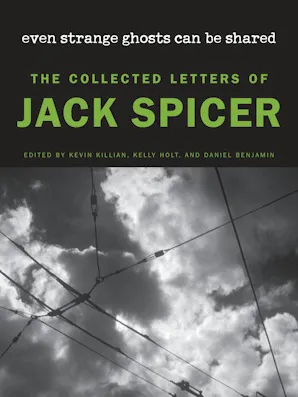
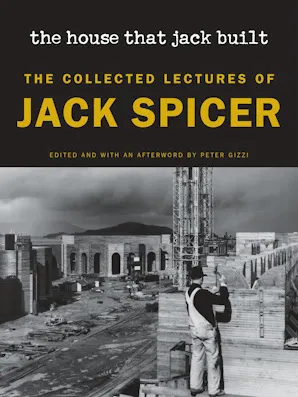
These letters are emblematic of the paradox that is Jack Spicer: the acerbic, deliberately un-PC misanthrope and the imaginative romantic. What they don’t reveal is Spicer the poet, who on his deathbed at the age of forty famously said to fellow poet Robin Blaser: ‘My vocabulary did this to me. Your love will go on.’ Stan Persky wrote of being confused by a Janus-faced Spicer whom he saw as shifting between what he called ‘Dirty Jack and Radiant Jack’. The former could be a manipulative and often cruel alcoholic while the latter championed community and encouraged others toward better writing. With Even Strange Ghosts Can Be Shared: The Collected Letters of Jack Spicer and The House That Jack Built: The Collected Lectures of Jack Spicer, we gain some memorable insights into Spicer’s poetics, literary networks, and contradictions.
They constitute the second half of ‘The Collected Works of Jack Spicer’, joining My Vocabulary Did This to Me: The Collected Poetry of Jack Spicer, edited by Kevin Killian and Peter Gizzi, and Be Brave to Things: The Uncollected Poetry and Plays of Jack Spicer, edited by Daniel Katz. The quartet is the result of a labour of love extending across more than a decade. As readers, we are invited to share with ghosts who remain present in our poetry – not just Spicer’s but now also that of Kevin Killian, himself a central force in the San Francisco Bay Area poetry community and beyond. In helping to edit two of the volumes, and co-authoring the indispensable Poet Be Like God: Jack Spicer and the San Francisco Renaissance (1998), Killian has ensured that Spicer receives the acclaim the latter so desired, and that the intricate histories of Bay Area poetry will provide ground for future generations of poets.
Killian, Kelly Holt, and Daniel Benjamin have meticulously edited Spicer’s letters, with detailed endnotes as well as wonderful appendices, including: a letter from Robert Duncan signing off in Poundian style, ‘Give my luv to al the little nude critticks’; ‘A Canto for Ezra Pound’, a collaboration between Duncan, Spicer, Josephine Frankel, Fred Fredman, and Hugh O’Neill; and a ‘Dialogue on Eastern and Western Poetry’ by Blaser and Spicer, with annotations by Duncan. Despite these bonuses, not all three hundred or so letters in Even Strange Ghosts can Be Shared will be new to readers acquainted with Spicer’s work. He blurred the distinctions between the epistle and the poem, viewing both as forms of intimate address. He let fellow poet James Alexander know that he intended to read his letters to Alexander at a poetry reading – letters which would eventually form a poetry manuscript and are included in My Vocabulary Did This to Me.
Through Even Strange Ghosts Can Be Shared, we can track when Spicer began projecting such personal objects as simultaneously public. The volume tracks the periods significant to Spicer’s career, beginning with what Spicer viewed as his birth year, 1946, when he met fellow poets Duncan and Blaser, and they started fashioning themselves as the base of a poetry community that became known as the Berkeley Renaissance. This was interrupted in 1950 when Spicer lost his job at the University of California for refusing to sign an anti-Communist loyalty oath. He moved to Minneapolis (‘a good place to face oneself and get to like one’s face’, as Blaser put it), where he wrote to Duncan:
In a way I’m closer to Berkeley than I was all last year. I hear from my friends more regularly and with more depth – and there is no danger that they will go on talking after I’ve ceased to listen. Berkeley is Berkeley whether in New York where Landis and George Haimsohn are rooming together with Sedgwick only 2 blocks away, or in Big Sur with Hugh, or on the hill that you live. And I am in ghostland, populated by incredibly beautiful people who don’t seem to exist, hearing from all these real people and feeling half real myself. I live on the Mississippi River which divides Berkeley from Berkeley and cross it daily, which seems to make no difference.
Spicer returned to Berkeley in 1952 when the University of California adjusted its requirements. He joined the Mattachine Society which was a key part of early gay liberation, began teaching at the California School of Fine Arts, and founded the 6 Gallery with some of his students. The letters reveal the close relationships he had with some of them, including Mackintosh, who was married and had been drafted into the army. Spicer would cajole Mac with lines like, ‘I could spend years inventing landscapes for you to walk in’. Another reflects on the ‘private weather’ that each person carries inside of them, with ‘most of us wast[ing] our hopes in the smog and hav[ing] little to fight with when the period of clear weather follows the rain’. Weather would be a prevailing metaphor in Spicer’s Minneapolis letters although the trouble with being a poet is that ‘you have to pick your symbols and risk getting stuck with them’.
Even Strange Ghosts Can Be Shared includes reproductions of the front page of a newspaper Spicer invented for Mac called ‘Aware America’, which featured witty reflections on Cold War politics and capitalism:
FOOD FOR THOUGHT
Eating too little food causes Bohemianism and Communism. Look how thin Bohemians and communists are. Remember your duty as a patriotic American citizen, remember your duty to your ivy-covered grandmother, remember your duty to the Cleveland Indians. Eat twice as much and be twice as American.
It is in this mock-newspaper that we begin to see the development of Spicer’s politics through the metaphor of the Martian, the alien par excellence. Many of his letters critiqued Cold War America’s conservatism and its fortification of cultural norms and hierarchies. The world he would have ‘like[d] to see’ was not a world of ‘anarchy’ but ‘a world of very small governments […] You could choose your government and your war and not be stuck with the government or war you were born with.’
Spicer’s irritation at being an outsider increased when he moved to New York in 1955. He declared upon departing the Bay Area, ‘A person leaving town is a dead man […]; one feels inhuman’. Failing to form connections with the New York School writers and artists, he wrote to another past student, John Allen Ryan, of his hatred for the city:
No sense of abandon here. No head-talk even among heads. People smoke their pot sadly. Nobody loves anybody. Nobody speaks Martian.
I’ll write you a real letter when I regain my sense of identity. The only time I remember who I am now is where I bitch about something.
He noted that on the East Coast, Westerners ‘form an exotic foreign population. We are like Jews I think’. On 11 July 1955, he wrote to Allen Joyce:
The main trouble I have in New York is with my identity. I know huge numbers of people here but each knows me from a different period in my life. I find myself alternating from this Jack Spicer to that Jack Spicer every time a new person enters the bar. And I don’t like any of those Jack Spicers – they should be decently dead instead of hopping around like an old man in a Turkish bath.
A number of Spicer’s letters, particularly those from this short period, include racist and sexist invectives that are challenging to read. In his introduction to Even Strange Ghosts Can Be Shared, Benjamin states that Spicer’s bigotry needs to be acknowledged as a ‘significant element of how [Spicer’s] poetic writing interacts with the world’. Maria Damon has previously discussed Spicer’s bitterness about the gay community’s being perceived as a minority even as his poetry ‘documents the gay subculture of the 1950s and 1960s as a minority group’. She suggests that there is ‘uneasy recognition of an analogy’ with other minority groups that can lead to ‘an attempt at distinction based on a more-oppressed-than-thou ressentiment’. For Spicer, the Martian is the most pronounced outsider, one whose sensibility and language perhaps needed to be encoded, intelligible only as trace, to survive in Cold War America.
Although both wrote openly about their sexuality, Spicer and Frank O’Hara took a dislike to one another in New York. Music producer Earl McGrath suggests that they did not gel there because they were too similar, particularly in trying to run their friends’ lives. Moreover, both poets’ letters foreground the absurdity of life in mid-century America, partly from a queer perspective but partly from attempting to live the life of the poet. Both would reject traditional conventions of the mythic hero but experiment with alternative constructions, O’Hara exploring post-heroic irony alongside artists like Larry Rivers while Spicer reworked English medievalism. Both desired poetic fame; it would be in New York that Spicer declared, ‘I have written enough and completed enough so that I have the right to be fairly famous as a poet. I wish to claim that right’. It would also be in New York that Spicer began wanting to share his letters with a public. Whereas O’Hara’s letters aim for charming spontaneity and effortlessness, Spicer’s can turn morose, tetchy, and preachy. To Duncan he would confess to making a ‘tempest in a pisspot’ in mixing messages around a poetry reading, noting even in his apology, ‘But it’s my pisspot’. His last letters to Stan Persky complain that the latter’s journal Open Space ‘is not too homosexual but […] too homogenous. Like cartons of milk’. Where O’Hara’s memorable poems like ‘Having a Coke with You’ and ‘Steps’ express a joy arising from their specific New York locale, melancholia is a more typical state for Spicer, who saw loneliness as a necessity for ‘pure poetry’. As he wrote in ‘For Hal’, ‘No one / Has lots of them / Lays or friends or anything / That can make a little light in all that darkness’.
With loneliness as one of his driving forces, Spicer viewed his poems as being always in conversation with other poets past and present. In his first poetry collection, After Lorca (1957), Spicer maintained that, ‘Poems should echo and re-echo against each other. They should create resonances. They cannot live alone any more than we can’. He insisted on their intertextuality, that they ‘correspond with something […] and, in turn, some future poet will write something which corresponds to them. That is how we dead men write to each other’.
Spicer moved to Boston after his stint in New York, finding work at the Boston Public Library and immersing himself in Emily Dickinson’s poetry (his critical essay, ‘The Poems of Emily Dickinson’ is reproduced in The Collected Lectures). He became part of a coterie that included Blaser, Joe Dunn, John Wieners, and Stephen Jonas. While the readership of their Boston Newsletter (1956) was restricted to the inner circle, the audience for their public readings was less so. Spicer began work on the poems and letters of After Lorca. As Robert Eric Shoemaker points out, Spicer may have borrowed from the idea of the duende, the performer who is possessed, in channelling Federico García Lorca for the collection. Spicer would write in a letter to Lorca, tradition ‘means generations of different poets in different countries patiently telling the same story, writing the same poem, gaining and losing something with each transformation – but, of course, never really losing anything’. To which he added, ‘Prose invents – poetry discloses’. During this period, Spicer also worked on ‘The Unvert Manifesto and Other Papers Found in the Rare Book Room of the Boston Public Library in the Handwriting of Oliver Charming’. Beginning as a joke for Mac, the manifesto demonstrates his interest in Dickinson’s orthography and features her editor Thomas Higginson as an angel. It cycles through genres, experiments with Dada, and holds forth on homosexuality as an outsider identity. Provocative and silly, by turns, it remained unfinished at the time of Spicer’s death.
In 1956, Spicer returned to the Bay Area. He ran a workshop on ‘Poetry as Magic’ at the San Francisco Poetry Center, which led to his initiating the White Rabbit Press with Dunn. With Duncan and Blaser, whose interest had taken root much earlier, Spicer began to dabble in mysticism. Spicer was also refining his idea of poetry as dictation, where the poet’s role was to empty themselves to function as a medium of poetry – an idea he began to link to seriality.
We can trace the various aspects of his thinking about poetics through his letters. As he wrote to Blaser in 1957:
The trick naturally is what Duncan learned years ago and tried to teach us – not to search for the perfect poem but to let your way with writing of the moment go along its own paths, explore and retreat but never be fully realized (or confined) within the boundaries of one poem.
For Spicer, ‘[t]here is really no one poem’, and he began dismissing his individual poems as ‘one night stands’. The contingency of his relation to single poems also characterised his sense of the importance of poetic impersonality. As he stated to Alexander in 1959, ‘the watch […] ticking on my wrist all the time […] would never be a Jack Spicer wristwatch and that should be the way with poems’. But this did not preclude the possibility of intimacy. As he wrote to Duncan, poets have a responsibility to each other that is ‘even more sacred than that of lover to lover’.
The House That Jack Built begins around the period when Even Strange Ghosts Can Be Shared ends. It contains four lectures given by Spicer between 13 June and 14 July 1965. These lectures were given in an environment of avant-garde excitement. In 1961, Duncan gave a reading at the University of British Columbia which sparked the birth of the little magazine TISH (its anagram deliberately scatological). This was followed by the Vancouver 1963 Poetry Conference, actually a three-week writing course organised by Warren Tallman and Robert Creeley. It featured Charles Olson, Duncan, Denise Levertov, Allen Ginsberg, and Philip Whalen who had all appeared in Donald Allen’s New American Poetry anthology. Tallman envisaged it as a ‘big open house with everybody available to everybody and all of it swinging’. The Conference was viewed as ‘landmark’ because it generated the feeling that major shifts were afoot in North American poetry. Spicer came to read at the Vancouver Festival in January 1965. He returned mid-year to present the first three lectures collected in Even Strange Ghosts, which were publicised as ‘semi-public readings with commentary’. Just as Spicer insisted on the significance for the poet of reading a poem before an audience in order to discover new things about it, these lectures suggest that Spicer’s arguments were, to a certain degree, shaped by their reception, peppered as they are, with interjections from an enthusiastic audience.
The lectures coincide with the publication of Spicer’s penultimate collection, Language, the poems of which also provide a testing ground. In his first lecture, Spicer elaborates on his poetics of dictation. Language, memories, and ‘all of these other things which are yours’ become ‘the furniture in the room’, the ‘building blocks’ the Martians play with and ‘rearrange to try to say something they want to say’. Yet the rearrangements can be ‘hard to translate’ for the poet. At times, there might be jamming or disturbance in transmission, as in the following excerpt from Language:
The emotional disturbance echoes down the canyons of the
heart.
Echoes there – sounds cut off – merely phoneme. A ground-
rules double. You recognize them by pattern. Try.
Hello shouted down a canyon becomes huhluh. You, and the
canyons of the heart,
Recognize feebly what you shouted. The vowels
Are indistinguishable. The consonants
A pattern for imagination.
Such poetry, however personable, is unafraid of abstraction and in his lecture Spicer clarifies that by ‘Martian’ he means an intelligence capable of ‘a higher level of abstraction’ and not ‘little green men [that] are coming in saucers and going into my bedroom and helping me write poetry’. But abstraction does not mean over-sophistication, with Spicer adding that ‘sometimes for great poetry, an infinitely small vocabulary is what you want’.
His second lecture expands on his concept of seriality. For Spicer, the serial poem ‘has the book as its unit’ and must be ordered chronologically so that the poet can ‘let the connections go the way they want to’. He identifies the career-spanning poems of ‘Imaginary Elegies’ as his first piece of serial writing. Picking up on the final lines of the third poem of ‘Imaginary Elegies’, ‘Unbind the dreamers. Poet, / Be like God’, the fourth one opens,
Yes, be like God. I wonder what I thought
When I wrote that. The dreamers sag a bit
As if five years had thickened on their flesh
Or in my eyes. Wake them with what?
Should I throw rocks at them
To make their naked private bodies bleed?
No. Let them sleep. This much I’ve learned.
An example of Spicer’s later, more experimental poetry, the ‘Imaginary Elegies’ stage the serial mourning yet vocational commitment to being a poet, riffing off Alice in Wonderland before returning to his attestation of faith: ‘Po-etery. Po-eatery. The eaxtra slyllables is unimportant. / because the poem said Drink Me. I’ll find a substitute / For all your long- / Ing. / And that little door with all those wheels in it. / Be- / leave in it / Like God’.
Spicer’s third lecture focuses on his poetry in progress, Book of Magazine Verse, which would be published posthumously the following year. Spicer frames Book of Magazine Verse around the ‘idea of writing poems for magazines which would not print them’. Very much in the same speculative spirit, Spicer’s lecture is, as Peter Gizzi suggests, his ‘most contrary and least accessible’. Yet, with increased interaction and familiarity between Spicer and his Vancouver audience, it is also more conversational than the others. Spicer reveals that the poet with whom he had the most ‘direct connection’ was Lorca, with the paradoxical twist that ‘[t]he fact that I didn’t know Spanish really well enough to translate [him]’ was ‘the reason I could get in contact with Lorca’.
The fourth lecture in The House That Jack Built was delivered at the Berkeley Poetry Conference, which built on the momentum of the 1963 Vancouver Poetry Conference. Besides Spicer, lectures were delivered by Olson, Duncan, Ginsberg, Creeley, Gary Snyder and Ed Dorn, with many emerging poets in attendance. Spicer’s lecture was controversial in its reflection on the relationship, or lack of relationship, between poetry and politics. For Spicer, a poem had no traction to transform the world at large. Even if successful in what it sought to convey, a poem had a limited audience: ‘it seems to me that you’re very lucky if you get two or three people within a five-year period who understand any of your poems’.
Keeping in mind the conference’s location, Spicer was critical not only of the ways in which poetry was being taught but also of the university, dubbing it the ‘factory’. Thinking back to the loyalty oath that had seen him ejected from the same institution, Spicer reflects that those who refused to sign had no shared politics. To a question about the successes of the free speech movement, Spicer responds:
But look, what’s going to happen with the university, which is expanding too fast, which is going to have to have administrators who have to be experts and all of that? It’s like trying to go against computers or something. The university wasn’t returned to the teachers or the students, which it never did belong to.
Brian Ang points out that while Spicer advocates for the importance of not selling out, he also acknowledges ‘the difficulty if not impossibility of total desuture from society’ and its economy. Spicer alludes to the temptation and potential impact of power on poets, comparing Olson’s position in poetry to that of Johnson’s in politics (Olson was appointed President of Poets at the conference while Allen Ginsberg was designated Secretary of State of Poetry). Indeed, Spicer would address his very last poem to Ginsberg, contrasting his own antisocial stance to Ginsberg’s success at rallying the young:
At least we both know how shitty the world is. You wearing a beard as a mask to disguise it. I wearing my tired smile. I don’t see how you do it. One hundred thousand university students marching with you. Toward.
Steve Clay and Rodney Phillips observe that the Berkeley Poetry Conference was ‘at once a triumphant victory and the beginning of the end’. A month later, Spicer died in the poverty ward at the San Francisco General Hospital. As Benjamin notes in his introduction to Even Strange Ghosts Can Be Shared, Spicer enjoyed invoking the line ‘Yes, Virginia, there is a Santa Claus’. This was taken from an editorial in an 1897 edition of The Sun, which responded to a young girl’s inquiry into the existence of Santa: ‘The most real things in the world are those that neither children nor men can see […] Nobody can conceive or imagine all the wonders there are unseen and unseeable in the world.’ Rather than speculate on what poetry was good for, Spicer simply believed. And, in turn, The House that Jack Built and Even Strange Ghosts Can Be Shared offer enough for us to believe in the continuing vitality of the difficult and strange ghost that is Spicer, so that we too can affirm, ‘Yes, Virginia, there is a Jack Spicer.’