
He wasn’t an exemplar; he was a man. He wasn’t a metaphor; he was a human. He wasn’t a narrative; he lived a life. He wasn’t a lesson; he was unfinished. He wasn’t a warning; he was a man. I say this. But I lie. (You know I lie!)
Now I Wanna Be Your Dog
Briohny Doyle on Michael Winkler’s shaggy tale of climate despair
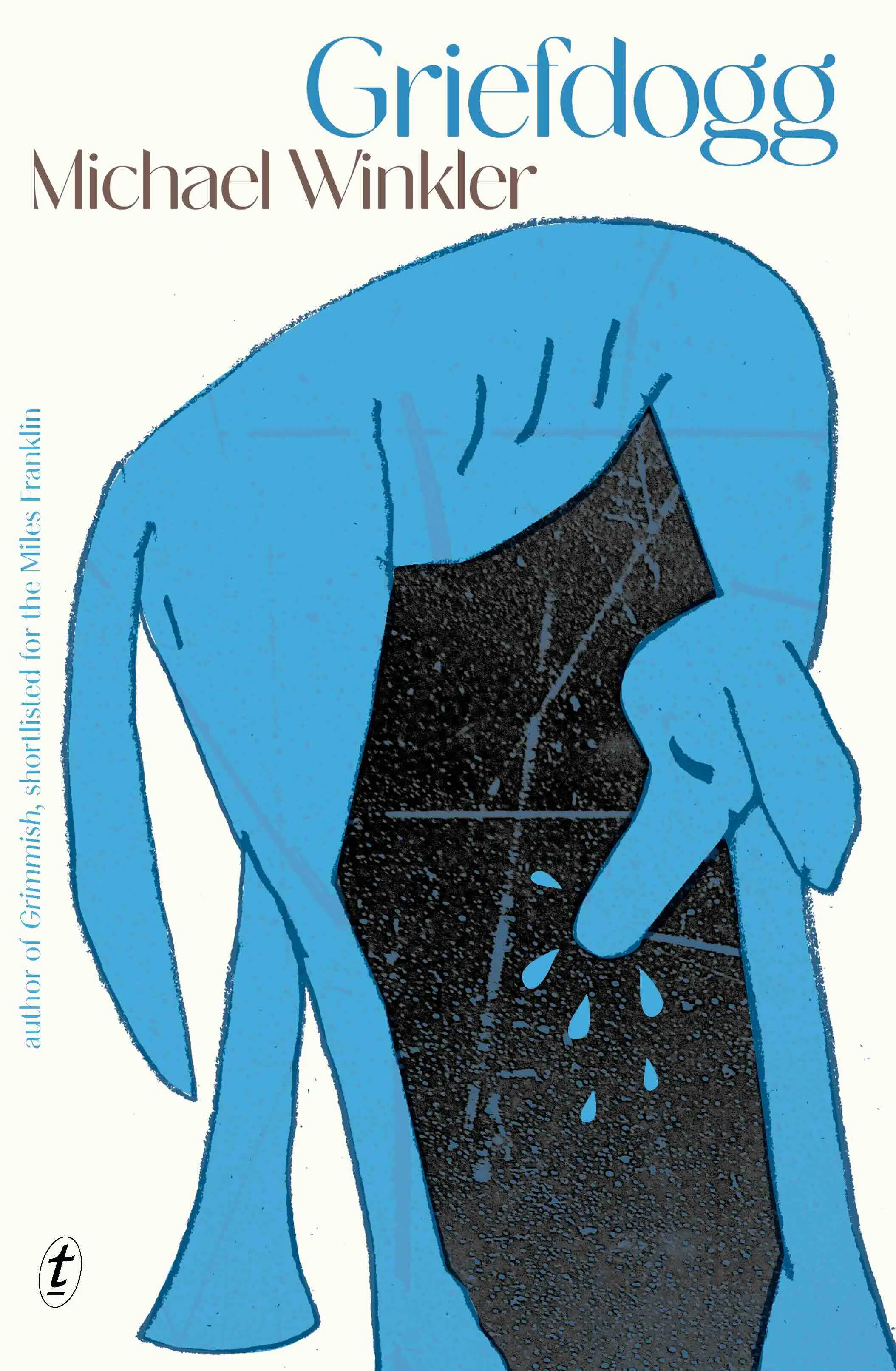
What constitutes an ‘appropriate’ response to a climate crisis that there is no hope of averting? Briohny Doyle reviews Michael Winkler’s Griefdogg and its heartfelt validation of the outsize emotions accompanying climate despair.
An elevator pitch for Michael Winkler’s Griefdogg might go something like this: after a surprise windfall, a formerly upright citizen opts out of the demands of modern life to live as the family pet. It’s a tantalising log-line, suggesting high-concept hijinks. But while other novels such as Rachel Yoder’s Nightbitch (wherein a new mother transforms into a dog) or Ottessa Moshfegh’s My Year of Rest and Relaxation (wherein a grieving twenty-first-century New Yorker self-administers a nineteenth-century-style rest cure) lean into concept, Winkler leans way out.
Let’s hit the emergency stop button so I have time to flesh out the themes. Griefdogg is a climate novel. It’s a novel specifically concerned with groundwater – the water that exists in aquifers beneath the Earth’s surface, which ‘could be the biggest canary in the most important coalmine’. It’s also a postcolonial novel that rises to the critical challenge of writing the connection between human life and groundwater while acknowledging its settler/coloniser perspective. It’s an existential novel – about how human grief might be like groundwater running deep below us, and how art might channel this grief into a reservoir for us to process and reabsorb. It’s a novel about how our attention, and where we put it, matters. Griefdogg is a bleak comedy of manners set in Mildura, a globalised and gentrified locale, but rarely used as a literary setting. It’s a novel populated with painstakingly diverse larrikins and oddballs who talk like they’re in an episode of Neighbours circa 1990. Struth, what’s such a surprising literary bricolage doing so far north of Melbourne? The prose is bloody beautiful; it’s lyric, larrikin and lachrymose!
Despite the man lives as pet blurb on the back cover, in the novel we do not reach this plot point for about a hundred pages. Instead, Griefdogg – like Winkler’s celebrated debut Grimmish – opens with a narrative frame, presenting opportunities for intertextual play. A eulogist is preparing the funerary commemoration of someone named ‘Jeffrey, Hubert’. The ceremony will be held at Mildura Powerhouse – a refurbished, repurposed generator shed turned civic-utility temple – and our orator is anxious about his task. He paces. Practises his gaze. He reaches for gravitas and frets about coming off too stagey. There are false starts, puns, personal anecdotes, philosophical asides and Tourettic word play. It’s through this enjoyably digressive monologuing that we learn of the deceased and his transition from Jeffrey, respected local do-gooder, health nut, father, husband and scientist, into Hubert, a puppy-fat, bearded layabout who abdicates all responsibility to amble by the mighty Murray, relaxing in creaturely repose beneath the Sunraysia sun. This split subject is Griefdogg’s protagonist, if we put stock in such labels. Our narrator has trouble with them. It’s part of his ongoing battle with eulogy as a form, particularly for this funeral. How does one give a eulogy for a person whose last acts were to abandon any attachment to coherent selfhood? A person who ‘strove and hove as close as he could to actually being the groundwater [...] suffused with minerals, hovering in history’? A person who is, the reader will learn, a main character in a story about the damage wrought by human exceptionalism? Discursive riffs become concentric ripples like raindrops on a river:
The eulogist won’t reveal his relationship to the deceased. Instead, the first and clearest fact he discloses is autobiographical. He is ‘in Mildura to write a book’, which should be sufficient to cue our surrender to the human pleasures of excessive textuality. He observes of funerals – and perhaps also of books – that ‘it’s hard to start these things, hard to get through them, hard to finish’:
The finish very much not the finish, because immediately there are the scones and the slices and the lukewarm milky tea, and then there are the logistics and the mechanics and the domestic dramatics, and everything else: the yaw, the gaping maw, the howl, the awful awe, the attenuated drawl of ever more. World without end? End without end, more like.
At the end of his life, we are told, the deceased had been ‘trying to put the water into words, trying to ventriloquise the eternal easing of water through granite, the arcana and iconography, veering ever closer to unironic mummery’. His research question is articulated and taken up by our narrator: ‘How do you represent groundwater for those above ground, with these meagre tools?’ Griefdogg suggests as follows: You pay attention. You articulate your findings, even if they are contradictory. You make art and tell stories even though you might never be satisfied with these activities, and they might make no difference to the problem they explore. It’s a poignant if discomfiting position – one at which many writers of literary fiction arrive whilst grappling a topic like the unrepresentable hyperobject of anthropogenic climate change.
Winkler’s own strategies for response include geographic precision that resists parochialism because, as our narrator says, ‘everything links back to Mildura, if you look hard enough or wait long enough’. There are also historically grounded ruminations on clay, water, pests. ‘Who decided to import buffel grass in the 1950s?’ the eulogist demands to know. ‘Names should be named.’ He does name the men who brought in cane toads and rabbits. He also claims one degree of separation from ‘the brothers who released the Boolarra strain of European carp in pondage near Merbein in 1964, after which they swam into the Murray River and wrecked the ecology forever’. These specificities enable the novel to avoid the fabling and universalising tendencies of some climate fiction. Griefdogg further embeds discourse via citation: ‘Walk around Lake Mungo. Think about deep time. Think about environmental stewardship over tens of thousands of years, what Ali Cobby Eckermann calls “generations from our continuum”.’
In light of Winkler’s planetary agenda, it’s unsurprising that the narrative events from our protagonist’s life get backgrounded, their importance overshadowed. It’s unclear, for instance, whether Jeffrey’s wife dies or doesn’t. His son might become a local hero, or maybe not. Does the funeral ever eventuate? It hardly matters given our inability to see the bigger picture of what is really happening, which is that, in Jeffrey’s view,
The planet was dead, it just hadn’t dawned on all the inhabitants yet. The climate battle had been fought, and crony capitalism and toasty-warm apathy had won. You Had One Job, and you muffed it. In your lifespan the planet was doomed, and you did nothing that helped, and your life and the life of everyone you knew should be deemed a profound failure.
It’s worthwhile noting that Jeffrey’s vocation as a hydrologist puts him in a group of people even more depressed about the future than writers of climate fiction. In 2024, The Guardian surveyed 380 climate scientists about how they were feeling. The consensus? None too great. Only 6 per cent of scientists believed that efforts to limit global warming to a 1.5C temperature increase would succeed. They were right, of course. We temporarily exceeded this target in 2024, and are set to do so again in the 2026-2030 period. But even before their suspicions were confirmed, these scientists reported deep depression and hopelessness. One felt her devotion to climate research ‘had not made a damn bit of difference [...] I started feeling, well, I love singing, maybe I’ll become a nightclub singer.’
Jeffrey would relate, and Hubert is the chanteuse he becomes. ‘It’s the hope that kills you,’ Hubert tells Dr Anuraj, a local GP and former tennis opponent of Jeffrey’s who responds, ‘Is it? Or is it the lack of hope?’ Dr Anuraj, for his part, is motivated by the devolution of his friend to revisit medical files, ‘connecting patient presentations to environmental factors wherever appropriate’, in a move that evokes Glenn Albrecht’s work on solastalgia in the drought-ravaged Upper Hunter Valley. Anuraj has initially linked climate crisis only to melanoma and heat stress, but he tells Hubert he’ll be adding ‘a shedload of mental health presentations’. In this time of climate crisis, all science might necessarily be climate science.
The same can be argued for literature: everything written now is, in some sense, climate literature. Whether individual writers choose to address or ignore the impacts of climate on how we live reveals the more broadly available orientations. Writing in The New York Review, Zadie Smith observes, ‘There is the scientific and ideological language for what is happening, but there are hardly any intimate words. Is that surprising? People in mourning tend to use euphemism; likewise the guilty and ashamed [...] It’s hard to keep apocalypse consistently in mind, especially if you want to get out of bed in the morning.’
Winkler writes into this tension. He is determined to do as Donna Haraway encourages and ‘stay with the trouble’. His protagonist is a climate scientist but his prose is littered with poetic meditations emphasising the importance of close, quiet attention to country: ‘Gaze into the emu’s footprint in the orange sand. On each footpad, dots. Like holes in a sea sponge, like Papunya Tula, like craters on a faraway planet.’ Griefdogg privileges clear vision of where we are over a hopeful gaze towards the future. It favours intertextual layering over narrative resolve. On a page of quotes from Nikola Tesla, Jackson Pollock and Harold Rosenberg, Winkler offers the image of a
single twisted ram horn, pitted and ablated, carapaces and coruscation, crevasses and cervices; the ram horn sprouting enormous from the desert sand [...] constructed from bones, inland bones, the glorious curve, the emergence from earth; no carpark, no cafe, no gift shop, no explanatory signs, no road in, no fence.
For Griefdogg’s narrator, the gnarled contradictions of art, philosophy and science are manifest in this ram horn. Or maybe it’s just a big dick sticking out of the dirt. Sometimes it’s hard to tell when Winkler (or his narrator) is cracking a joke. Throughout Griefdogg, shrugging fallibility undercuts fervent belief. There are, we are reminded, many things to do other than reading and writing; ‘art is hard, but goat feeding is delightful’, the narrator tells us, by way of example.
Perhaps infected by the novel’s core ambivalence, I found myself alternately floored by poetic passages and left cold by punny Socratic dialogues. I felt productive discomfort in my desire for escape into the absurd humour Winkler’s premise prefigured. I thought of Ian McEwan’s recent climate novel What We Can Know, which suggests that we reading humans might very well care more about tawdry marital infidelities and crimes of passion than we ever will for the tragedy of our ecocidal existence. Can we laugh at this? Certainly. Our callousness and comedic sensibility are part of what makes our species charming (at least in literature).
Franz Kafka’s Metamorphosis also comes to mind. Though, when Gregor Samsa wakes up many thousands of kilometres from metropolitan Mildura to find himself transformed into an infernal insect, all he wants to do is get dressed and catch the next train to work. Samsa perceives his transformation as a setback. He is determined to overcome the disarray of his many legs, accruing injuries and newfound taste for garbage so he can continue to support his family with a mid-level job in sales. In Kafka’s story, capitalism cannot accommodate the aberration. Gregor is excluded from work, society and the family. His sister usurps him. He eventually starves to death and is swept out of the house by an unmoved char-woman. More than a century later, Winkler’s unnamed narrator chides, ‘How late will late capitalism get? Baby, it might get a lot later than you think. [...] Capitalism isn’t going anywhere, it’s just going to stretch the civic skin thinner and thinner’.
Contra Gregor, Jeffrey wants to terminate his position. He believes the choice to live as the family pet – not a furry, this isn’t a sex thing, he assures his wife – will excuse him from the inhumanity of participating in the violence of late-capitalist life. He expects surrender, and perhaps, peace. Unlike Samsa, however, his inner transformation is in excess of the outer and he becomes a hyper-empath attuned to the deep, secret grief of all those around him. As Hubert, he not only understands the groundswell of human sorrow but finds he can ease it through intense sessions of dry-heaving lamentation: ‘Tearless. He convulsed. He cried and kept crying. Hour upon hour, this also borderless, without limitation [...] this crying of unspeakable intensity.’ The people he cries for feel better, some even thank him for his efforts. The implication here being that the noise from our individual lives distracts us from a more profound, collective grief. By letting go of life’s constant activity and ambition, Hubert opens space for this grief to flood in, but he’s not happy about it. Being ‘forced to care about the deep water of other people’ is, as a dog-park friend observes, not what he signed up for when casually relinquishing human agency.
In the final act, grief enters the body of the novel as unpunctuated slabs of text, stylised in all caps, recalling midnight texts from a wasted ex: ‘I MARRIED HER AND I DIDNT WANT HER BUT THOUGHT I COULD GROW TO LOVE HER BUT IT HASN’T HAPPENED I LOVE HER LESS EACH DAY BUT CAN NEVER LEAVE.’
Hubert hears and transcribes these subterranean lamentations onto bandages, which he will wrap around the trees by the banks of the Murray, as if dressing a collective wound. It’s the grief of characters we know from the story, and others we don’t; incarcerated people, refugees, the unloving and unloved and those who mourn the loss of capacities and dreams. In this big, sad text we encounter the grief of not being able to save ourselves, or the world we care about. ‘WHAT TONGUES DOES THE RIVER SPEAK WOULD GROUNDWATER UNDERSTAND IT OR IS THAT A DIFFERENT LANGUAGE OR ONE LANGUAGE TWO DIALECTS PLS TELL ME BECAUSE ALL THAT GROUNDWATER ALL THAT SOUND ALL THAT ALWAYS’.
On first read, I found these interjections lacked emotional heft. When I reread them later, as a complementary text staged in the margins of Winkler’s narrative, they felt like profound missives. Either way, their accretion creates a trash-can ending – a stadium rock concert finale, with previously collaborating instruments crashing into performative chaos. Here, Hubert/Jeffrey/the eulogist and Winkler’s voice merge. Hubert, seized by Christlike passions, is finally unable to stop the flood of grief with anything but self-extinction.
In the face of such a disintegration, what should we focus on? The grief of our fellows, which we turn away from in order to live on, comfortably? The death of our protagonist, which, having been declared on the first page, has nothing further to reveal? The groundwater, which we should organise to protect? The narrator even throws a couple of bogus hopeful endings at us, too, if that’s what we’d prefer. Ultimately, the choice is personal, ongoing, and, as the narrator asks: ‘will it make any difference?’
Winkler’s debut, the not-quite-a-boxing-novel Grimmish was similarly genre-defying and self-reflexive. It was also a frame narrative composed from dialogues, citations and personal reflections voiced by a depressive male-writer/narrator. Grimmish was the first self-published novel ever shortlisted for the Miles Franklin Literary Award, lavished with praise from Helen Garner, J.M. Coetzee and some of our hardest-to-impress critics. Winkler, then, likely belongs to that category of the ‘writer’s writer’. He is unapologetic in wrangling the writerly obsession – namely, writing – into the centre of his stories. Typically, writer’s writers cannot get over the fact of writing. What is it and why is it? Is writing too extractive to resist extractive capitalism? Can you truthfully describe a rock, or will it always be a metaphor? What are the politics of these questions? Why do some people spend so much time writing given its tumultuous, obsessive symptoms? Because I, too, am obsessed with these questions, my reading experience of Griefdogg was often reminiscent of the popcorn-eating GIFs people used to spew during Twitter beefs in the olden days. At other moments, I felt the true heft and power of the novel’s more heartfelt explorations. This is a novel that gives you as much to feel as to think about. Will you feel the same way? By Griefdogg’s own logic, it doesn’t matter. Winkler wrote a book because that’s what writers do. You can read it if you want to, or you can do something else. Do you want to pick up a book, or put one down, take a walk, or a nap? Perhaps you’d prefer to gaze at the sky? What colour is it right now?
The novel concludes with the inevitable and ongoing human compulsion to bear witness and make art. I like such endings because they align with my own privileged compulsions. Picture the writer, bashful, shrugging, offering a book. It’s a gift, or maybe an apology. They’re not sure.
In the end, the eulogist and his partner – an artist who struggles throughout the novel to capture the exact hue of Mallee soil – simply go elsewhere. To Queensland, actually, because Winkler is all about specificity. It’s bad form to drive off into a symbolic sunset. Even in an imagined world, you must absolutely acknowledge your place.